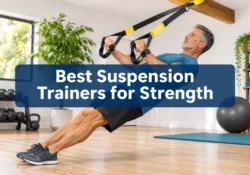
Last updated: November 18, 2026
Quick Answer
The best suspension trainers for strength training after 40 are the ones with a locking anchor system, fast strap adjustment, and a weight capacity well above your bodyweight. TRX remains the benchmark, the Home2 supports roughly 350 lb and advertises 700+ exercises, but cheaper TRX alternatives like Recoil and budget nylon-strap systems deliver most of the same function for a fraction of the cost [1][2]. Door anchoring is safe only on a solid, inward-opening door that stays latched, with the trainer loaded away from the door swing [3][4]. One well-anchored trainer plus a stable floor covers full-body exercise for pushing, pulling, hinging, squatting, and core.
Key Takeaways
- Suspension training is low-impact and self-limiting, which makes it well suited to adults over 40 who want strength without heavy spinal loading.
- Anchor security matters more than brand. Ceiling or beam mounts beat door anchors every time for stability and capacity [3][5].
- A door anchor is safe on a solid-core, inward-opening, latched door, never on hollow or flimsy frames, and never pulled in the direction the door opens [4][6].
- TRX PRO4 is still the category standard; Home2 is the best full-feature pick; GO and All-In-One are the travel options [2][7].
- Good TRX alternatives cost far less and often match capacity, the main gaps are hardware polish, strap feel, and app content [1][8][9].
- You can build real strength with suspension work up to a point; beyond that, add external load for lower-body progression.
- Two to three sessions per week, 48 hours apart, is the practical sweet spot for strength gains after 40.
- Shoulder-friendly options exist: low rows, face pulls, and chest presses at shallow angles protect the rotator cuff.
- A suspension trainer is the single most space-efficient home gym for small apartments, it packs into a shoebox.
Is suspension training actually safe for people over 40?
Yes, for most healthy adults over 40 it's one of the safer strength formats, because load is set by your body angle rather than by a fixed weight. Step your feet closer to the anchor and the exercise gets harder; step back and it gets easier instantly. That means you never get pinned under a bar.
The real risks are the anchor failing and the strap handles slipping, not the exercise itself. TRX's own product-safety guidance stresses inspecting straps, carabiners, and anchor points before every session and replacing anything frayed [4]. If you have uncontrolled blood pressure, a recent joint replacement, or balance problems, get medical clearance first.
Decision rule: if you can hold a 20-second plank and get off the floor unassisted, you can start suspension training at a shallow (near-upright) angle.
How do you safely install a suspension trainer on a door, and can it damage your door frame?
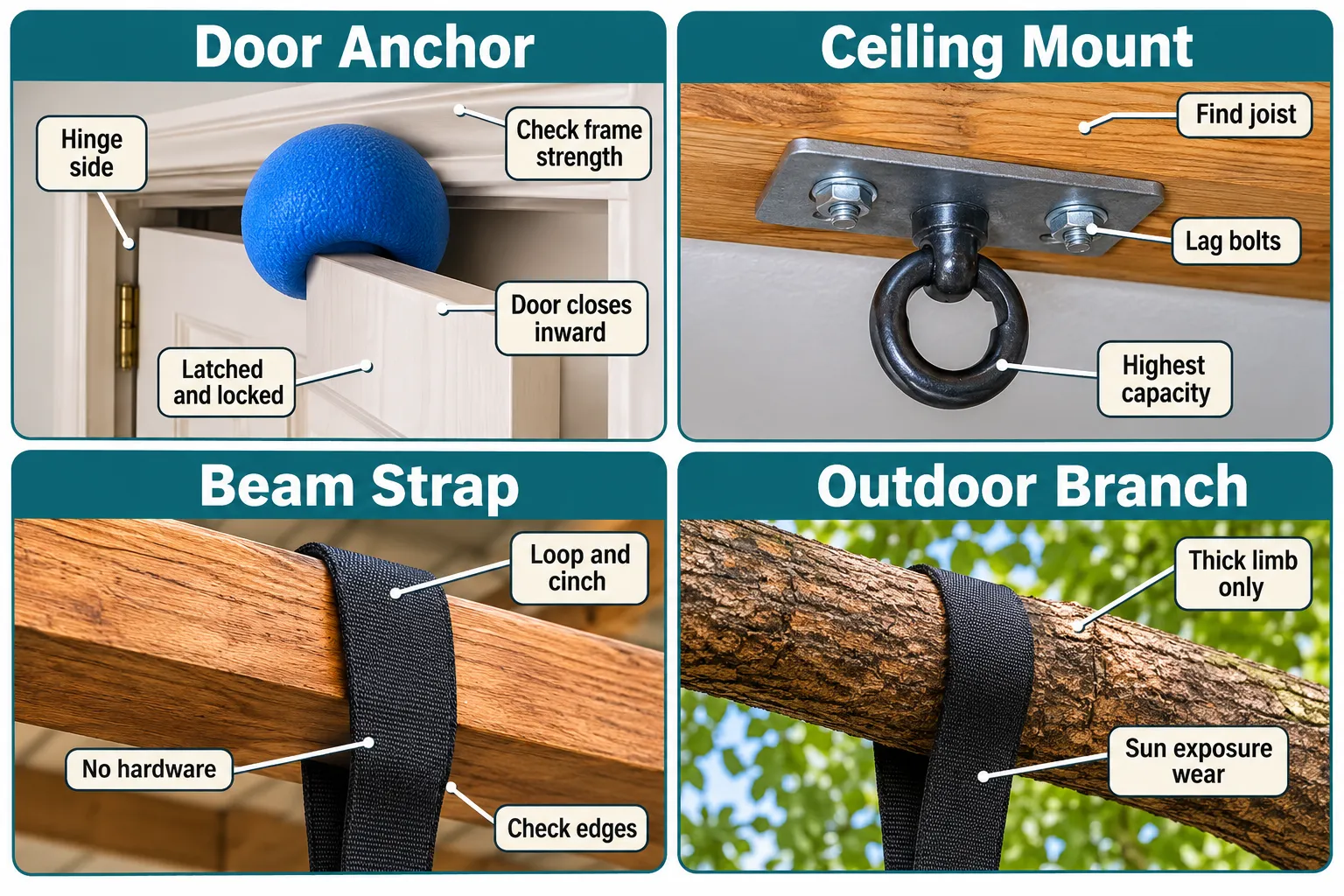
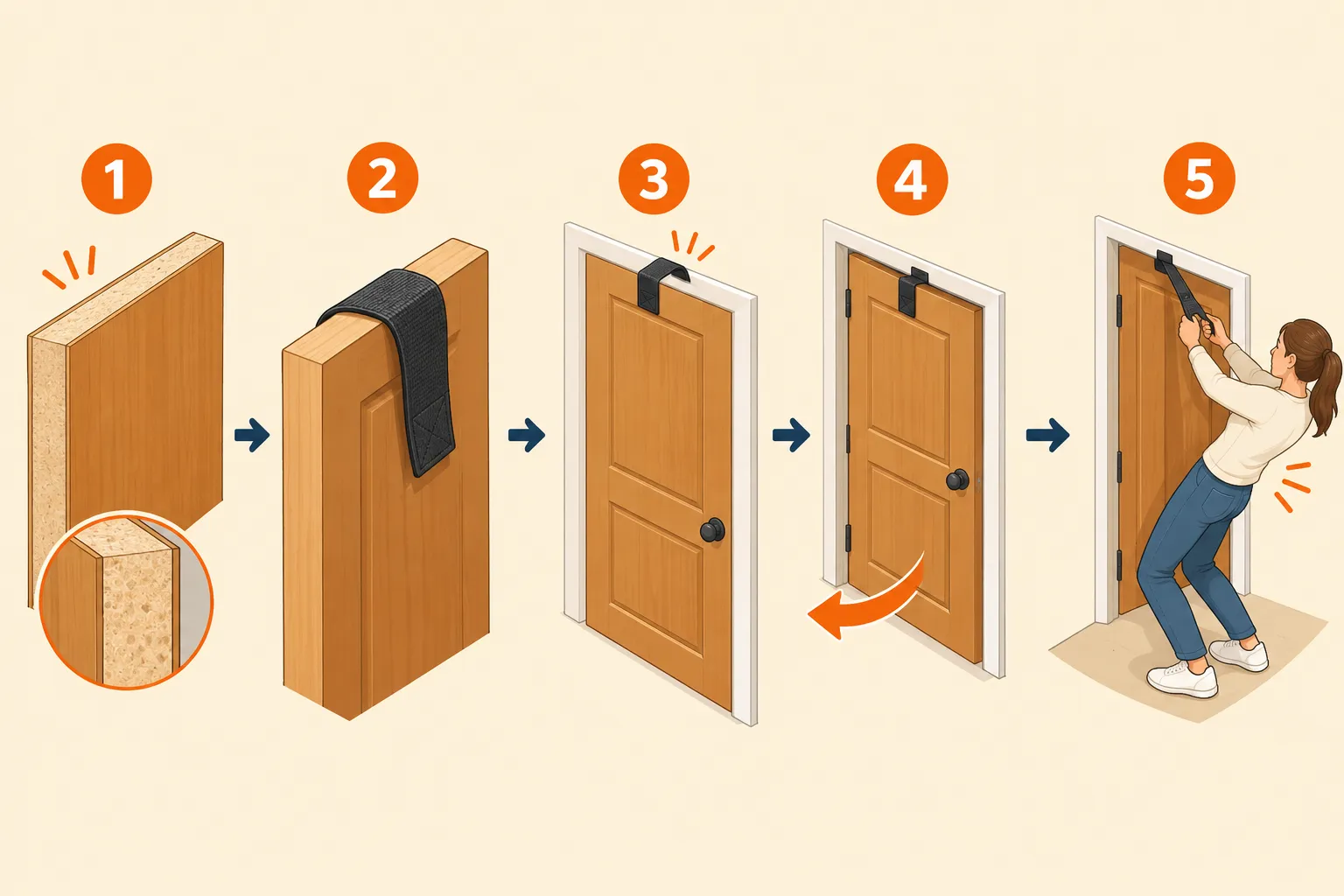
A door anchor is safe on a solid-core door that opens away from you and stays latched; it can absolutely damage a hollow-core door or a weak frame. The anchor's foam or rubber block sits over the top edge of the door, the door closes on the webbing, and all pulling force must travel toward the hinges and frame, never against the latch [3][6].
Step-by-step door setup:
- Check the door. Knock on it. A hollow echo means hollow-core, don't use it. Solid wood or metal only.
- Check the frame. Loose trim, soft wood, or a door that rattles in the jamb is a no.
- Drape the anchor over the top of the door with the block on the far side.
- Close and latch the door, then lock it if possible so nobody opens it mid-set.
- Work on the side the door closes toward, so your force presses the door into the frame.
- Load-test slowly, lean back with partial bodyweight, listen for creaks, then commit.
Common damage: dents in the top door edge from thin anchors, and crushed weatherstripping. A wider, padded anchor block spreads the pressure [6]. Hinge-side anchors and over-the-top-of-the-door straps are generally safer than any wedge-style product [5].
If a door anchor ever shifts, creaks, or the door flexes under load, stop. A ceiling joist mount with lag bolts is the gold standard and costs very little [3][5].
What's the difference between TRX and cheaper suspension trainer brands?
TRX differences are mostly in hardware quality, adjustment speed, and included programming, not in the exercises you can do. Budget systems use the same nylon webbing and cam buckles; they tend to have stiffer adjusters, less comfortable foot cradles, and vaguer weight ratings [1][8].
| Factor | TRX (PRO4 / Home2) | Mid-tier alternatives (e.g. Recoil S2 Pro) | Budget straps |
|---|---|---|---|
| Stated capacity | ~350 lb on Home2 [2] | High, often exceeds TRX [1] | Often unstated |
| Adjustment | One-pull locking cams | Advanced hardware, sometimes dual-anchor | Manual, slower |
| Anchors included | Door + suspension anchor [3] | Usually door + strap | Door anchor only |
| App / coaching | Large library, 700+ exercises [2] | Varies | None |
| Durability track record | Strong owner ratings [2] | Growing | Mixed |
Choose TRX if you want proven hardware, resale value, and guided programming. Choose an alternative if you already know your exercises and want capacity-per-dollar.
What suspension trainer alternatives are cheaper than TRX, and how much should you spend?
Expect to spend roughly a quarter to a third of TRX pricing for a functional alternative, and about half for a well-reviewed mid-tier system. Buyers' guides in 2026 consistently rank Recoil S2 Pro as the leading TRX alternative on hardware and capacity, with several unbranded nylon systems covering the basics acceptably [1][8][9].
What you actually pay for as price rises:
- Entry tier: webbing, handles, door anchor. Works. Adjusting mid-set is annoying.
- Mid tier: better cams, padded cradles, higher verified capacity, extension strap.
- Premium (TRX PRO4, Home2): fastest adjustment, best handles, app library, replacement parts available [2][7].
Spend more if you're over 200 lb or training 4+ days a week, because hardware wear is real. Spend less if you mainly want core and upper-body accessory work.
Can you get a full body workout with just a suspension trainer?
Yes. A single suspension trainer covers every basic movement pattern: push, pull, hinge, squat/lunge, and anti-rotation core. TRX markets the Home2 as a full gym replacement with 700+ exercises for that reason [2].
A complete weekly template:
- Push: chest press, triceps extension, pike push-up
- Pull: low row, inverted row, biceps curl, face pull
- Hinge: hamstring curl, single-leg deadlift
- Legs: assisted pistol squat, Bulgarian split squat, lunge
- Core: plank, fallout, oblique crunch, mountain climber
The gap is heavy lower-body loading. Legs adapt fast, and bodyweight angle changes eventually stop being enough.
Can you build real strength with suspension trainers or do you need weights?
You can build genuine strength for 6 to 18 months, especially in the upper back, chest, and core, then progress slows for the lower body. Suspension work is excellent for relative strength and joint control; it's limited for maximal strength because you can't load much beyond bodyweight.
Progression tools that keep working:
- Steeper body angle
- Slower eccentrics (4-second lowering)
- Single-limb variations
- Pauses at end range
- Added weight vest or dumbbells for squats and hinges
Realistic plan after 40: suspension trainer as the base, plus one pair of adjustable dumbbells or a kettlebell for lower-body load.
Is suspension training good if you have joint pain, arthritis, or bad shoulders?
Often yes, because the handles let your wrists, elbows, and shoulders rotate freely instead of locking into a fixed bar path. That floating grip is why many people with arthritis tolerate suspension rows better than barbell rows.
For rotator cuff issues or shoulder impingement:
- Start with low rows and face pulls, both strengthen the external rotators.
- Keep hands below shoulder height early on.
- Avoid deep chest-press stretches, overhead pike push-ups, and any wide-arm "T" fly until cleared.
- Use a near-upright stance to cut load dramatically.
Edge case: if pain appears during the lowering phase only, reduce range before reducing load. Persistent night pain means see a clinician, not a workout tweak.
How often should you do suspension training for strength gains?
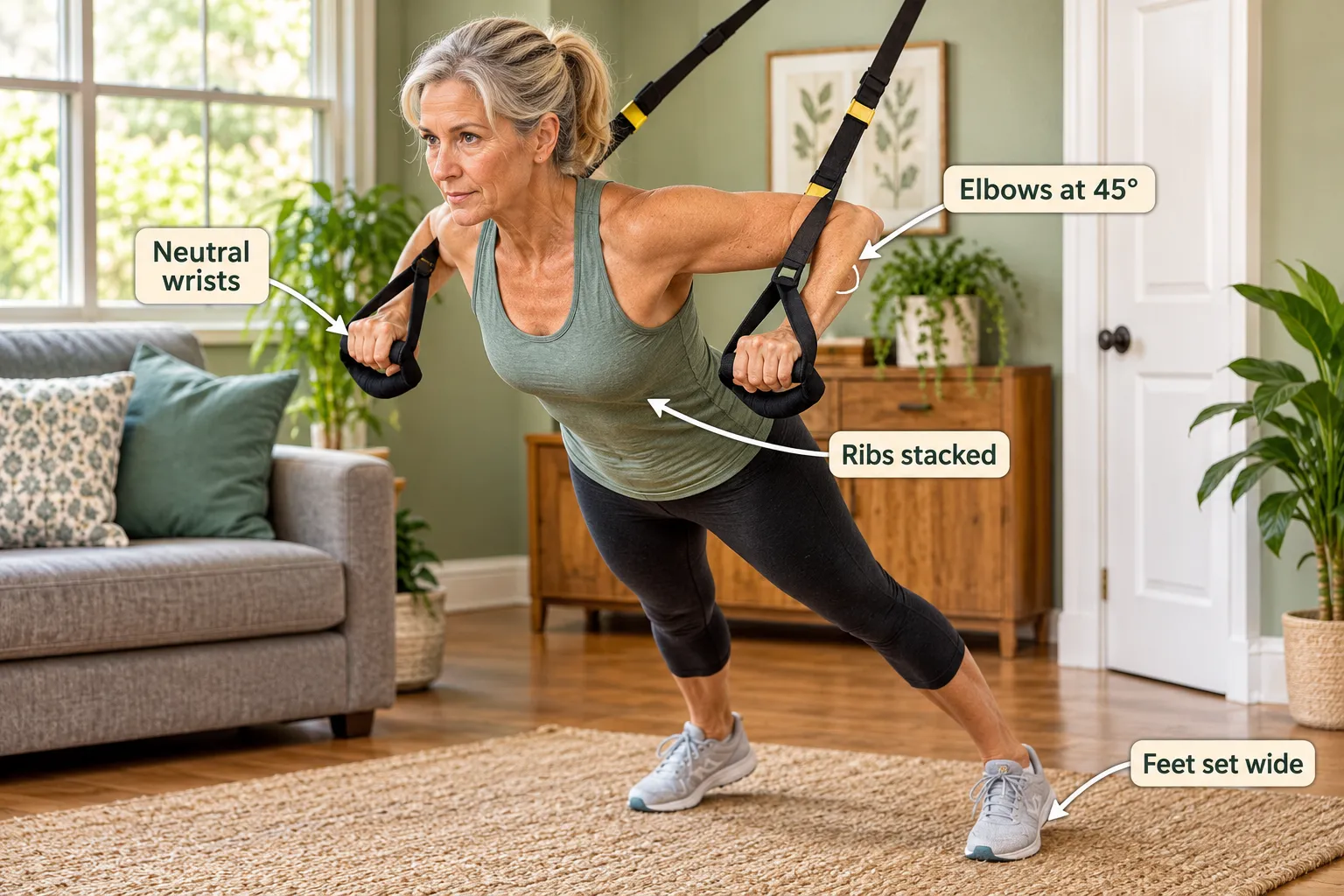
Two to three full-body sessions per week, with at least 48 hours between sessions, is the practical frequency for strength after 40. Recovery capacity, not effort, is the limiter for most people in this age group.
- Beginner: 2 sessions, 6 exercises, 2 sets of 8-12
- Intermediate: 3 sessions, 8 exercises, 3 sets
- Add: 2 days of walking or cycling for joint health
Skipping rest days is the fastest route to elbow and shoulder tendon irritation.
Are suspension trainers good for people who are out of shape, and what's best for a small apartment?
Yes on both counts. Because resistance scales with foot position, a deconditioned beginner can start at 20% of bodyweight on a row and progress without buying anything new. And a suspension trainer is the most space-efficient strength tool available, the whole system fits in a drawer, which is why TRX GO and All-In-One are rated highly for travel and apartments [1][2].
For small spaces:
- No drilling allowed? Door anchor on a solid-core door [3].
- Can drill? Ceiling joist mount gives you full 360° exercise range in about four square feet [5].
- Ceiling height under 8 ft? Choose a system with an extension/adjustable loop strap.
Accessible setup instructions exist too, the TRX GO manual has been adapted for visually impaired users, covering anchor placement by feel [10].
What common mistakes do beginners make with suspension trainers?
The top mistakes are anchoring badly, letting the straps go slack, and progressing the angle too fast. All three are avoidable in the first week.
- Anchoring to a hollow door, towel rail, or shower rod
- Pulling against the door's opening direction [6]
- Letting handles sit at uneven lengths (check the tabs)
- Shrugging during rows instead of pulling shoulder blades down
- Sagging hips in planks and fallouts
- Never inspecting straps for fraying [4]
- Going straight to near-horizontal rows and wrecking the shoulders
Conclusion
Picking among the best suspension trainers for strength training after 40 comes down to four checks: a secure anchor, fast one-hand adjustment, a capacity cushion above your bodyweight, and comfortable handles. TRX earns its price through hardware and programming; solid TRX alternatives earn theirs through value.
Next steps:
- Decide your anchor first, ceiling joist if you can drill, solid-core door if you can't.
- Match the trainer to that anchor and your bodyweight.
- Spend week one at shallow angles learning low rows, chest press, and planks.
- Add a kettlebell or weight vest around month three for lower-body progression.
- Inspect straps and carabiners before every session [4].
References
- Best Suspension Trainers. health.yahoo.com.
- Trx Suspension Trainers. gymradar.com.
- Trx Anchors 6 Ways to Set Up Your Suspension Trainer. trxtraining.com.
- Product Safety. trxtraining.com.
- How to Anchor a Trx. hamiltonhomefitness.com.
- The Minimalist Trx Door Anchor. forgetheflow.com.
- Trx Pro4 Suspension Trainer. thetestedhub.com.
- Best Suspension Trainer. repreturn.com.
- Best Suspension Trainer. stronghomegym.com.
- Trx Go Suspension Trainer Manual. tsbvi.edu.