Last updated: November 20, 2026
Quick Answer
In the debate of Resistance Band Anchor vs Door Anchor: Which Setup Is Safer for Over-40 Strength Training?, a professionally installed wall or stud anchor gives the highest structural margin of safety, while a purpose-built door anchor is the safest no-drill option when used on the hinge side of a solid, locked door. Both are far safer than improvised anchors like door handles, chair legs, or furniture. For most people over 40 training at home, a quality door anchor plus a strict inspection habit covers 90% of needs; add a wall anchor if you want heavy rows, pulldowns, or a permanent station.
Key Takeaways
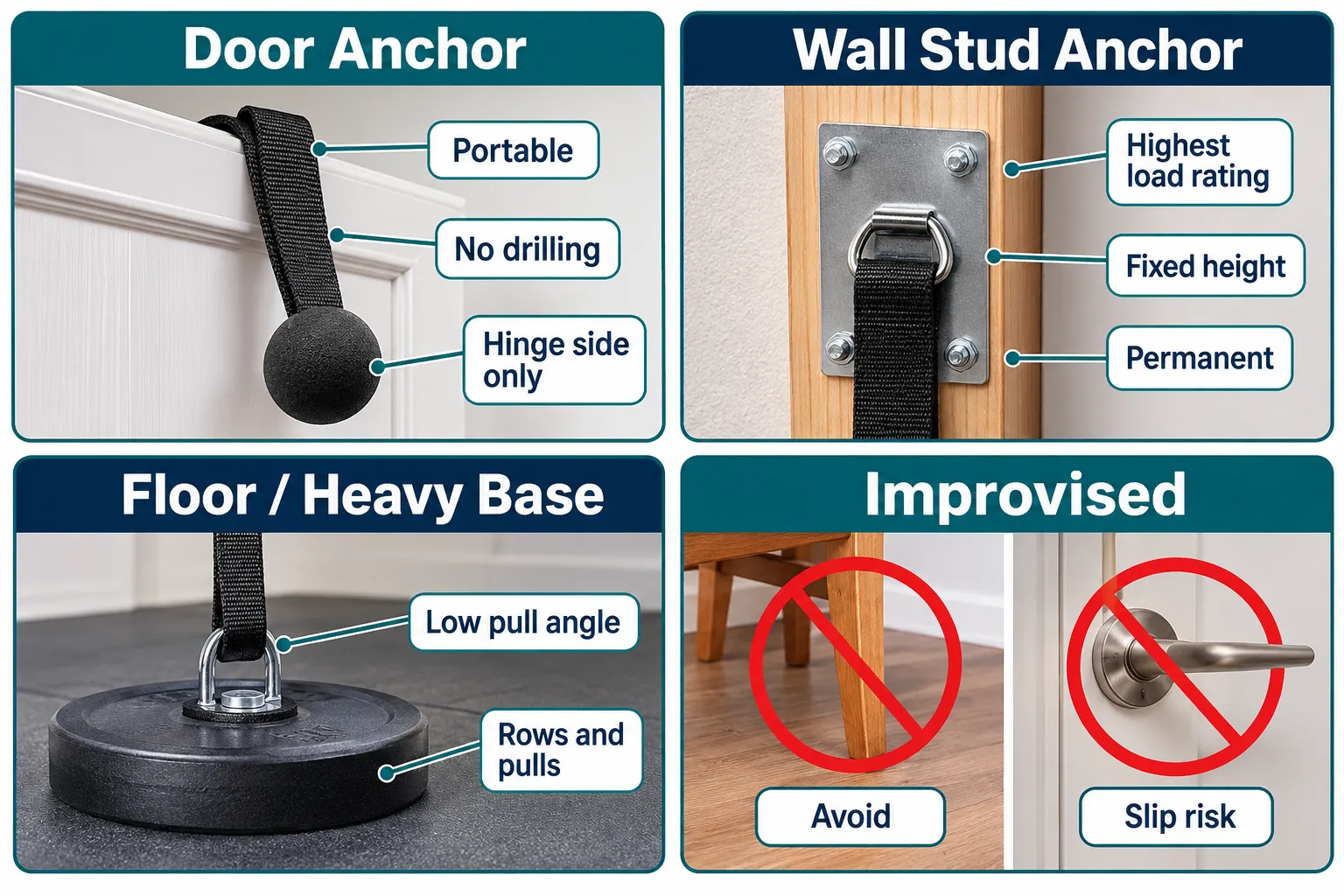
- Door anchor = a padded strap or foam ball that wedges between door and frame. Wall/stud anchor = a bolted steel plate or eye bolt rated for a known load.
- Hinge-side placement plus a locked door is the single most important door-anchor safety rule, and manufacturer manuals say so directly [1].
- Hollow-core, sliding, bifold, and outward-opening doors are not suitable. Not every door in your home qualifies.
- Most catastrophic band failures start at the anchor interface, abrasion, sharp edges, or crimping, not in the middle of the band [2].
- Elastic resistance is rated safe and effective for older adults when anchors are secure and recoil risk is managed [3][4].
- Quality door anchors run roughly $8,$25; wall-mounted steel anchors typically $20,$60 plus hardware and installation (market estimates, late 2026).
- Eye protection matters. Snap-back is the injury people underestimate most [2].
- Over-40 decision rule: drill if you can, door anchor if you can't, never improvise.
What's the difference between resistance band anchors and door anchors?
A "door anchor" is one type of resistance band anchor. The broader category includes wall-mounted plates, ceiling eye bolts, floor anchors, weighted-base anchors, squat-rack straps, and heavy-post wraps. The difference that matters is load path: a door anchor transfers force into a door leaf and frame, while a wall anchor transfers it into framing lumber.
| Factor | Door anchor | Wall / stud anchor |
|---|---|---|
| Install | 30 seconds, no tools | Drill, stud finder, lag bolts |
| Portability | Travels in a pocket | Fixed |
| Anchor height options | Top, middle, bottom of door | Only where mounted (unless multiple) |
| Load margin | Limited by door quality | Highest when properly rated |
| Movement selection | Good; limited by door width | Excellent; pair two for cable-style work |
| Main failure mode | Door opens, strap pulls through | Bolt pull-out (rare if in stud) |
| Renter friendly | Yes | Usually no |
Quick example: a seated row needs a low, central anchor at roughly hip height. A door anchor handles that fine. A kneeling lat pulldown needs a high, overhead line of pull directly above the shoulders, a ceiling or high wall anchor does that better than any door.
Is a door anchor safe for resistance bands during workouts?
Yes, a purpose-built door anchor is safe when the door is solid, locked, and the strap is placed on the hinge side so your pull pushes the door closed, not open. Rehab and clinical guidance commonly describe correctly used door anchors as the safest no-drill option.
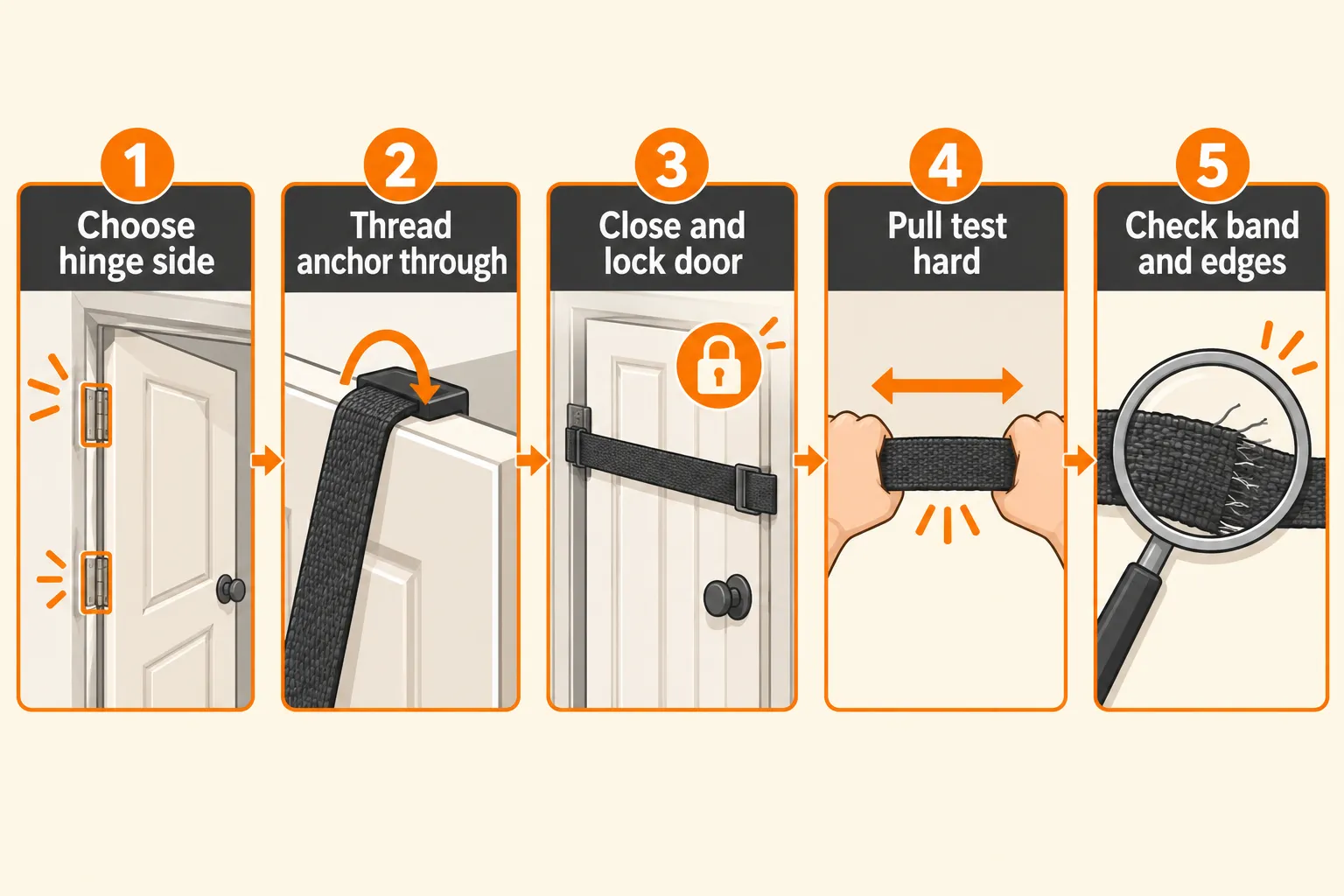
Non-negotiables from manufacturer manuals and care guidance [1][2]:
- Thread the anchor through the hinge side of the door.
- Close and lock the door; if possible, put something heavy against it.
- Verify the stopper (foam ball or flat plate) sits fully on the far side.
- Pull-test hard, twice, before loading your body weight into the movement.
- Inspect the band near the anchor for nicks, shine, or stickiness before every session.
Common mistake: anchoring on the latch side and then doing a face-pull. If the latch slips, the door swings open and the band fires back at you.
Can you use a resistance band anchor on any door in your home?
No. Door anchors are only appropriate on solid-core doors with a sturdy frame that open away from you and lock. Skip anything else.
Doors to avoid:
- Hollow-core interior doors (common in homes built after the 1970s), the top edge can crush or split.
- Sliding, pocket, bifold, and accordion doors.
- Doors that open toward you on the side you're pulling from.
- Doors with decorative trim or sharp metal edges that abrade the band.
- Any door with loose hinges or a wobbly frame.
Edge case: glass French doors may look solid but the latch hardware is often light. Treat them as unsuitable.
What's the safest anchor for someone over 40 doing strength training?
For over-40 home lifters, the safest setup is a wall- or stud-mounted steel anchor at chest height, installed into framing with rated lag bolts, because it removes the single biggest variable, whether the door holds. The next safest option is a quality door anchor used strictly per the hinge-side rule.
Why over-40 users specifically benefit from the sturdier option:
- Joint positioning is more consistent, so shoulders and knees are loaded the same way every rep.
- Tendon tissue tolerates less sudden shock loading with age, and a failing anchor is a shock load.
- Balance recovery after a snap-back is slower, raising fall risk.
Guidance for older adults consistently warns against improvised anchors, furniture, handles, railings, and unstable surfaces [3][5].
How much do quality resistance band anchors cost?
Expect $8,$25 for a good door anchor and $20,$60 for a wall-mounted steel anchor plate, plus $10,$20 in lag bolts and washers (market estimates, late 2026; prices vary by retailer and region). Professional installation, if hired, usually falls in the $50,$150 range for a single plate.
What you're paying for in a door anchor: thick nylon webbing, a bar-tack stitched loop, a dense foam or molded plastic stopper, and a smooth metal D-ring that won't score the band. Cheap anchors fail at the stitching or use a rough ring that abrades the tubing.
Decision rule: if the anchor costs less than one month of a gym membership and protects your eyes and shoulders, buy the better one.
Do door anchors slip or break during exercise, and what happens if one fails?
Yes, door anchors can slip, and when they do the band recoils toward your body at speed. Reported failure modes in order of frequency: door pops open (latch-side placement or unlocked door), stopper pulls through a worn gap, webbing tears at the stitch, and band tears where it contacts the D-ring.
What failure actually looks like:
- The band snaps back along its stretched line, usually toward the face or hands.
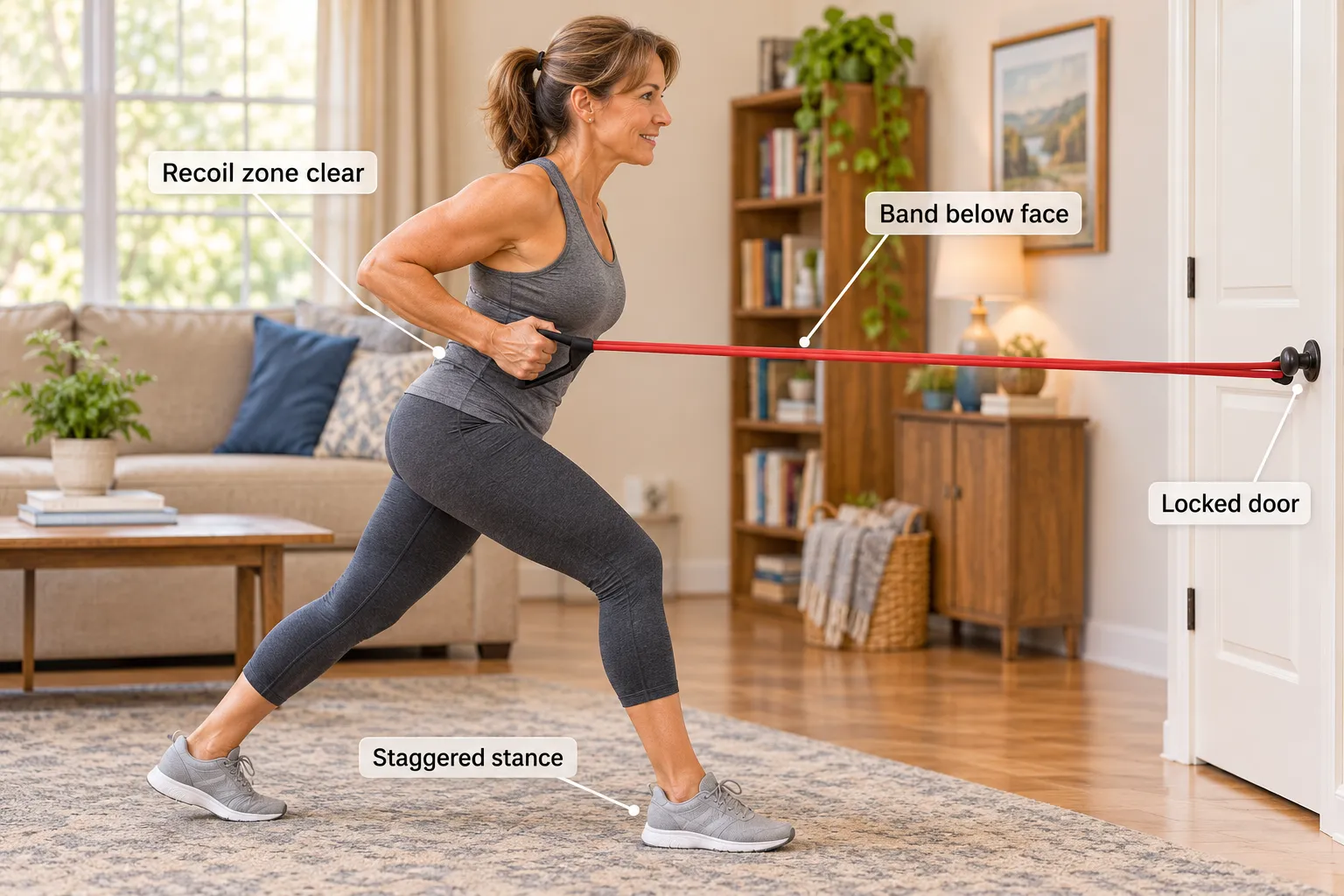
- Eye injury is the most serious realistic outcome, which is why eye protection and keeping the band below face level are emphasized [2].
- Secondary risk: losing balance and falling, especially during single-leg or rotational work.
Mini example: a 52-year-old doing standing chest presses at 60% stretch with the door unlocked. Door swings open, press collapses forward, shoulder takes a sudden eccentric load. Prevented entirely by a turned lock.
What are common mistakes people make with resistance band anchors?
The top mistakes are latch-side placement, over-stretching, sharp contact points, and skipping inspection. Band failures overwhelmingly begin at the anchor interface, where abrasion and crimping concentrate [2].
- Anchoring to a door handle, chair, bed frame, or treadmill.
- Stretching bands beyond roughly 2.5-3x resting length.
- Running a band over a metal edge, screw head, or brick.
- Training directly in the recoil line with the face at band height.
- Using sun-damaged or sticky latex (a sign of degradation) [2].
- Using one anchor height for every exercise instead of matching line of pull.
- Storing bands in a hot car or garage.
Can I anchor resistance bands to something else besides a door?
Yes. Good alternatives include a stud-mounted steel plate, a ceiling eye bolt in a joist, a loaded barbell or heavy dumbbell on the floor, a squat rack upright, a sturdy porch post, or your own feet for lower-body work.
For renters who can't drill:
| Need | No-drill substitute |
|---|---|
| Low row / seated row | Band looped around both feet, seated on floor |
| Chest press | Band behind back, no anchor needed |
| Lat pulldown | Band under a knee, or over a pull-up bar |
| Pallof press / anti-rotation | Door anchor at mid height |
| Face pull | Door anchor at head height on hinge side |
| Hip extension / kickback | Band under a loaded dumbbell on the floor |
| Overhead press | Stand on the band |
Caution: a weighted base only works if the weight is at least several times the band tension and the pull angle is low.
Are resistance bands safe for older adults building strength?
Yes. Elastic resistance is widely recommended for older adults because it's joint-friendly, scalable, and effective for maintaining muscle and function [3][4][6][7]. Research reviews and clinical programs support band training for strength and mobility in aging populations, provided anchors are secure and recoil is controlled [4].
Practical loading for over-40 and older beginners:
- Start with light-to-medium bands, 2-3 sessions weekly.
- 8-15 reps, stopping 2-3 reps shy of failure.
- Control the return phase; that's where bands build the most tissue resilience.
- Progress band thickness before increasing stretch, not the reverse [8].
How do I know if my door anchor is secure enough, and what weight limit should I look for?
Test it before every session: anchor the band, set your feet, and apply a hard two-handed pull at 1.5x the force you plan to use. If the door shifts, creaks, or the stopper moves, stop. For rated hardware, look for a manufacturer-stated working load of at least 300 lb (around 135 kg) on wall anchors, and buy door anchors from brands that publish compatible band limits.
How to read limits:
- "Breaking strength" is not the usable number. Working load limit is.
- Band tension at hard stretch is usually far lower than body weight, often 20-80 lb per band, so the anchor isn't the bottleneck, the door is.
- Stack bands and tension adds up fast; two heavy bands can exceed a cheap anchor's stitching.
How do you install a resistance band anchor correctly?
For a door anchor: thread, close, lock, test. For a wall anchor: find the stud, drill pilot holes, drive rated lag bolts into solid framing, then load-test.
Setup checklist:
- Pick the door or wall, solid core, or a confirmed stud (not drywall alone).
- Place the anchor on the hinge side, or mark stud center with a finder and confirm by drilling a small pilot hole.
- Choose height by exercise: ankle-height for curls and kicks, hip for rows, shoulder for presses, overhead for pulldowns.
- Close and lock the door, or torque lag bolts snug with washers.
- Pull-test hard from the training position.
- Clear a 6-foot recoil zone: no pets, kids, lamps, or glass.
- Inspect the band at the D-ring, then put on eye protection.
- Re-check the anchor between exercises when you change height.
Which anchoring setup is better for low-impact strength training over 40?
For low-impact over-40 training, a door anchor at mid-height is the better everyday choice because it's cheap, portable, and covers rows, presses, pulldowns, and anti-rotation work without altering your home. Choose a wall anchor instead if you train heavy, stack bands, want a fixed station, or own your home.
Use this as the final rule:
Drill if you can. Door anchor on the hinge side if you can't. Never improvise, and never stand in the recoil line.
FAQ
Is a door anchor the same as a resistance band anchor?
A door anchor is one kind of resistance band anchor. The category also includes wall plates, ceiling eye bolts, floor anchors, and rack straps.
Which side of the door should the anchor go on?
The hinge side. Your pull then presses the door into the frame instead of pulling it open [1].
Can I use a door anchor on a hollow-core door?
No. Hollow-core doors can crush or split at the top edge and the latch hardware is light.
Do I need eye protection with resistance bands?
It's strongly recommended, especially for anchored exercises where the band crosses face level. Snap-back eye injuries are the most serious common risk [2].
How often should I replace resistance bands?
Replace at the first sign of nicks, tears, shiny spots, stickiness, or color change. Inspect before every session, especially near the anchor [2].
What's a safe stretch limit for a band?
Most guidance keeps bands under roughly 2.5-3x resting length. Beyond that, tension spikes and tear risk rises.
Are resistance bands good enough for strength after 40?
Yes. Bands build and preserve strength effectively and are easier on joints than heavy free weights for many users [7][9].
Can I anchor two bands to one door anchor?
Only if the anchor's rated limit allows it. Stacking doubles tension at the stitch point, which is where cheap anchors fail.
What if I live in an apartment and can't drill?
Use a door anchor on a solid locked door, plus foot-anchored and body-anchored variations for rows, presses, and pulldowns.
How much does a wall anchor cost to install?
Hardware runs roughly $30,$80; hiring a handyman for a single plate typically adds $50,$150 (estimates, late 2026).
Conclusion
The safest setup is the one with the fewest unknowns. A stud-mounted steel anchor removes the question of whether the door holds, which is why it wins on pure structural margin. But a purpose-built door anchor, used on the hinge side of a solid locked door with a hard pull-test and a clear recoil zone, is a genuinely safe and far more practical choice for most people over 40, and it's dramatically safer than looping a band around a handle or a chair.
Next steps:
- Audit your doors today. Knock on them, hollow sounds mean no.
- Buy one quality door anchor with bar-tack stitching and a smooth D-ring.
- Write the four-step rule on a sticky note by the door: hinge side, locked, pull-test, inspect.
- Add safety glasses to your kit.
- If you own your home and train more than twice a week, budget for one stud-mounted plate at chest height.
References
- Door Anchor Product Manual. media-amazon.com.
- Care & Safety. theraband.com.
- Resistance Band Exercises Seniors. everydayhealth.com.
- Pmc11090353. pmc.ncbi.nlm.nih.gov.
- Resistance Band And Dumbbell Exercises For Seniors: Safe Strength Training At Home. lifeline.com.
- Resistance Band Exercises for Seniors. hingehealth.com.
- Older Adult Strength Training. medicalnewstoday.com.
- The ACE Workout Builder For Resistance Band Workouts. acefitness.org.
- Resistance Bands vs. Weights for Longevity. verywellhealth.com.