
Last updated: November 17, 2026
Quick Answer
How to warm up before strength training after 40 comes down to three jobs done in about 10 minutes: raise tissue temperature, move each joint through its range, and rehearse the lifts you're about to do. A practical template is roughly 5 minutes of brisk walking or easy cycling, then ankle circles, arm circles, and supported leg swings, then 2-3 easy sets of squats, incline push-ups, calf raises, and glute bridges kept well short of fatigue [1][2]. Long static stretch sessions are not the goal and can be moved to the cool-down [3]. Health systems now routinely advise 5-10 minutes of light aerobic work before lifting for adults 50 and up [4][5].
Key Takeaways
- Ten minutes is enough. Five minutes pulse-raising, two to three minutes of joint mobility, two to three minutes of rehearsal sets [1][2].
- Temperature first, range second, load third. That order matters more than any single exercise choice.
- Dynamic beats static before lifting. Save long holds for after the session [3].
- Keep the warm-up easy. Older lifters should finish each warm-up set feeling they could do many more reps [1].
- Stiff or arthritic joints need more, not less. Gentle aerobic work of 10-15 minutes may suit people with mobility limits better than 5.
- No equipment required. Marching in place, punches, knee thrusters, squats, and inchworms cover it [6].
- Light sessions still need a warm-up, just a shorter one.
- Mobility work can count if it includes a pulse raise and rehearsal of the day's movements.
Why do you need to warm up more as you get older?
Because after 40 the tissues around your joints change. Tendons stiffen, synovial fluid takes longer to spread through the joint, and muscle temperature climbs more slowly from rest. A 25-year-old can often go from couch to a working squat with a single light set; a 48-year-old usually can't without feeling it in the knees and shoulders.
What changes practically:
- Joint lubrication lags. Light aerobic work increases blood flow and helps joints move more freely before you load them [4].
- Morning stiffness is real. Adults who feel tight early in the day often do better training later or adding extra warm-up sets before the first heavy lift [7].
- Recovery is slower, so a warm-up that prevents one tweak is worth more than it was at 25.
Decision rule: if your first working set feels better than your first warm-up set, your warm-up was too short.
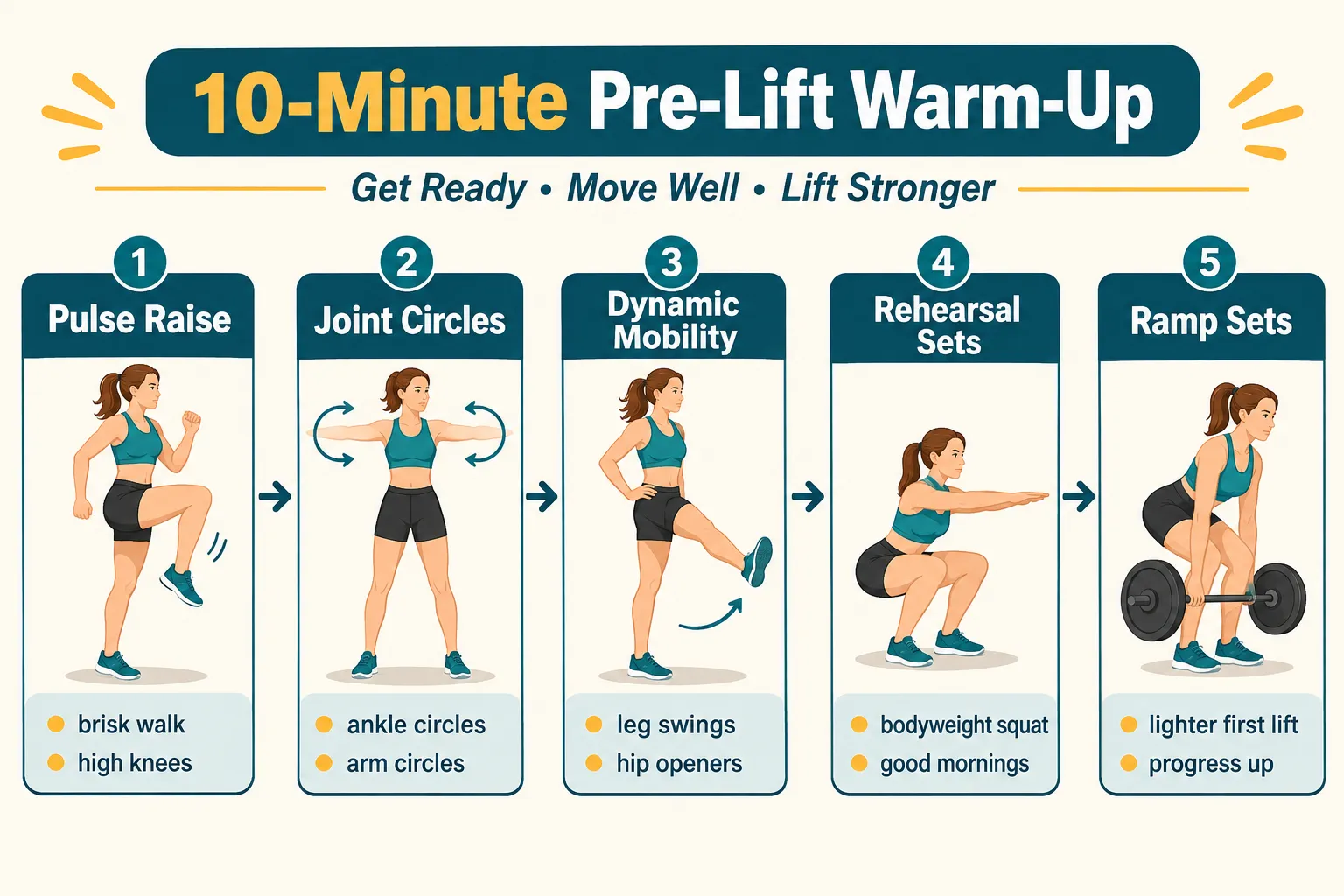
How long should a warm up actually take before lifting?
Ten minutes is the sweet spot for most adults over 40, and clinical resistance-training trials in older adults have used 10-15 minute aerobic warm-ups on a bike without harming the strength work that followed [15, see note]. Health systems commonly advise 5-10 minutes of walking, treadmill, or stationary cycling before lifting for people 50 and beyond [4][5].
| Situation | Warm-up length | Emphasis |
|---|---|---|
| General strength session, 40-55 | 10 minutes | Pulse raise + mobility + rehearsal |
| Stiff joints, arthritis, mobility limits | 10-15 minutes | Longer gentle aerobic phase |
| Light/accessory day | 5-7 minutes | Pulse raise + specific joints only |
| Heavy lower-body day | 12 minutes | Extra ramp sets on the first lift [7] |
Common mistake: counting your walk from the parking lot. That raises temperature a little but rehearses nothing.
What's the difference between warming up and stretching?
A warm-up prepares tissue for work; stretching changes how a joint feels at end range. They're not interchangeable. Professional guidance orders a session as warm-up → strength work → cool-down → stretching, with the warm-up intended to prepare muscles and joints rather than tire them.
- Dynamic warm-up: controlled movement through range (leg swings, arm circles, bodyweight squats). Raises temperature, wakes up coordination.
- Static stretching: holding a lengthened position 20-60 seconds. Useful, but better placed after training.
Put the long hamstring hold at the end of the session, not before the deadlift.
Should I do static or dynamic stretching before weights?
Dynamic. Current national and professional guidance endorses dynamic, non-fatiguing activity that increases blood flow to the muscles you're about to train, rather than static stretching alone, as the safety standard before resistance work [3].
Edge case: if a specific joint genuinely blocks a lift (a tight ankle stopping a squat), a short 20-30 second static hold on that one area, followed by a few squats to re-groove the pattern, is reasonable. Keep it targeted, not a 15-minute floor routine.
Can you do strength training without warming up?
You can, but after 40 it's a poor trade. Skipping the warm-up means your first set doubles as your warm-up, so you'll either lift less than you could or load cold joints. Neither helps.
If you're genuinely short on time, don't delete the warm-up, compress it:
- 90 seconds of brisk marching or stair walking.
- 10 arm circles, 10 ankle circles each side, 10 supported leg swings per leg.
- Two ramp sets of your first lift at a light and then moderate weight.
That's under four minutes and covers all three jobs.
The 10-minute routine for mobility, temperature, and joint readiness
Here's the core sequence. Modern programming frameworks describe the progression as stabilize → mobilize → potentiate → ramp → train, using roughly 5-10 dynamic reps per movement [8].
Minutes 0-5, Temperature. Brisk walk, easy bike, elliptical, or marching in place. You should be breathing a little harder but able to talk easily [1][2][4].
Minutes 5-7, Mobility. 10 ankle circles each side, 10 arm circles each direction, 10 supported leg swings per leg (front-to-back, then side-to-side), 10 slow trunk rotations [1][2].
Minutes 7-10, Rehearsal and ramp. 2-3 easy sets of bodyweight squats, incline push-ups, calf raises, and glute bridges, all stopped well short of hard [1][2]. Then one or two light ramp sets of the first barbell or machine lift [7][8].
Band, bodyweight, and limited-equipment versions
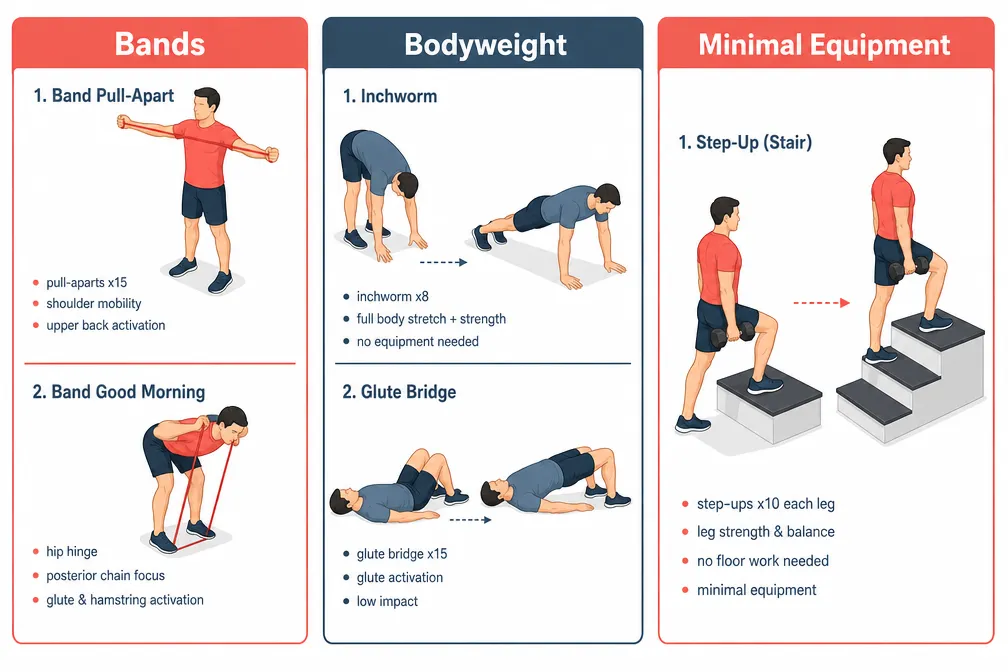
- Bands: pull-aparts (15), band good mornings (10), band-assisted squats (10), monster walks (10 steps each way).
- Bodyweight only: march in place, punches, knee thrusters, basic squats, about one minute each, then 2-3 sets of five inchworms, which open the shoulders and switch on the core at the same time [6].
- Home with one dumbbell or a chair: sit-to-stands, step-ups on a stair, single-dumbbell suitcase carries for 20 steps, chair-supported calf raises.
What are the best warm up exercises for bad knees, arthritis, or stiff joints?
Start with non-impact aerobic work and short-range movement, then widen the range as the joint loosens. Guidance for people with limited mobility suggests 10-15 minutes of gentle aerobic exercise, stationary bike, elliptical, treadmill, brisk walk, or pool work, before bodyweight or resistance training to limber up muscles and joints [13, see note].
For knees and arthritic joints specifically:
- Stationary bike, low resistance, 8-10 minutes. Smooth, loaded cycling is usually the kindest knee warm-up.
- Partial-range sit-to-stands from a high bench, progressing to a lower one.
- Heel slides and ankle pumps if morning stiffness is bad.
- Glute bridges to wake the hips so the knees do less work.
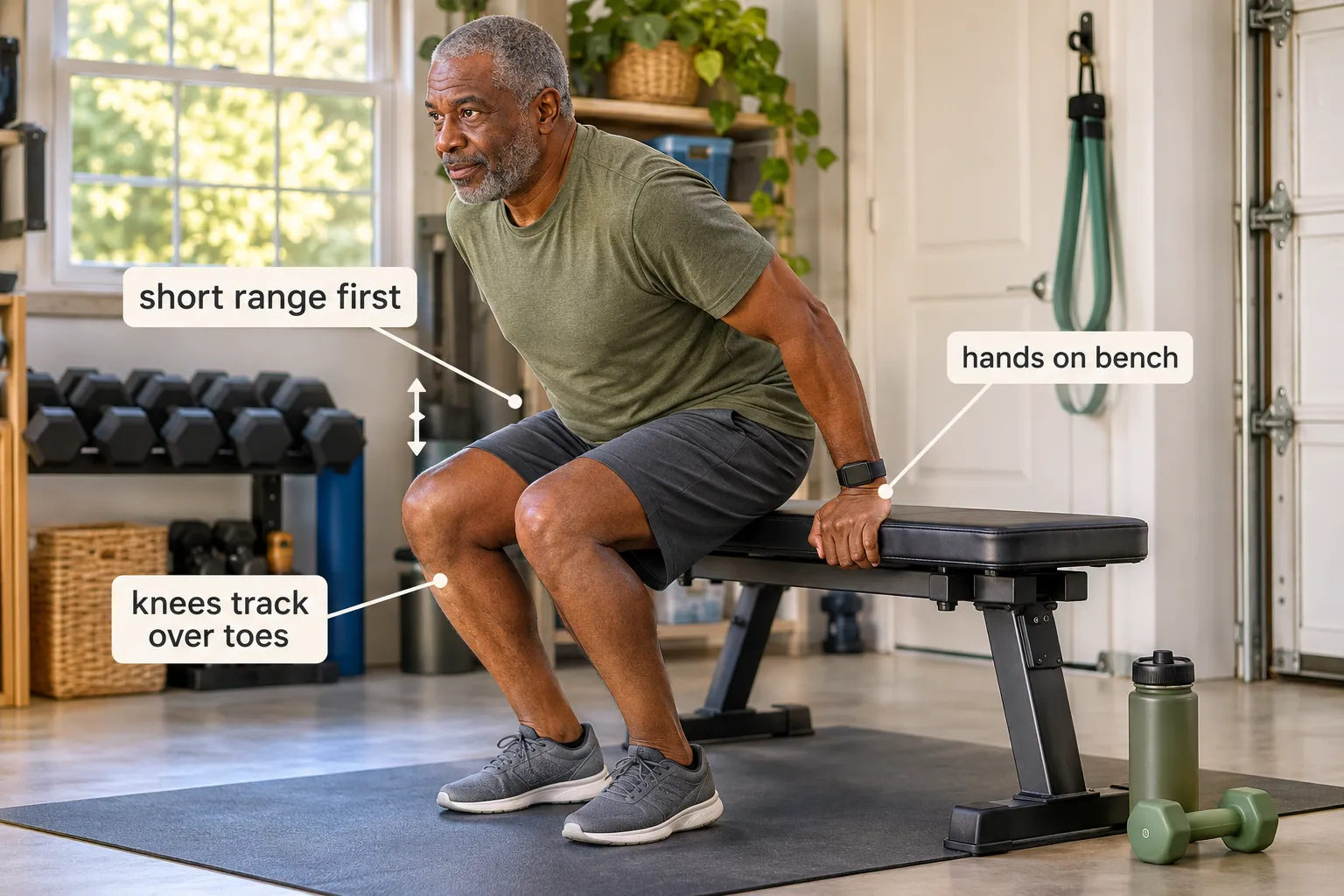
Decision rule: if pain decreases as you warm up, continue. If it increases set after set, stop and reassess with a clinician.
Is cardio a good warm up for weight training?
Yes, for the temperature portion, but cardio alone isn't a complete warm-up. Walking or cycling raises blood flow and joint lubrication [4][5], yet it doesn't take your shoulders overhead or rehearse a hip hinge.
Use this split: 5 minutes of easy cardio, then mobility and rehearsal. Keep intensity low. A hard 15-minute interval session before squats leaves you pre-fatigued, which is the opposite of readiness.
Can you warm up too much before strength training?
Yes. The warm-up should prepare you, not drain you. Seniors' warm-up guidance stresses low perceived effort and keeping reps in reserve even during the warm-up, move slowly, breathe steadily, and stop each warm-up set before it feels hard [1].
Signs you've overdone it:
- Your first working set feels heavier than usual.
- You're sweating heavily or out of breath before lifting.
- The warm-up runs past 15-20 minutes regularly.
What are the most common mistakes people make when warming up over 40?
The biggest ones are doing too much stretching, too little pulse-raising, and skipping movement rehearsal.
- Long static stretch routines before lifting instead of after.
- No ramp sets, jumping to the working weight on lift one.
- Treating the warm-up as a workout and arriving at set one already tired [1].
- Same warm-up for every session. Bench day needs shoulders; squat day needs ankles and hips.
- Ignoring morning stiffness rather than adding warm-up sets or shifting training later [7].
Do you need to warm up for light strength training, and can mobility work count?
Light sessions still need a warm-up, but a shorter one, around 5 minutes covering a pulse raise plus the specific joints involved. National aging guidance even treats lighter muscle-strengthening exercise as a legitimate warm-up step in itself [9].
Mobility work can count as your warm-up if it does two things: raises your heart rate and body temperature, and rehearses the movements in your session. Slow floor-based mobility alone usually fails the temperature test. Add three minutes of brisk walking in front of it and it qualifies.
How do you know if your warm up is actually working?
Judge it by your first working set, not by how the warm-up felt. A good warm-up produces a first set that feels smooth, controlled, and no harder than your third.
Quick checklist:
- Joints feel quieter at the end of the warm-up than at the start.
- Range of motion in the day's main lift is full and pain-free.
- Breathing is slightly elevated, not labored.
- Bar speed on the first working set matches later sets.
- You'd describe the warm-up as "easy" [1].
FAQ
How many minutes should a warm-up be after 40?
About 10 minutes: 5 pulse-raising, 2-3 mobility, 2-3 rehearsal and ramp sets [1][2].
Is walking enough of a warm-up before lifting?
It covers temperature but not mobility or movement rehearsal. Add joint circles and light sets of the day's lifts.
Should I stretch before or after strength training?
After. Guidance places stretching in the cool-down and dynamic movement in the warm-up.
What's a good warm-up with no equipment?
Marching in place, punches, knee thrusters, bodyweight squats, roughly one minute each, then inchworms and glute bridges [6].
Can arthritis sufferers warm up safely?
Yes. Start with 10-15 minutes of low-impact aerobic work and short-range movement, widening the range as the joint loosens.
Do I need to warm up before machine exercises?
Yes, but it can be brief. Add 1-2 light sets before the leg press, chest press, and rows [7].
Should the warm-up make me sweat?
Light sweat is fine. Heavy sweating before set one means the warm-up is too hard.
Is a warm-up needed on light or accessory days?
Yes, around 5 minutes focused on the joints you'll be using.
Conclusion
The point of a warm-up after 40 isn't flexibility, it's readiness. Warm tissue, mobile joints, and a rehearsed movement pattern, all inside 10 minutes.
Next steps:
- Pick your pulse raise: walk, bike, or march in place, 5 minutes.
- Write a three-move mobility list for your main lift and keep it the same every week.
- Add two ramp sets to the first exercise of each session [7][8].
- Move static stretching to the cool-down.
- Test it for two weeks and judge success by how your first working set feels.
Note: two items in the research material (a Health.com mobility article and a 2017 systematic review on aerobic warm-ups in older-adult resistance trials) could not be matched to a verified URL in the source list, so they are referenced descriptively rather than linked.
References
- Seniors Warm Up Exercises. rirlift.com.
- Full Body Exercises for Seniors. rirlift.com.
- Kravitzlifetimesm. unm.edu.
- Staying Strong Staying Independent the Power of Strength Training for Healthy Aging. adventisthealth.org.
- Strength Training After 60 How to Ward Off Effects of Age Related Muscle Loss Especially When Taking Glp 1 Drugs. news.cuanschutz.edu.
- 2026 10 Home Strength Everyday Tasks Easier. medicalxpress.com.
- Best Workout for Seniors. rirlift.com.
- Ultimate Warm Up Stabilize Mobilize Potentiate. theelitetrainer.com.
- Three Types Exercise Can Improve Your Health and Physical. nia.nih.gov.