
Last updated: October 30, 2026
Quick Answer
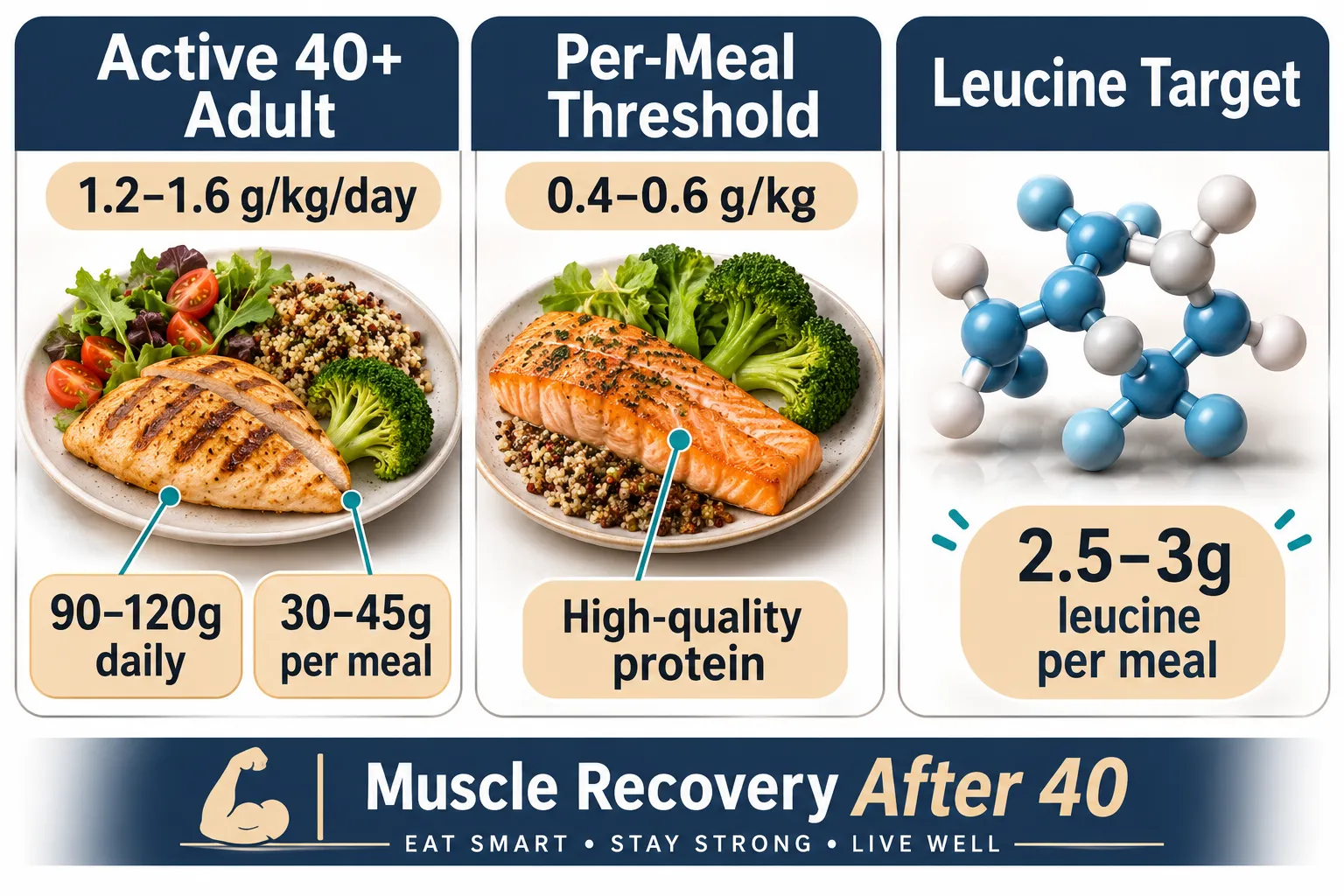
Most active adults over 40 should aim for roughly 1.2-1.6 g of protein per kg of body weight per day, about 90-120 g for a 75 kg person, spread across 3-4 meals of 30-45 g each [1]. That's double the old 0.8 g/kg RDA, because ageing muscle responds less strongly to each protein dose (a phenomenon called anabolic resistance) [1][2]. The question of how much protein you need for muscle recovery after 40, daily targets, timing, and meal examples, comes down to one priority: hit the daily total consistently, then worry about timing.
Key Takeaways
- Daily target: 1.2-1.6 g/kg/day for adults over 40 who train; 1.0-1.2 g/kg/day as a floor for less active adults [3].
- Per meal: about 0.4-0.6 g/kg, which works out to roughly 30-45 g of high-quality protein per eating occasion [2].
- Leucine matters: aim for ~2.5-3 g leucine per meal, easiest from dairy, eggs, meat, fish, or fortified plant blends [1][4].
- Timing is secondary: a 2025 trial found no extra muscle gain from shifting protein to pre-sleep or immediately post-exercise once daily intake was already ~1.0-1.3 g/kg [5].
- No powder required. Eggs, canned fish, milk, lentils, and chicken thighs hit the same targets for less money.
- Safety: up to about 1.5-2.0 g/kg/day is generally considered safe for healthy older adults with normal kidney function [3][6].
- Dieting? Don't drop below about 1.2 g/kg/day if you want to keep muscle [1].
- Biggest mistake: a protein-light breakfast and lunch followed by one giant dinner.
How does protein actually help muscle recovery after 40?
Protein supplies the amino acids your body uses to repair and rebuild the muscle fibers damaged by training, and it switches on muscle protein synthesis (MPS), the process that actually adds tissue. Resistance exercise raises the sensitivity of muscle to protein, so training plus feeding together produce a much stronger building response than either alone [1][7].
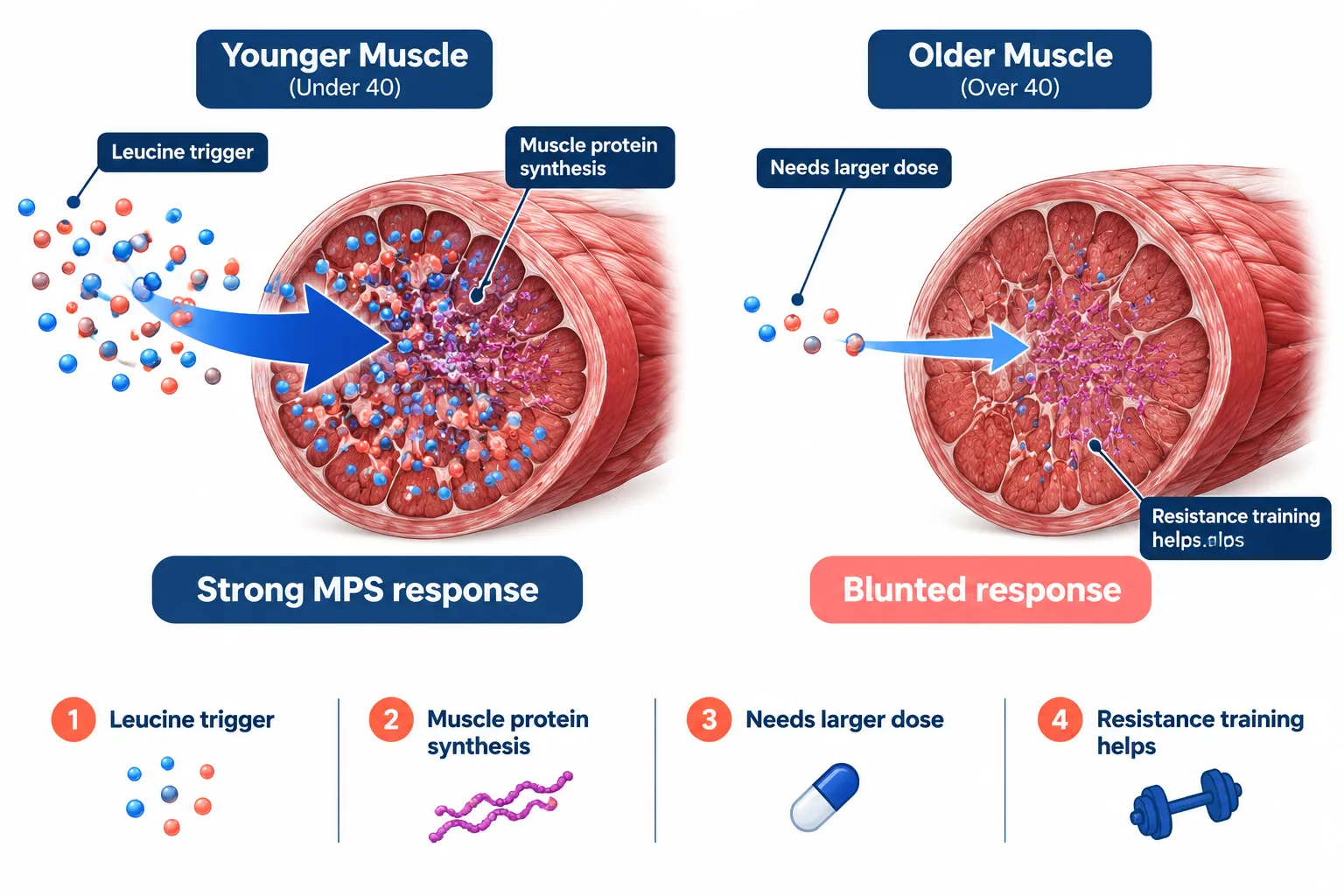
The amino acid leucine acts as the main trigger. Below a certain leucine threshold, a meal barely moves the needle. That's why a 10 g protein snack does far less than you'd expect, and why reviews now recommend meals carrying roughly 2.5-3 g leucine [1][4].
Recovery isn't one event after a workout. It's the sum of every meal in the 24-72 hours that follow [1][7].
Quick example: two eggs on toast (~14 g protein) won't maximize MPS. Add a cup of Greek yogurt and you're near 35 g, above the threshold, in the same 10 minutes of effort.
Do you need more protein as you get older, or is it the same?
You need more. Expert groups including PROT-AGE and ESPEN recommend at least 1.0-1.2 g/kg/day for older adults instead of the 0.8 g/kg RDA, rising to 1.2-1.5 g/kg/day for people who are active, recovering from illness, or losing muscle. Muscle-focused reviews put the hypertrophy range at 1.2-1.6 g/kg/day, with an upper meta-analytic limit near 2.2 g/kg [1].
The reason is anabolic resistance. Older muscle needs a bigger bolus, around 40 g of high-quality protein (or ~20 g essential amino acids), to maximally stimulate MPS after exercise, versus roughly 20-25 g in younger adults [1][8].
| Body weight | Maintenance (1.0-1.2 g/kg) | Muscle-focused (1.2-1.6 g/kg) |
|---|---|---|
| 60 kg (132 lb) | 60-72 g | 72-96 g |
| 75 kg (165 lb) | 75-90 g | 90-120 g |
| 90 kg (198 lb) | 90-108 g | 108-144 g |
Decision rule: choose the higher end if you lift weights 2+ times a week, are in a calorie deficit, or are rehabbing an injury. Choose the lower end if you're sedentary and weight-stable.
Do sedentary people need less protein than active people?
Yes, but less than most assume. Inactive adults over 40 still need about 1.0-1.2 g/kg/day to defend against age-related muscle loss, because the problem isn't training damage, it's the slow drift of muscle breakdown exceeding rebuilding [3][9]. Routinely active adults are often advised to use 1.2-2.0 g/kg/day [6].
The edge case: a sedentary person eating just the RDA while dieting is in the worst position of all. Low protein plus low calories plus no resistance stimulus is the fastest route to losing lean mass.
What happens if you don't get enough protein for recovery?
Chronic under-eating of protein shows up as slower recovery between sessions, stalled strength, and gradual loss of lean mass and function, the pattern that drives sarcopenia. Short-term, you'll notice workouts that don't "stick": the same lifts feel hard week after week.
Signs worth paying attention to:
- Strength plateaus despite consistent training
- Soreness lasting well beyond 48-72 hours
- Losing weight but looking softer, not tighter
- Poor wound healing or frequent minor illness
During weight loss after midlife, higher protein (≥1.0 g/kg/day, often 1.2-1.5) helps preserve muscle in older adults who already have blunted post-meal MPS.
How soon after a workout should you eat protein, and does timing actually matter?
Eat a protein-containing meal within a few hours of training, same day is the real requirement, not a 30-minute window. A 2025 trial in older untrained adults found that once daily intake reached roughly 1.0-1.3 g/kg/day, shifting protein to just before sleep or straight after exercise produced no additional gains in muscle size [5].
That said, current ageing-and-exercise reviews still recommend a substantial serving in proximity to resistance exercise, because exercise plus feeding together stimulates MPS strongly in older adults [1][7]. A practical compromise: a post-exercise meal with ≥30 g of high-quality protein, eaten whenever is convenient in the hours afterward [1][7].
Distribution, though, probably does matter. Three to four roughly even protein "hits" of 0.4-0.6 g/kg each likely supports muscle health better than dumping most of the day's protein into one evening meal [2][4]. One meta-analysis in community-dwelling older adults found timing and frequency of supplements mattered little when total intake was adequate [5][10], so treat even distribution as a useful habit, not a rule to stress over.
What does a typical high-protein day of meals look like after 40?
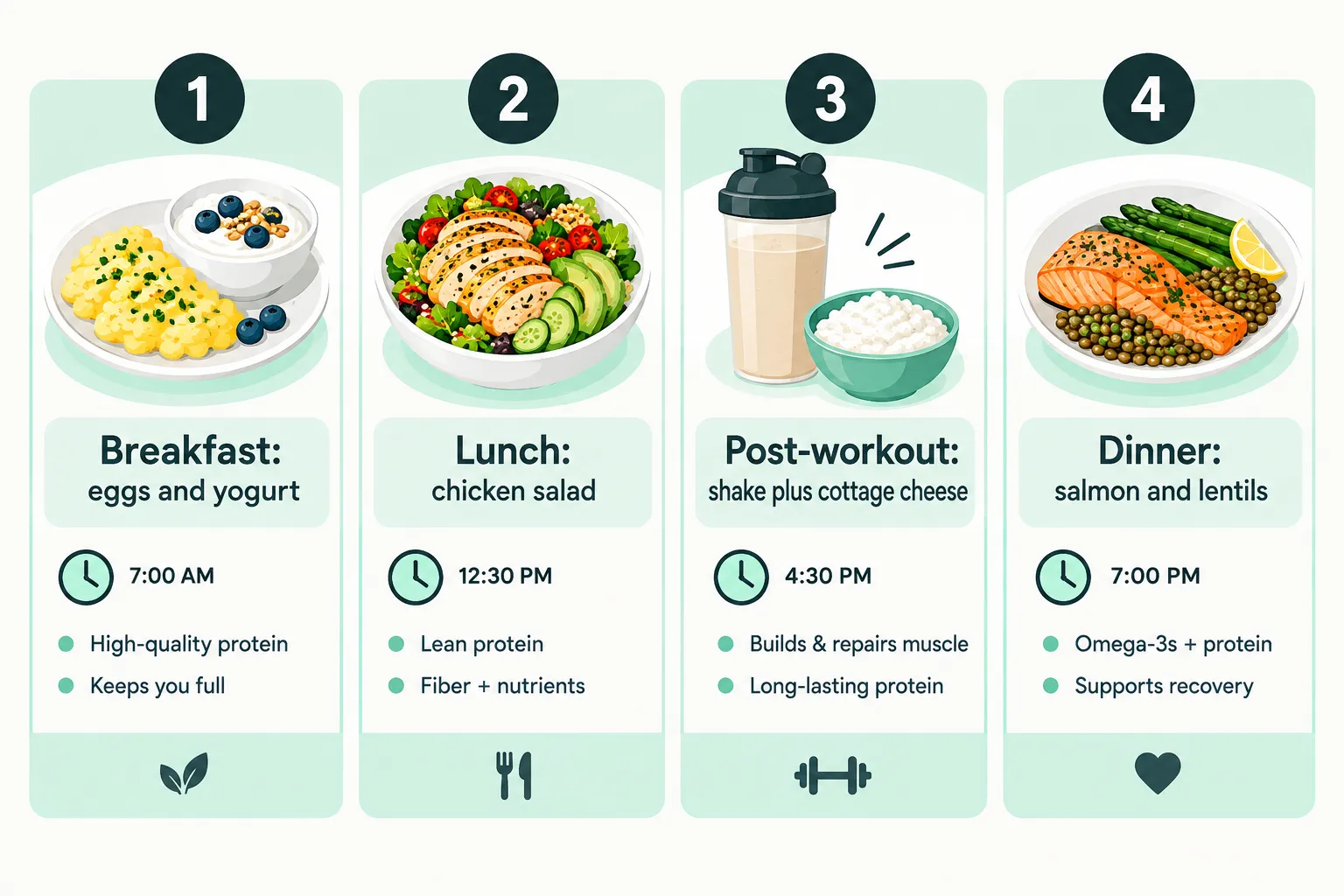
Here's a realistic workday pattern for a 75 kg adult, landing near 120 g across four eating occasions, each clearing the per-meal threshold [1][8].
| Time | Meal | Protein |
|---|---|---|
| 7:00 am | 3 eggs + 1 cup Greek yogurt + berries | ~35 g |
| 12:30 pm | Grilled chicken (or 200 g firm tofu) over salad, with chickpeas | ~35 g |
| 4:30 pm (post-training) | Whey or soy shake + ½ cup cottage cheese | ~35 g |
| 7:30 pm | Salmon fillet with lentils and vegetables | ~30 g |
Swaps that keep the numbers intact: tinned tuna for chicken, skyr for Greek yogurt, tempeh for tofu, a glass of milk to top up any meal by ~8 g.
Workday reality check: if lunch is a sandwich from a café, add a yogurt pot or a small tin of fish. Most convenience lunches land around 15 g, half of what you need.
Can you build muscle after 40 without protein powder, and what are the cheapest ways to get enough?
Yes. Powder is a convenience product, not a requirement, whole foods hit the same targets, and the cheapest protein sources are rarely supplements.
Best value per gram, roughly in order:
- Eggs, ~6 g each, versatile, long shelf life
- Dried lentils and beans, ~18 g per cooked cup, pennies per serving
- Milk and plain yogurt, ~8 g per cup; skyr and Greek yogurt are 15-20 g per pot
- Canned sardines, mackerel, tuna, 20-25 g per tin
- Cottage cheese, ~13 g per half cup, high in leucine
- Chicken thighs, pork shoulder, frozen fish, cheaper than breast or fillets
- Tofu and tempeh, 15-20 g per serving
Use a powder when you genuinely can't eat: travel days, early training, poor appetite, or a 30 g gap at bedtime. That's it.
How do you get enough protein on a vegan or vegetarian diet?
It's achievable, but plant eaters over 40 should target the upper end of the range and lean on higher-quality or combined sources, because unfortified plant proteins carry less leucine per gram [1][4]. Soy, pea protein, seitan, tofu, tempeh, and lentils do the heavy lifting.
- Build each meal around a 50-60 g protein anchor food (tofu block, tempeh, seitan, lentils)
- Combine grains with legumes across the day to cover amino acid gaps
- Consider a leucine-enriched or soy/pea blend powder if meals keep landing under 25 g
- Vegetarians can use dairy and eggs to close the leucine gap easily
Common trap: assuming nuts and nut butters are protein foods. A tablespoon of peanut butter has ~4 g, it's a fat source with protein attached.
Is a high-protein diet safe if you have kidney problems, and can you eat too much in one day?
For healthy adults with normal kidney function, intakes up to about 1.5-2.0 g/kg/day are generally considered safe, especially in physically active people [3][6]. If you have existing kidney disease, diabetes-related kidney changes, or another metabolic condition, set your target with a clinician rather than from a general guideline, ESPEN and PROT-AGE both stress individual tailoring.
On "too much": extra protein beyond roughly 1.6 g/kg/day shows diminishing returns for muscle, with meta-analysis confidence fading near 2.2 g/kg [1]. Eating 100 g in one sitting isn't harmful, it's just inefficient, the surplus is oxidized rather than used for building.
Why am I still sore even though I'm eating enough protein?
Soreness is mostly driven by training variables, not protein. Delayed-onset muscle soreness follows new exercises, eccentric loading, and sudden volume jumps, adequate protein supports repair but doesn't eliminate the sensation.
Check these before adding more protein:
- Sleep under 7 hours blunts recovery more than a 20 g protein shortfall
- Total calories, under-eating overall limits repair even with high protein
- Volume ramp, more than ~10% weekly jumps reliably produce soreness
- Hydration and carbohydrate intake around sessions
- Programming, training the same muscle hard every 24 hours doesn't allow repair
What's the most common protein mistake people make after 40?
Back-loading. Most people eat 10-15 g at breakfast, 15-20 g at lunch, and 50-60 g at dinner, a skewed pattern that misses the per-meal threshold twice before finally overshooting it once [2][4].
Other frequent errors:
- Counting protein in grams of food rather than grams of protein (200 g of chicken is ~45 g protein, not 200)
- Relying on bars and snacks under 15 g
- Cutting protein alongside calories while dieting
- Training hard but eating the same protein as on rest days
Fix in one move: add 25-30 g to breakfast. For most people that single change closes most of the daily gap.
FAQ
How much protein does a 70 kg person over 40 need?
About 84-112 g per day if training (1.2-1.6 g/kg), or 70-84 g as a maintenance floor [1].
Is 100 g of protein a day enough after 40?
It's enough for most adults up to about 80 kg who train regularly, but someone at 95 kg aiming for muscle gain would need closer to 120-150 g [1].
Do I need protein immediately after lifting?
No. Meeting your daily total matters more; a 2025 trial found no added benefit from immediate post-exercise or pre-sleep timing once intake reached ~1.0-1.3 g/kg/day [5].
How much protein per meal after 40?
Roughly 0.4-0.6 g/kg per meal, or about 30-45 g of high-quality protein at each main eating occasion [2].
Can protein help me lose fat while keeping muscle?
Yes. Keeping protein at 1.2-1.5 g/kg/day during energy restriction helps preserve lean mass in older adults.
Is whey better than plant protein after 40?
Whey is higher in leucine per gram, which matters given anabolic resistance, but soy and pea blends work well at slightly larger doses [1][4].
Does protein damage healthy kidneys?
There's no evidence that intakes up to about 1.5-2.0 g/kg/day harm healthy kidneys, though those with kidney disease need medical guidance [3][6].
How many meals should I spread protein across?
Three to four, each hitting the per-meal threshold, is the pattern most supported for ageing muscle [2][4].
Conclusion
Protein strategy after 40 isn't complicated: pick a daily number, split it into 3-4 meals, and keep each meal above roughly 30 g of high-quality protein. Everything else, exact timing, supplement brands, pre-sleep casein, is fine-tuning that matters far less than consistency [1][5].
Next steps:
- Multiply your body weight in kg by 1.2 and by 1.6 to set your target range.
- Divide by four to get a per-meal number, then audit yesterday's meals against it.
- Add 25-30 g to whichever meal is lightest (usually breakfast).
- Pair the diet with resistance training at least twice a week, protein without loading won't build muscle.
- If you have kidney disease or another metabolic condition, confirm your target with a clinician before raising intake.
References
- Full. frontiersin.org.
- Article Abstract. academic.oup.com.
- 1092 Protein Guidelines Topic Disposition. effectivehealthcare.ahrq.gov.
- pubmed.ncbi.nlm.nih.gov.
- Pmc12897527. pmc.ncbi.nlm.nih.gov.
- Evidence Based Recommendations for Optimal Dietary Protein Intake. researchexperts.utmb.edu.
- Dietary Protein and Exercise Training in Ageing. cambridge.org.
- Recovery. featherstonenutrition.com.
- Protein Dga Tip Sheet. acl.gov.
- The Effect of Dose Frequency and Timing of Protein Supplementation. research.hva.nl.