Last updated: October 29, 2026
Quick Answer
Your metabolism isn't broken at 40, it's mostly losing muscle and daily movement. Strength Training After 40 and Metabolism: How to Maintain Muscle While Losing Fat comes down to four controllables: lift weights 2-4 times per week at moderate-to-high intensity, eat enough protein spread across meals, keep daily steps high, and run a moderate calorie deficit instead of an aggressive one. Research in adults 50+ shows resistance training reliably builds strength and improves cholesterol, blood sugar, mobility, and balance, even when started late [1][2].
Key Takeaways
- Age-related muscle loss (sarcopenia) is the real driver of a slower metabolism, not permanent "metabolic damage."
- Low muscle mass and strength strongly predict disability, frailty, and mortality; resistance training is the primary intervention.
- Higher-load training (≥70% 1RM) produces larger lower-limb strength gains in adults 50+, with adverse events comparable to lighter loads [2].
- Lighter loads taken close to failure also build strength, which matters if joints won't tolerate heavy weights [3].
- Even 4 minutes a day of functional strength work improved chair-stand reps, one-legged stance, and sit-to-stand speed in adults averaging 74 years old [4][5].
- Protein target for most adults over 40 in a deficit: roughly 1.6-2.2 g per kg of body weight daily.
- A moderate deficit (about 10-20% below maintenance) protects muscle better than crash dieting.
- Starting at 45, or 71, works. Supervised heavy training has sustained strength into the 70s over eight years [6].
How does metabolism actually change after 40?
Metabolism after 40 slows mainly because lean muscle shrinks and daily activity drops, not because the body "breaks." Muscle is metabolically active tissue, so losing it lowers resting energy use and reduces how much glucose your body can soak up after meals.
Three things usually stack up:
- Muscle loss. Strength decline begins in midlife and accelerates, according to a 47-year longitudinal dataset summarized in 2026, but people who did weekly resistance exercise improved upper- and lower-body strength regardless.
- Less movement. Desk jobs, knee aches, and fatigue cut incidental steps.
- Less intense exercise. Walking replaces lifting, so the stimulus to keep muscle disappears.
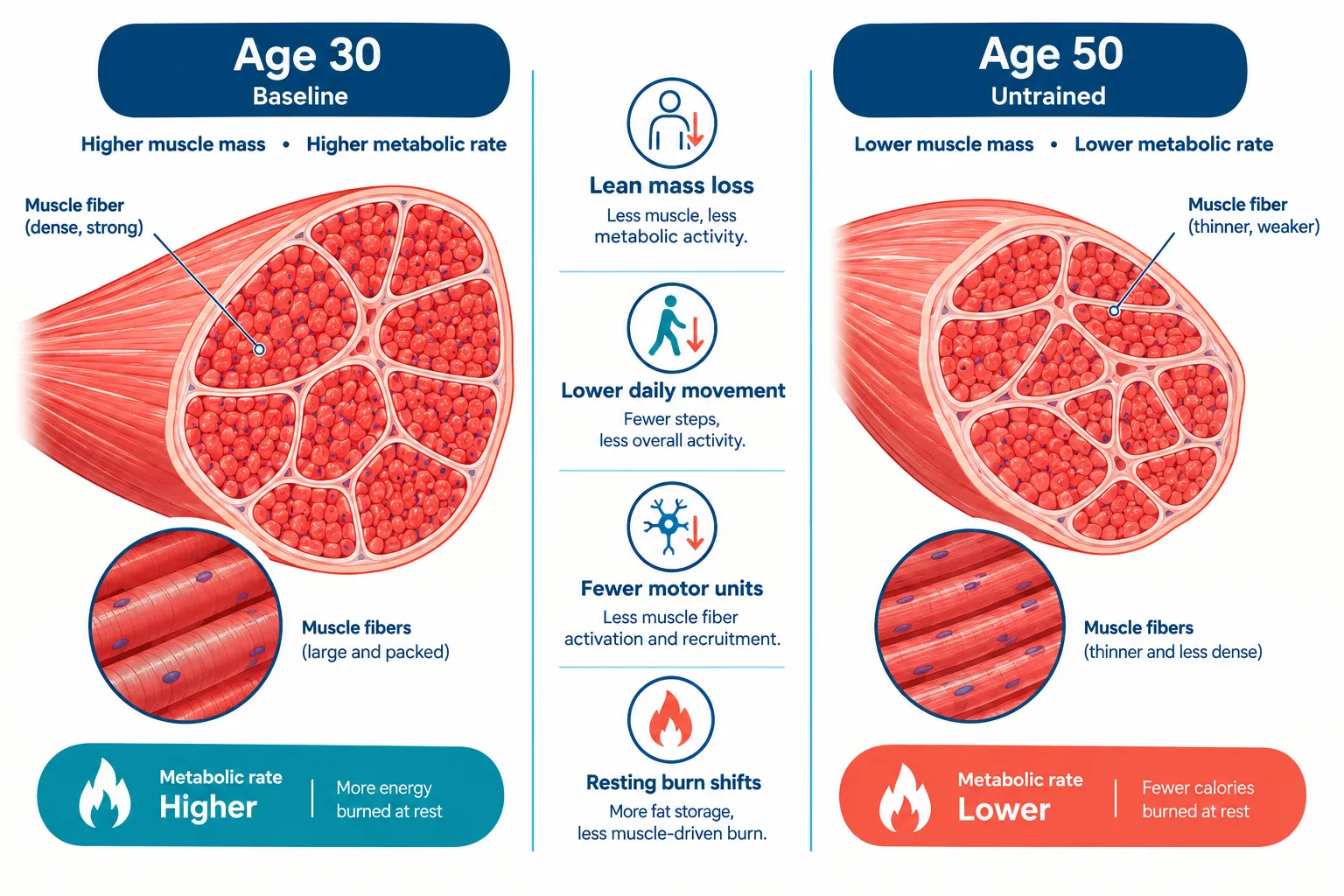
The slowdown most people blame on hormones is largely a strength-and-steps problem, and both are trainable.
Common mistake: assuming the scale number proves metabolic failure. Two people of the same weight can differ by 10+ pounds of muscle, which changes everything about how they burn fuel.
Can you build muscle and lose fat at the same time over 40?
Yes, especially if you're new to lifting, returning after a layoff, or carrying higher body fat. The effect is called body recomposition, and it's strongest in beginners.
Choose your approach using this rule:
- Newer to lifting or higher body fat? Expect genuine simultaneous muscle gain and fat loss for the first 6-12 months.
- Already trained and lean? Aim to maintain muscle during fat loss, then build in a separate phase. Trying both at once gets slow and frustrating.
Conditions that make recomposition work: a small deficit, high protein, progressive resistance training, and 7+ hours of sleep. Remove any one of those and muscle gets sacrificed.
How much protein do I really need after 40?
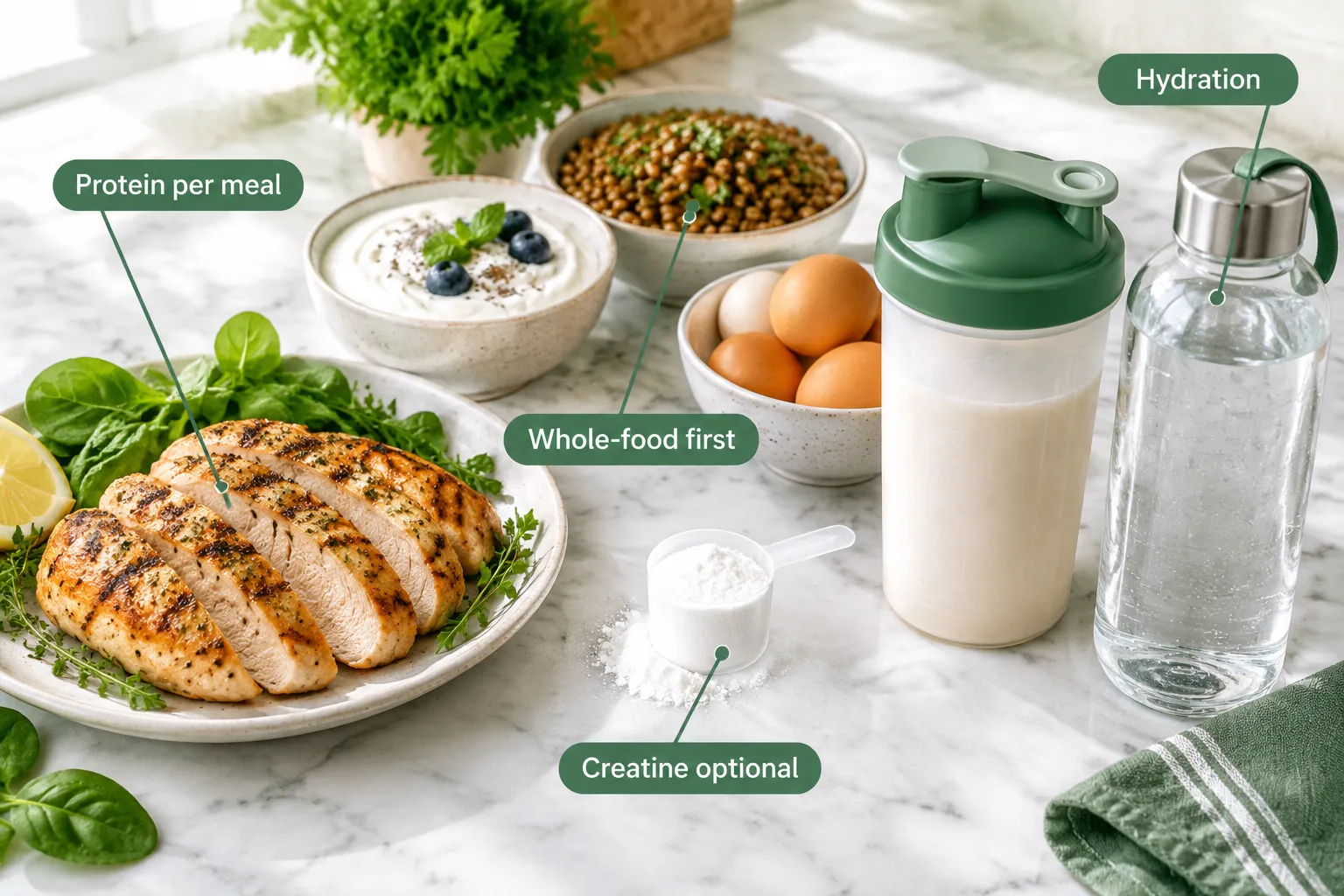
Most adults over 40 losing fat do well on 1.6-2.2 grams of protein per kilogram of body weight per day (roughly 0.7-1.0 g per pound), split across 3-4 meals of 30-45 g each. Older muscle responds less efficiently to small protein doses, so per-meal amount matters as much as the daily total.
Practical anchors:
| Body weight | Daily protein target | Per meal (4 meals) |
|---|---|---|
| 60 kg / 132 lb | 96-132 g | 24-33 g |
| 80 kg / 176 lb | 128-176 g | 32-44 g |
| 100 kg / 220 lb | 160-220 g | 40-55 g |
Edge case: anyone with chronic kidney disease should set protein targets with a physician, not a calculator.
Strength training vs cardio: which is better for fat loss?
Cardio burns more calories per session; strength training protects the muscle that keeps your metabolism from falling. For fat loss while staying strong after 40, resistance training is the priority and cardio is the support.
A clean split for most people:
- Resistance training: 2-4 sessions weekly, non-negotiable.
- Walking: 7,000-10,000 steps most days, the cheapest, lowest-risk calorie lever.
- Harder cardio: 1-2 sessions weekly for heart health. Participants who combined resistance and aerobic work improved both strength and aerobic fitness.
Choose cardio-first only if a doctor has flagged cardiorespiratory fitness as your urgent risk. Otherwise lift first, then walk.
What's the best strength training routine for over 40, and how often should I lift?
Lift 2-4 times per week using compound movements, 2-3 sets of 10-15 reps at about 60-80% of your one-rep max. Sarcopenia exercise guidelines recommend resistance training more than three times weekly for at least 24 weeks at moderate-to-high intensity, in sessions of at least 30 minutes.
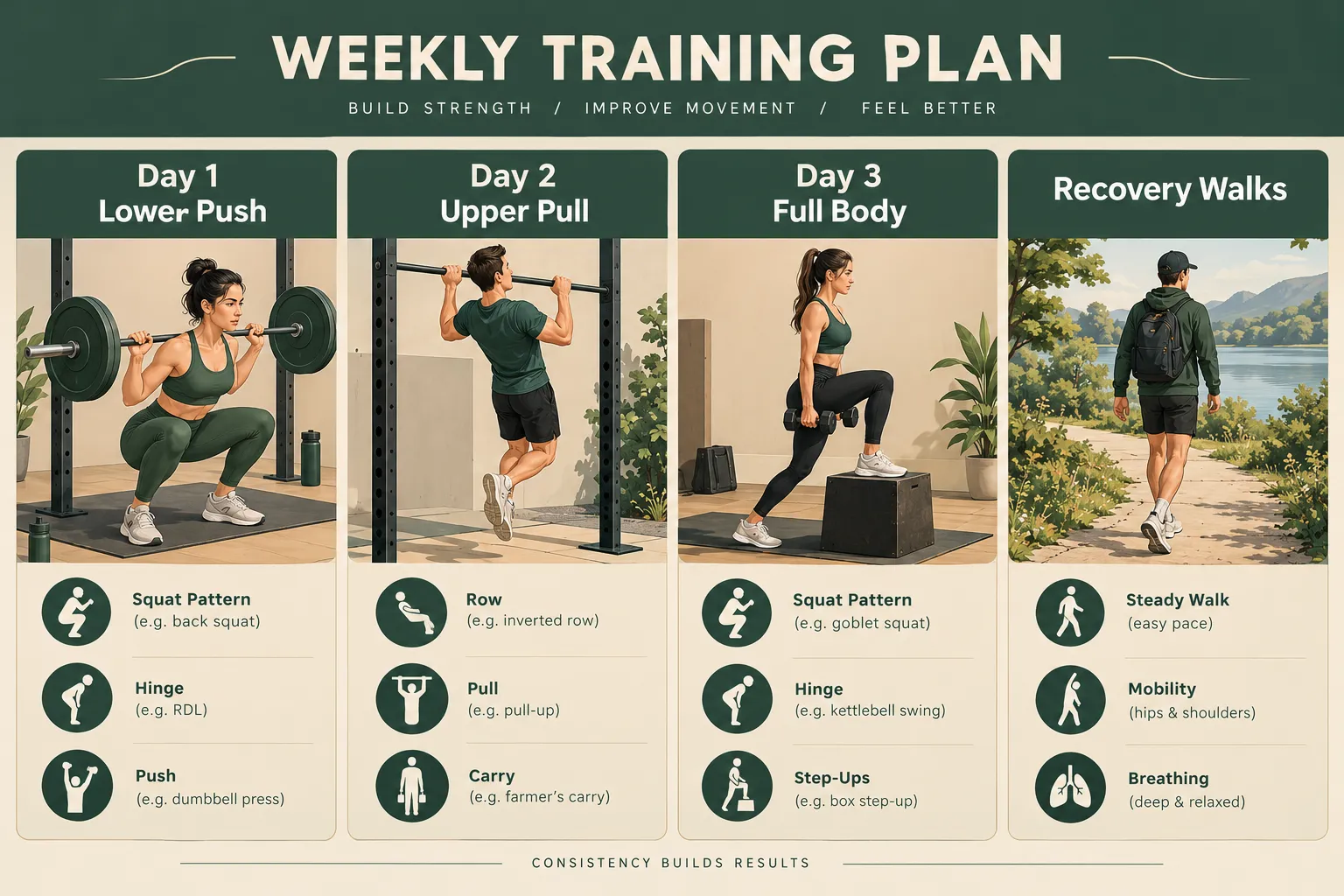
A workable three-day week:
- Lower push, goblet squat or leg press, step-ups, calf raises.
- Upper pull + press, rows, lat pulldown, dumbbell press, face pulls.
- Full body, hip hinge (Romanian deadlift), split squat, carries, planks.
On load: a 2026 meta-analysis in adults 50+ found ≥70% 1RM produced substantially larger leg press and leg extension strength gains than lighter training, with similar rates of adverse events [2]. If heavy loads aggravate joints, an 8-week trial at 40% vs 60% 1RM found both built leg strength when sets went close to failure [3].
Short on time? The FAST-2 trial had adults averaging 74 do four 30-second lower-body exercises daily for 12 weeks; they gained about 4.2 extra chair stands in 30 seconds, 3.6 seconds of one-legged stance, and cut 2.3 seconds off sit-to-stand time [4][5][7].
Why am I not losing weight even though I'm exercising?
Usually because intake quietly matches output, activity outside the gym dropped, or the scale is masking real fat loss. Exercise raises appetite and new lifters hold water in repairing muscle.
Run this checklist before changing your program:
- Track food honestly for 7 days, including oils, drinks, and bites.
- Check steps, many people move less on training days.
- Measure waist circumference and progress photos, not only weight.
- Give any change 3-4 weeks before judging it.
- Audit sleep; short sleep raises hunger and lowers training quality.
What are the most common mistakes people make trying to lose fat after 40?
The biggest mistakes are cutting calories too hard, skipping resistance training, and quitting before 12 weeks. Each one costs muscle, which makes the next attempt harder.
- Aggressive deficits. Below roughly 1,200-1,400 kcal, protein and training quality collapse.
- Cardio-only plans. Weight drops, but a share of it is muscle.
- Program hopping every two weeks, so progressive overload never happens.
- Chasing soreness instead of load, reps, and consistency.
- Ignoring daily steps while obsessing over gym time.
How long does it take to see results, and can you start for the first time at 45?
Expect strength gains in 4-6 weeks, visible body changes around 8-12 weeks, and meaningful muscle change by 6 months. Starting at 45, or 65, is well supported: a 12-week twice-weekly program using dumbbells, bands, and chair exercises in 227 adults aged 60+ improved cholesterol, blood sugar, mobility, balance, and well-being [1].
Longer term, a Frontiers in Aging case study followed a 71-year-old woman through eight consecutive years of supervised high-intensity resistance training, documenting sustained high strength and function into her 70s [6].
How do I avoid injury when lifting weights at an older age?
Start lighter than you think, add load slowly, and use machines or supervised free weights while you learn patterns. Higher-intensity training in adults 50+ showed adverse event rates similar to lighter training when properly supervised [2].
- Spend 8-10 minutes warming up the joints you're about to load.
- Add weight only when the top rep still looks clean.
- Keep 1-3 reps "in reserve" on most sets; save true failure for machines and lighter loads.
- Manage fatigue, current research is testing cluster sets precisely because recovery structure matters for older trainees [8].
- Get a screening from a physician or physiotherapist if you have cardiac, joint, or back history.
Do I need protein powder or supplements, and can women build muscle after 40?
Supplements are optional; whey or casein powder is just convenient protein. Creatine monohydrate is the one extra with decent evidence, a 2026 three-level meta-analysis in healthy older adults found a small but significant added strength benefit alongside resistance training (g ≈ 0.31, moderate certainty), with unclear effects on muscle mass and function.
Women absolutely build muscle after 40. Absolute gains are smaller than men's because of lower starting mass and testosterone, but relative strength improvements are comparable, and resistance training is the primary intervention against sarcopenia for both sexes. Programs that improved functional strength were also tied to better health-related quality of life in adults around 68 [9].
Is it possible to lose fat without strength training?
Yes, a calorie deficit alone will reduce body weight. But a meaningful share of that loss comes from muscle, which lowers resting energy expenditure and makes regain easier.
Choose a no-lifting approach only if injury or medical restriction rules out resistance work, and even then, bands, bodyweight chair stands, and supervised machines are usually available. Four minutes daily was enough to move the needle in adults in their 70s [7][10].
FAQ
Does metabolism really drop sharply at 40?
No. The sharp drop people describe mostly reflects lost muscle and reduced daily movement, both of which respond to training.
How many days a week should I lift?
Two days maintains, three to four builds. Sarcopenia guidelines suggest more than three sessions weekly for at least 24 weeks.
Can I lift heavy with arthritis?
Often yes, with modified ranges and machine-based loading. Lighter loads near failure also build strength [3].
How big should my calorie deficit be?
About 10-20% below maintenance. Deeper cuts accelerate muscle loss and tank training quality.
Is creatine safe after 40?
Monotherapy with creatine monohydrate is well studied in healthy older adults and showed a small strength benefit with resistance training. Check with a doctor if you have kidney disease.
Do I need a gym?
No. Dumbbells, bands, and chair exercises produced measurable metabolic and mobility improvements in a 12-week program [1].
Why is the scale stuck while clothes fit better?
You're likely gaining muscle and losing fat at once. Track waist measurements and photos.
How long before strength improves?
Most people notice better strength in 4-6 weeks of consistent progressive training.
Conclusion
Strength Training After 40 and Metabolism: How to Maintain Muscle While Losing Fat isn't a hormonal mystery to decode, it's muscle you keep or lose based on what you do this month. The evidence points one direction: load the muscles, feed them protein, keep walking, and cut calories moderately.
Your next steps:
- Book three 45-minute lifting sessions into next week's calendar.
- Set a protein target at 1.6-2.2 g/kg and build one high-protein meal template you'll repeat.
- Set a daily step floor (start at 7,000) and track it.
- Cut calories by 10-20%, not more.
- Measure waist, strength numbers, and photos at week 0 and week 12, then judge.
References
- Strong At Any Age: UTMB Health Strength Training Program Helps Older Adults Improve Health And Independence. utmb.edu.
- High-intensity resistance training in adults 50+: systematic review and meta-analysis. pubmed.ncbi.nlm.nih.gov.
- Low-load vs higher-load resistance training in older adults. ciss-journal.org.
- Four Minute Daily Workout Improves Strength Balance Older Adults. psu.edu.
- FAST-2 trial full text. pmc.ncbi.nlm.nih.gov.
- Aging Strong: eight-year high-intensity resistance training case study. frontiersin.org.
- Four-minute daily strength routine improves older adults' strength and balance. sciencedaily.com.
- Cluster sets vs continuous multiple sets in older adults (trial registry). ensaiosclinicos.gov.br.
- Beyond Muscle Mass: How Strength Training Enhances Health Related Quality Of Life In Older Adults. findanexpert.unimelb.edu.au.
- A Little Strength Training Every Day Brings Big Benefits For Older Adults, Study Finds. safetyandhealthmagazine.com.