
Last updated: November 5, 2026
Quick Answer
Most adults over 40 do well with 10-20 hard sets per muscle group per week, spread over 2-3 sessions. Use 3-6 reps for pure strength, 6-15 reps for muscle growth, and 8-12 reps for general maintenance, stopping 1-3 reps short of failure on most sets. Age alone shouldn't set your volume, soreness, sleep, bar speed, and your schedule should. Strength training is well supported for older adults and is one of the best defenses against age-related muscle loss [1][2].
Key Takeaways
- Start at 8-12 weekly sets per muscle group if you're new or returning, then add sets only if recovery holds.
- Strength: 3-5 sets of 3-6 reps, 2-4 minutes rest. Muscle: 3-4 sets of 6-15 reps, 90-120 seconds rest.
- Train each muscle 2-3 times per week instead of one brutal session.
- Lifting after 40 is safe for most healthy adults and improves bone density, balance, and metabolic health [2][3].
- You can absolutely gain muscle at 45, 50, or 70, gains are slower, not blocked [1][4].
- Most stalled progress comes from too little protein, too little load progression, or too little sleep, not age.
- Heavy and light loads both build muscle when sets are taken close to hard effort; load choice should follow joint tolerance.
- Visible change usually shows in 8-16 weeks; strength often improves within 2-4 weeks.
How many reps should I do to build muscle after 40?
Use 6-15 reps per set for muscle growth, with 3-4 working sets per exercise and roughly 10-20 total weekly sets per muscle group. The reps matter less than taking each set close to hard effort, usually leaving 1-3 reps in reserve.
A practical split by goal:
| Goal | Reps | Sets per exercise | Rest | Weekly sets per muscle |
|---|---|---|---|---|
| Max strength | 3-6 | 3-5 | 2-4 min | 8-14 |
| Muscle size | 6-15 | 3-4 | 90-120 sec | 10-20 |
| Maintenance | 8-12 | 2-3 | 60-90 sec | 6-10 |
| Rebuilding after a layoff | 10-15 | 2-3 | 90 sec | 6-10 |
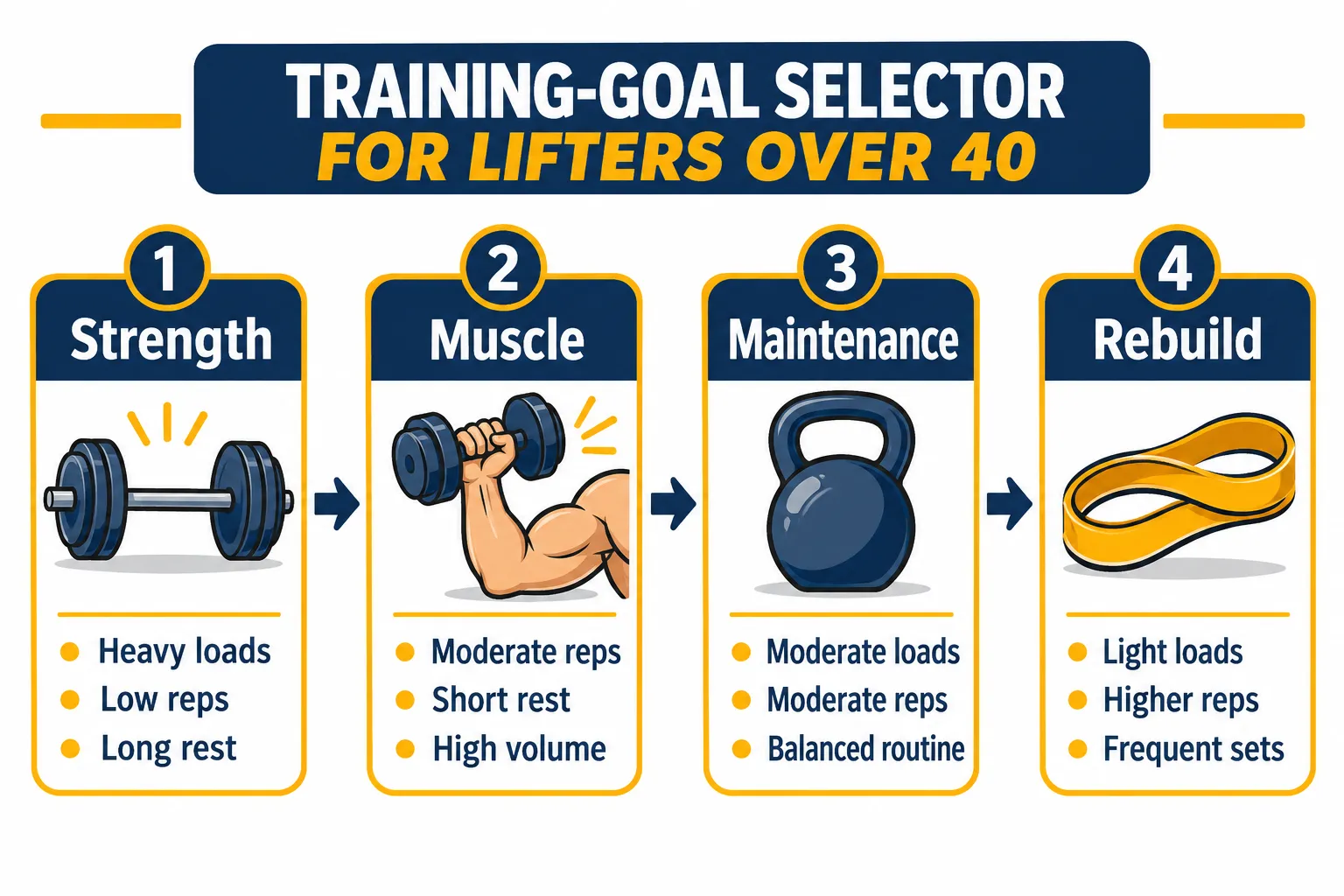
Decision rule: choose the 6-10 rep range if your joints feel good and you want size plus strength. Choose 12-15 if knees, elbows, or shoulders complain under heavy loads, the growth stimulus is similar when effort is high.
Common mistake: counting easy warm-up sets toward weekly volume. Only sets within about 3 reps of failure count.
Is strength training safe for people over 40?
Yes. Resistance training is considered safe and strongly recommended for healthy adults in midlife and beyond, with benefits for bone density, blood sugar control, balance, and fall prevention [1][2]. Risk comes from poor load progression and ignored pain, not from lifting itself.
Reasonable precautions:
- Get medical clearance if you have uncontrolled blood pressure, heart disease, recent surgery, or a hernia.
- Spend 5-10 minutes warming up; tendons and joint tissue need more lead time after 40 [3].
- Add weight in small jumps (2.5-5 lb upper body, 5-10 lb lower body) rather than big leaps.
- Learn the lift pattern with light load before chasing numbers.
Should I do high reps or low reps at my age? Light vs heavy weights for older adults
Both work. Research and position guidance for older adults support a mix: heavier loads (roughly 3-6 reps) drive strength and bone adaptation, while moderate-to-light loads taken near failure build comparable muscle with less joint stress [1][5].
A simple blend most people over 40 can run:
- One heavier day: squat or leg press, press, row, 3-5 sets of 4-6 reps.
- One moderate day: same patterns at 8-12 reps.
- Optional third day: 12-20 reps on machines, cables, and single-joint work.
Edge case: if you have osteopenia or low bone density, keep some heavier compound loading in the plan, light-only training does less for bone [1].
How much rest do you need between workouts after 40, and how does recovery change as you age?
Plan 48 hours between hard sessions for the same muscle group, and 2-3 full rest or light-activity days each week. Recovery slows modestly with age because muscle protein turnover, tendon repair, and sleep quality all shift, so the same workout takes longer to bounce back from [3][4].
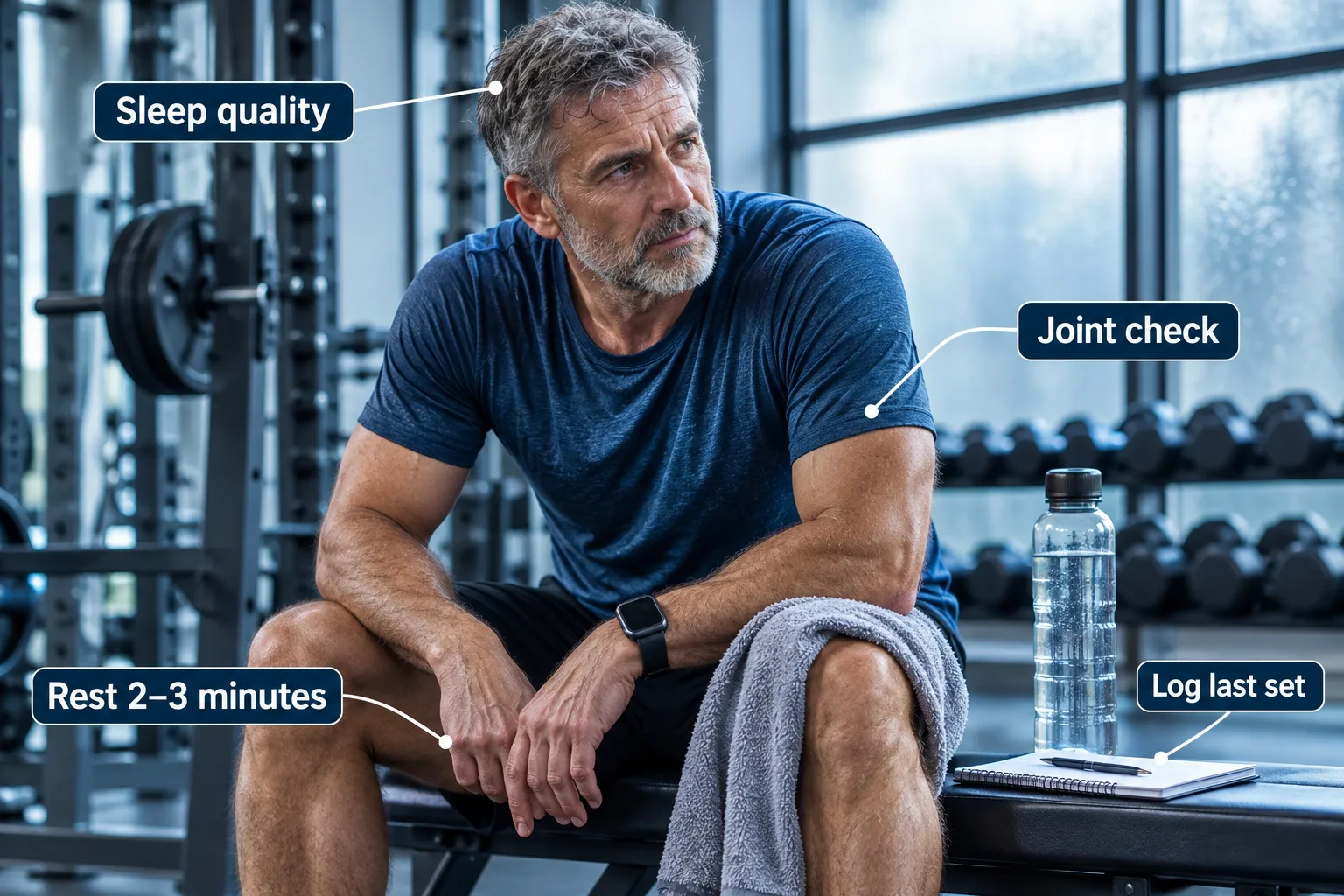
What actually speeds recovery:
- Sleep 7-9 hours. Nothing on this list matters more.
- Protein 1.6-2.2 g per kg bodyweight daily, split across 3-4 meals [4].
- Walk on off days. Light movement beats total rest for soreness.
- Deload every 6-10 weeks by cutting sets roughly in half for one week.
Auto-regulation rule: if a muscle is still clearly sore at the next scheduled session, cut that session's sets by a third. If soreness and performance are fine for two weeks running, add 1-2 sets per muscle group.
Can you still gain muscle mass at 45 or 50? Is it too late to start at 50?
Yes to the first, no to the second. Adults in their 40s, 50s, 60s, and beyond reliably add muscle and strength with progressive resistance training, this is one of the most consistent findings in aging research, and it's the main countermeasure to sarcopenia [1][5]. Beginners starting at 50 often see the fastest relative gains of their lives.
What changes is pace, not possibility: expect perhaps 0.5-1% of bodyweight in muscle per month early on for a true beginner, slowing after the first year. Starting at 50 with two sessions a week and 8-12 weekly sets per muscle is enough to shift strength, posture, and balance within a few months.
Why am I not building muscle even though I'm lifting after 40?
Almost always one of five things, and age is rarely the real culprit. Run this checklist in order.
- No progressive overload. Same dumbbells for six months means no new stimulus. Add reps, then load.
- Sets too easy. If you could do 5 more reps, the set barely counts.
- Not enough protein. Under roughly 1.6 g/kg daily, growth stalls [4].
- Too few weekly sets (under 8) or far too many (over 25) with no recovery.
- Poor sleep or high stress. Chronic short sleep blunts both recovery and appetite for training.
Quick example: a 47-year-old doing 3 sets of 12 push-ups twice weekly for a year isn't stalled by age, the stimulus hasn't changed. Adding a weighted press at 6-8 reps usually restarts progress inside a month.
What's the best workout routine for men and women over 40?
A three-day full-body or upper/lower plan built on six movement patterns: squat, hinge, push, pull, carry, and core. Men and women over 40 need the same patterns and rep ranges; differences are individual, not sex-based, though women often tolerate slightly higher reps and shorter rest comfortably.
Starter template (3 days/week, ~45-55 minutes):
- Squat pattern (goblet squat or leg press): 3 × 8-10
- Hinge pattern (Romanian deadlift or hip thrust): 3 × 8-10
- Horizontal push (dumbbell bench or push-up): 3 × 8-12
- Horizontal pull (one-arm row): 3 × 10-12
- Vertical push or pull (overhead press / lat pulldown): 3 × 8-12
- Loaded carry: 3 × 30-40 seconds
- Core (dead bug or side plank): 2-3 sets
Rotate one heavier day (5-6 reps) in once you've run the template for 6-8 weeks. Add two to three short cardio sessions weekly for heart health [2][3].
Common mistakes people make lifting weights after 40
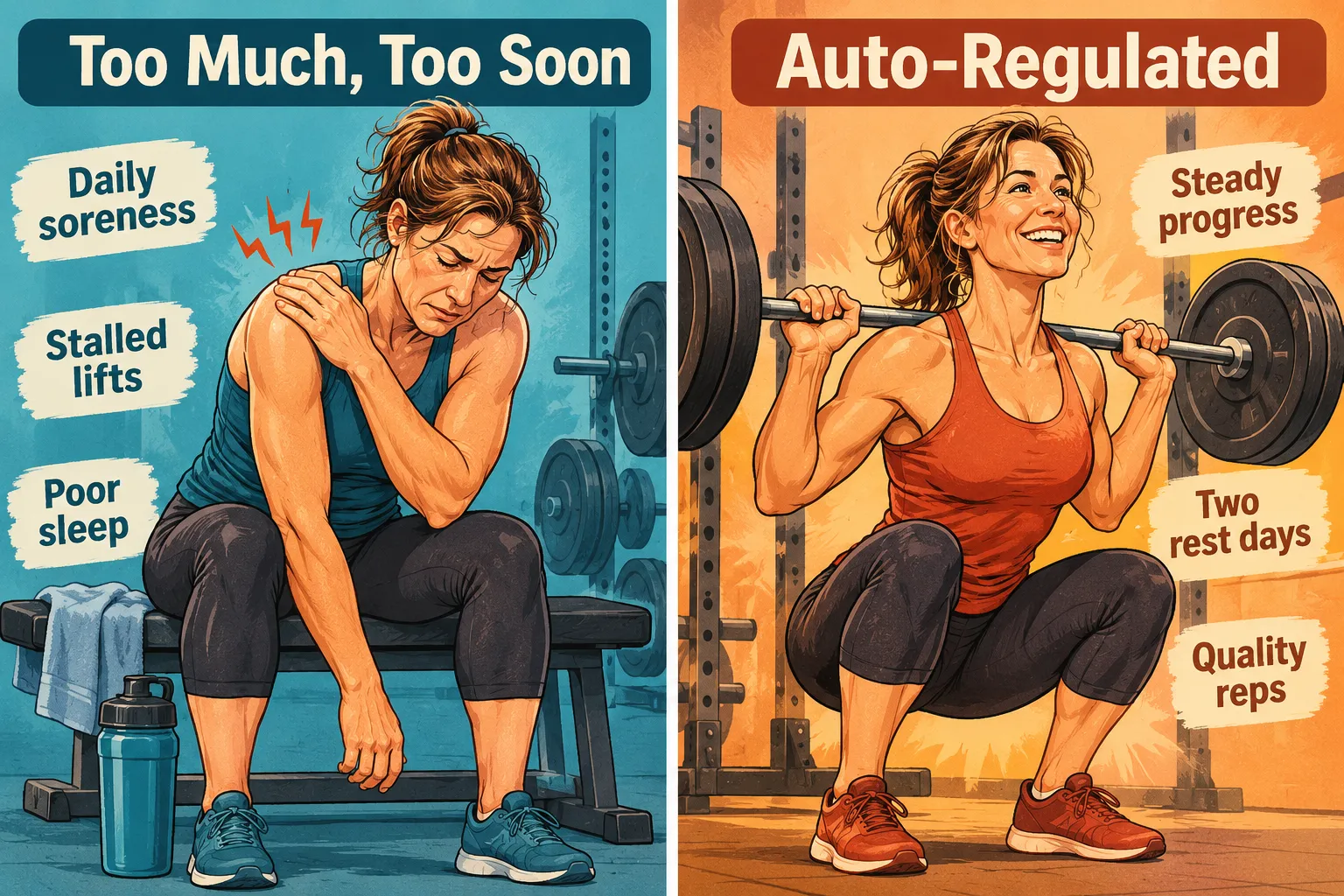
The biggest error is training like a 22-year-old on Monday and nothing for the rest of the week. Consistency across 2-3 moderate sessions beats one heroic workout every time.
- Skipping the warm-up and jumping straight into heavy sets.
- Chasing soreness as proof of a good session, soreness tracks novelty, not growth.
- Ego-loading on exercises your joints dislike instead of swapping the variation.
- Ignoring legs and pulling muscles, which drives posture and fall-risk problems later.
- No deloads. Volume creeps up until sleep and lifts both decline.
- Quitting after 6 weeks because the mirror hasn't changed yet.
What if I have joint pain or arthritis and want to lift weights?
Lift anyway, but change the variation, range, and load rather than stopping. Resistance training generally improves joint pain and function in arthritis when loads are tolerable and progression is gradual [1][2]. Pain during a set that stays at or below a mild level, and settles within 24 hours, is usually acceptable.
Practical swaps:
- Knee pain: leg press or box squat instead of deep barbell squats.
- Shoulder pain: neutral-grip dumbbell press or landmine press instead of barbell bench.
- Low back pain: hip thrusts and trap-bar deadlifts instead of conventional deadlifts.
- Elbow pain: cable or machine work; reduce grip-heavy volume for 2-3 weeks.
Stop and consult a physiotherapist for sharp pain, swelling, locking, or pain that lingers more than 48 hours.
How long does it take to see muscle gains after 40?
Expect noticeable strength improvement in 2-4 weeks (mostly nervous system), visible muscle change in 8-16 weeks, and clear body-composition change by 6 months of consistent training plus adequate protein [4][6]. Clothes fitting differently usually arrives before the mirror shows much.
Track it properly: log loads and reps, measure waist and arm circumference monthly, and take photos every 8 weeks in the same light. Scale weight alone is a poor measure when muscle rises and fat falls at once.
FAQ
How many sets per workout is enough after 40?
Roughly 12-20 hard sets total per session, spread across 4-6 exercises, is plenty for most people training 3 days a week.
Should I lift to failure after 40?
Rarely. Stop 1-3 reps short on compound lifts. Failure is acceptable occasionally on machines and single-joint moves where the injury risk is low.
Is two days a week enough?
Yes. Two full-body sessions covering all six movement patterns maintain and even build muscle for most adults over 40.
How long should rest between sets be?
2-4 minutes for heavy sets of 3-6 reps, 90-120 seconds for 6-15 reps, 60-90 seconds for isolation work.
Do I need supplements?
No, but protein powder helps hit 1.6-2.2 g/kg daily, and creatine monohydrate (3-5 g/day) is among the best-supported aids for strength in older adults.
Does cardio cancel out muscle gains?
Not at normal volumes. Keep hard cardio on separate days or after lifting, and heart-health benefits stack with strength work [2].
What if I only have 30 minutes?
Do three exercises, one squat or hinge, one push, one pull, for 3 sets each with short rests. That covers most of the benefit.
Is machine training fine, or do I need free weights?
Machines are fine and often better for joint-sensitive lifters. Free weights add balance and coordination demands; a mix works best.
Conclusion
Age changes the dials, not the formula. Pick your range, 3-6 reps for strength, 6-15 for size, 8-12 for maintenance, keep weekly volume between about 8 and 20 hard sets per muscle group, and train each area 2-3 times a week. Then let soreness, sleep, bar speed, and your calendar tell you when to add sets and when to pull back.
Next steps this week:
- Pick two or three fixed training days and put them in your calendar.
- Run the starter template at 8-10 weekly sets per muscle group for four weeks.
- Log every set and aim to add one rep or a small load jump each session.
- Set a protein target in grams and hit it on training days first.
- Reassess at week 4: progressing and recovering well? Add 1-2 sets per muscle group.
References
- Resistance Training for Older Adults Position. nsca.com.
- What Are the Benefits of Strength Training After Age 40. ochsner.org.
- How to Exercise After 40. blogs.bcm.edu.
- Muskelaufbau Ab 40. kineo-physiotherapie.ch.
- Pmc8775372. pmc.ncbi.nlm.nih.gov.
- Strength Training After 40. repfitness.com.