Last updated: October 18, 2026
Quick answer
Testosterone falls roughly 1% to 2% per year after about age 30 to 40, but that slow drift is rarely the reason a man over 40 stops gaining muscle. Far more often, the culprits are poor sleep, excess visceral fat, under-eating protein and calories, and a training program with no real progressive overload. Testosterone Decline After 40: How to Improve the Strength-Training Response Naturally starts with fixing those modifiable variables, because the muscle-building machinery stays responsive to hard training well into the sixties and beyond, even at the lower end of the normal hormone range.
Key takeaways
- Normal age-related decline is gradual. Total testosterone drops about 1% to 2% yearly after age 30 to 40 [5]. That alone doesn't explain sudden strength loss.
- Comorbidities matter more than birthdays. Obesity, type 2 diabetes, sleep apnea, and chronic opioid use drive most clinically low readings in middle-aged men [1][7].
- Healthy, lean, active men often keep normal levels into their seventies. Metabolic health is the strongest modifiable predictor.
- Resistance training doesn't permanently raise baseline testosterone much, but it dramatically improves how muscle responds to the hormone you already have.
- Sleep is the most underrated lever. Most testosterone release happens during sleep; 7 to 9 hours is the practical target [9].
- Losing visceral fat reduces aromatase activity, the enzyme that converts testosterone to estradiol.
- Most "testosterone booster" supplements don't work. Only correcting a true vitamin D, zinc, or magnesium deficiency shows reliable benefit [3][4].
- Testosterone therapy is for diagnosed hypogonadism confirmed by two morning blood tests plus symptoms, not for normal aging [1][2].
- Expect 8 to 12 weeks of consistent lifting before strength and body-composition changes are clearly measurable.
What is a normal testosterone level for men over 40?
Most laboratories report a normal total testosterone range of roughly 300 to 1,000 ng/dL for adult men, and that reference range does not change simply because a man turns 40. A reading below 300 ng/dL on two separate early-morning tests, combined with symptoms, is the usual threshold for diagnosing hypogonadism [1][2].
A few details change how a result should be read:
- Timing matters. Testosterone peaks in the early morning. A 2 p.m. draw can read 20% to 30% lower than an 8 a.m. draw in the same man.
- One test is never enough. Day-to-day variation is large. Guidelines call for two separate morning measurements before any diagnosis [1].
- Free vs. total. Sex hormone-binding globulin rises with age, so total testosterone can look fine while free (bioavailable) testosterone sits low. If symptoms don't match the total number, ask for free testosterone and SHBG.
Decision rule: If your total testosterone is between 300 and 500 ng/dL and you have symptoms, treat it as a lifestyle and body-composition problem first. Below 300 on two morning tests with clear symptoms, get a full endocrine workup.
How much does testosterone drop after 40, and why does it decline with age?
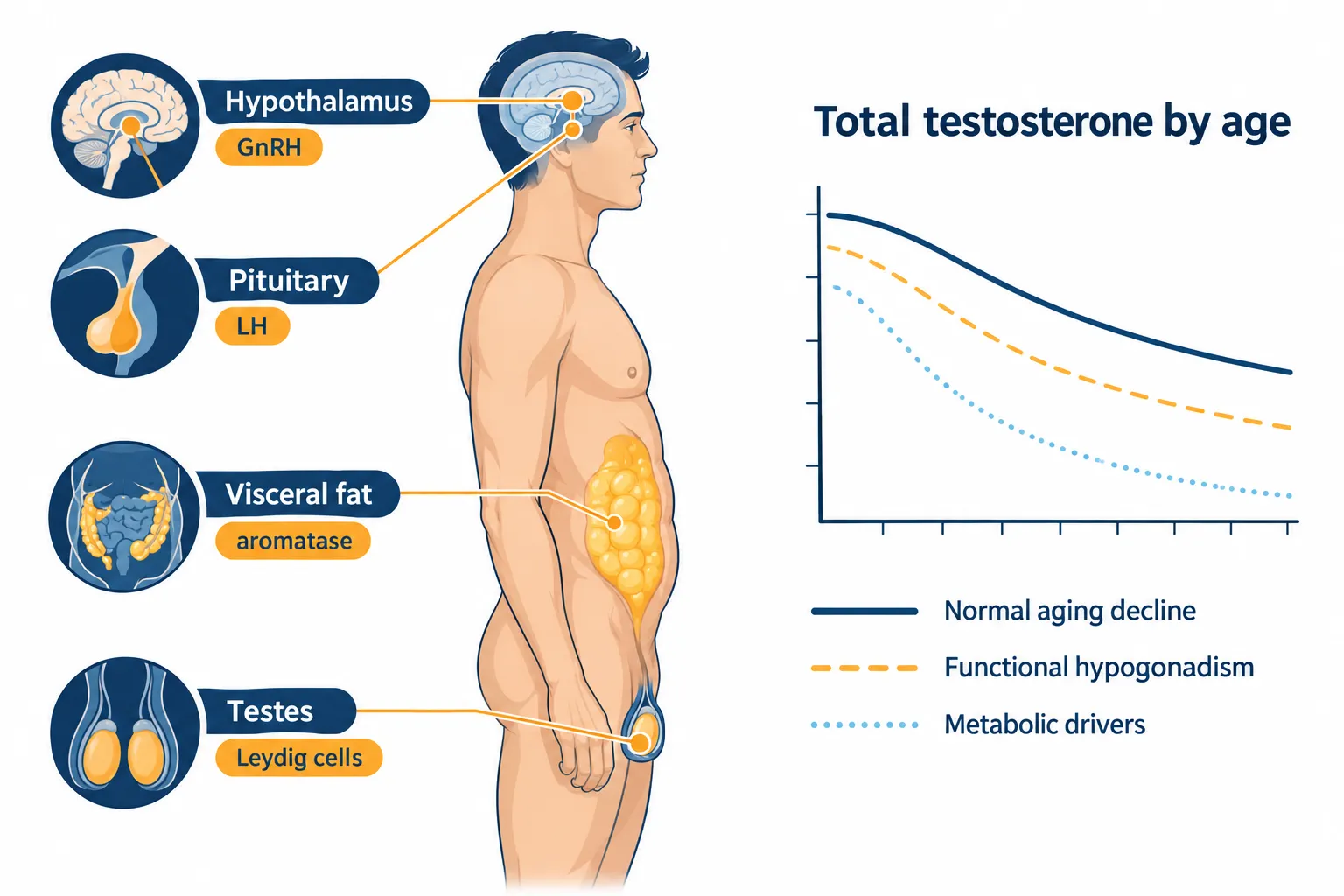
Testosterone declines about 1% to 2% per year starting in a man's thirties, which means a typical 50-year-old sits noticeably below his 25-year-old self but usually still inside the normal range [5]. The decline comes from changes at several points in the hormonal chain, not one single failure.
What drives the drop:
- Testicular aging. Leydig cells, which produce testosterone, decline in number and output.
- Weaker brain signaling. The hypothalamus and pituitary send less robust LH pulses with age.
- Rising SHBG. More testosterone gets bound and becomes biologically unavailable.
- Visceral fat and aromatase. Abdominal fat converts testosterone into estradiol, which further suppresses the signal from the brain.
- Accumulated illness. Obesity, insulin resistance, sleep apnea, and chronic medication use (especially opioids and glucocorticoids) suppress production independently of age [1][7].
That last point is the one most men miss. Research into functional hypogonadism has shifted the framing: in middle-aged and older men, low readings usually track with comorbidities rather than chronological age [7]. Population-level testosterone has also drifted down over the past several decades, which points toward obesity rates, sedentary behavior, and environmental factors rather than aging alone.
Is testosterone decline after 40 normal, or should you worry?
A slow decline with no symptoms is normal and does not require treatment. Worry is justified when the decline is steep, symptomatic, or paired with other red flags, because those patterns often point to a treatable underlying condition rather than aging.
Low testosterone symptoms men should watch for:
- Persistently low libido and fewer spontaneous morning erections
- Erectile dysfunction that doesn't respond to lifestyle changes
- Unexplained loss of muscle mass and strength despite consistent training
- New central weight gain, especially around the abdomen
- Fatigue that sleep doesn't fix, low mood, or irritability
- Reduced body hair, hot flashes, or breast tenderness (less common, more specific)
- Poor concentration and loss of motivation
Get evaluated promptly if you also have headaches or vision changes (possible pituitary issue), testicular pain or shrinkage, loud snoring with daytime sleepiness (sleep apnea), or you're on long-term opioids or steroids.
Common mistake: attributing every symptom to hormones. Fatigue, low mood, and poor gym performance overlap heavily with depression, iron deficiency, thyroid disease, and simple under-recovery. Rule those out too.
Can you increase testosterone naturally after 40?
Yes, within limits. Natural strategies can meaningfully raise testosterone in men whose levels are suppressed by obesity, poor sleep, heavy alcohol use, or chronic under-eating, but they won't push a healthy man's levels far above his genetic baseline [9].
The honest framing: natural methods restore what's being suppressed. They don't create supraphysiologic levels.
The highest-yield changes, ranked by expected impact:
| Lever | Who benefits most | Realistic timeframe |
|---|---|---|
| Lose visceral fat (if waist > 40 in / 102 cm) | Men with central obesity | 3-6 months |
| Fix sleep to 7-9 hours | Anyone sleeping under 6 hours | 2-6 weeks |
| Resistance train 3-4x weekly | Sedentary or detrained men | 8-12 weeks |
| Correct vitamin D / zinc deficiency | Only those actually deficient | 8-12 weeks |
| Cut heavy alcohol intake | 2+ drinks/day regularly | 4-8 weeks |
| Treat untreated sleep apnea | Loud snorers, daytime fatigue | 1-3 months |
| Reduce chronic stress load | High-cortisol lifestyles | Ongoing |
Does strength training increase testosterone in older men?
Resistance training produces a short, sharp testosterone spike during and after hard sessions, but it causes only modest changes in resting baseline levels in older men. The real benefit is that training makes muscle tissue far more responsive to the androgens already circulating, which is why men in their fifties and sixties still gain measurable strength and muscle.
Think of it as two separate systems:
- Hormone production changes a little with training.
- Androgen receptor density, satellite cell activity, and muscle protein synthesis change a lot.
The second system is where the strength-training response lives, and it stays trainable. This is the central point of Testosterone Decline After 40: How to Improve the Strength-Training Response Naturally, stop chasing the number on a lab slip and start improving tissue sensitivity through progressive overload.

Edge case: Chronic overtraining with inadequate calories does the opposite. Men who pile on high-volume lifting plus daily cardio while eating in a steep deficit often see testosterone fall and strength stall. Energy availability is a prerequisite, not an afterthought.
What are the best exercises to boost testosterone in men over 40?
The most effective exercises are heavy, multi-joint compound lifts loaded progressively, supported by short bouts of high-intensity interval work. Large muscle mass recruited under meaningful load produces the strongest acute hormonal and adaptive response.
Core movement pattern template:
- Squat pattern: back squat, front squat, goblet squat, leg press
- Hinge pattern: trap-bar deadlift, Romanian deadlift, hip thrust
- Horizontal push/pull: bench press, dumbbell press, barbell row, chest-supported row
- Vertical push/pull: overhead press, pull-up or lat pulldown
- Loaded carry: farmer's walk, suitcase carry
A workable week for a 45-year-old lifter:
- Monday: Lower body, heavy. Squat 4×5, RDL 3×6, split squat 3×8, calf work.
- Tuesday: Upper body, heavy. Bench 4×5, row 4×6, overhead press 3×8, pull-ups 3×max.
- Thursday: Lower body, moderate. Trap-bar deadlift 4×6, leg press 3×10, hamstring curl 3×12, carries.
- Friday: Upper body, moderate. Incline dumbbell press 4×8, lat pulldown 4×10, lateral raise 3×15, arms.
- Saturday (optional): 8-10 sprint or bike intervals of 15-20 seconds, full recovery between.
Programming rules that matter most after 40:
- Progressive overload is non-negotiable. Add weight, reps, or sets week to week and log it. Training without a logbook is how a decade of lifting produces no change.
- Keep most work sets 1-3 reps shy of failure. Repeated true failure raises fatigue and joint stress without proportional gains.
- Prioritize recovery capacity. Most men over 40 do better on 3-4 lifting days than 6, with a deload every 4-8 weeks.
- Protect joints. Trap-bar over straight-bar deadlifts, neutral-grip pressing, and a thorough warm-up prevent the injuries that derail progress.
How long does it take to see testosterone results from lifting?
Expect subjective improvements in energy and mood within 2 to 4 weeks, measurable strength gains by 6 to 8 weeks, and visible body-composition change at 10 to 16 weeks. Resting testosterone itself, if it moves at all, typically takes 8 to 12 weeks of consistent training plus fat loss to shift noticeably.
A realistic timeline:
- Weeks 1-3: Neural adaptations. Lifts go up fast, muscle size barely changes. Sleep often improves.
- Weeks 4-8: Genuine hypertrophy begins. Waist measurement usually starts dropping if diet is controlled.
- Weeks 9-16: Visible change, better insulin sensitivity, and the point where a repeat morning blood test becomes worth doing.
- Beyond 6 months: Gains slow but continue. Consistency, not program novelty, drives them.
Common mistake: retesting blood work after three weeks and concluding nothing works. Hormonal change follows body-composition change, which takes months.
What foods help increase testosterone naturally, and do any supplements work?
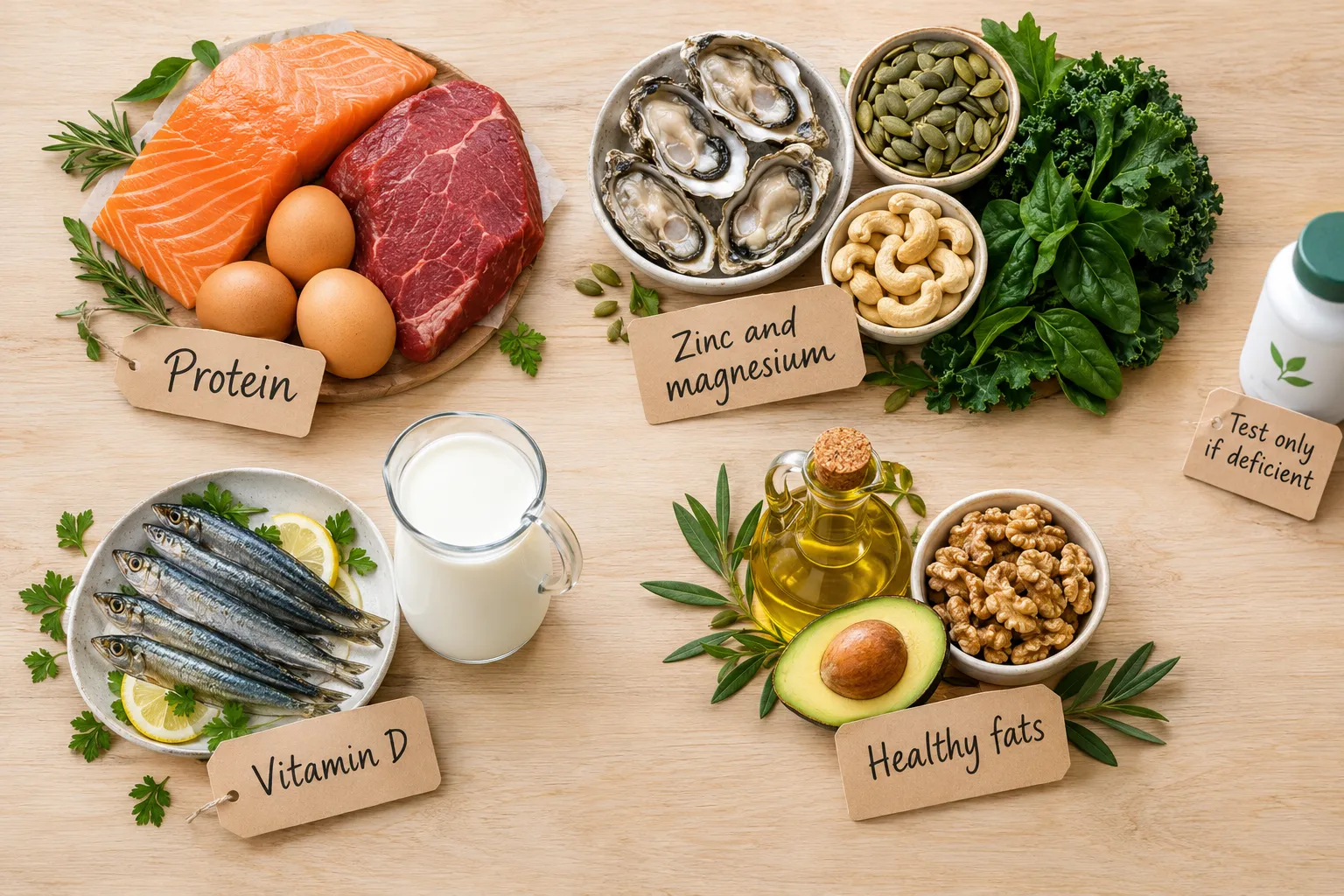
Food supports testosterone mainly by correcting deficiencies and supporting a healthy body weight, not by directly stimulating production. A diet with adequate protein, sufficient total calories, healthy fats, and good sources of zinc, magnesium, and vitamin D covers nearly everything that matters [8][9].
Foods worth building meals around:
- Protein: eggs (including yolks), lean beef, salmon, sardines, poultry, Greek yogurt. Target roughly 1.6 g per kg of body weight daily for lifters.
- Zinc: oysters, beef, pumpkin seeds, cashews, chickpeas.
- Magnesium: spinach, almonds, black beans, dark chocolate.
- Vitamin D: fatty fish, egg yolks, fortified dairy, plus sensible sun exposure.
- Healthy fats: olive oil, avocado, nuts. Very low-fat diets are associated with lower testosterone.
Two dietary mistakes that suppress hormones: chronic severe calorie restriction, and heavy alcohol intake. Both reliably lower testosterone and blunt training recovery.
Supplements that actually work for testosterone
Only a short list has credible support, and most of it depends on correcting a deficiency rather than adding a boost [3][4]:
- Vitamin D, helpful if your blood level is low; little effect if it's already adequate.
- Zinc, helpful in deficiency, common in heavy sweaters and restricted diets.
- Magnesium, modest evidence, mainly in deficient or heavily training men.
- Creatine monohydrate, doesn't raise testosterone, but it's the best-evidenced supplement for strength and lean mass after 40. Take it anyway.
- Ashwagandha, some small trials suggest modest benefit on testosterone and stress markers; evidence is limited.
Skip or stay skeptical of: tribulus, D-aspartic acid, "proprietary blend" test boosters, and anything advertised with before-and-after photos [3][4].
How do sleep and recovery affect testosterone in men over 40?
The bulk of daily testosterone release happens during sleep, especially deep and REM stages, so short or fragmented sleep directly suppresses production. Aiming for 7 to 9 hours nightly is one of the fastest, cheapest ways for a man over 40 to improve both hormone levels and training response [9].
Practical sleep protocol:
- Fixed wake time, seven days a week. Anchor the rhythm before anything else.
- Last caffeine 8-10 hours before bed. Half-life climbs with age.
- No alcohol within 3 hours of sleep. It fragments REM badly.
- Cool, dark room. Blackout curtains beat sleep supplements.
- Screen for sleep apnea if you snore loudly, wake unrefreshed, or have a collar size over 17 inches. Untreated apnea is a major and reversible cause of low testosterone.
Other recovery levers: manage chronic stress (sustained cortisol suppresses the hormonal axis), stop smoking, keep alcohol under modest weekly limits, and avoid long-term opioid use where alternatives exist [1][7].
Testosterone replacement therapy vs. natural methods: which is right?
Testosterone replacement therapy (TRT) is appropriate for men with confirmed hypogonadism, meaning two low morning blood tests plus consistent symptoms, ideally with a cause identified. For men whose levels are low-normal and whose symptoms stem from obesity, poor sleep, or inactivity, lifestyle change is the better first step [1][2].
| Natural optimization | Testosterone therapy | |
|---|---|---|
| Best for | Low-normal levels, modifiable risk factors | Confirmed hypogonadism with symptoms |
| Diagnosis needed | None | Two morning tests + symptoms [1] |
| Effect on fertility | Neutral or improves it | Suppresses sperm production |
| Commitment | Habit change, ongoing | Often lifelong; stopping drops levels further |
| Monitoring | Periodic blood work | Regular testosterone, hematocrit, PSA checks [2] |
| Known risks | Minimal | Polycythemia, acne, sleep apnea worsening, infertility; cardiovascular questions remain under study [1][2] |
| Cost | Low | Prescription plus labs, indefinitely |
Choose natural methods first if your waist is above 40 inches, you sleep under 6 hours, you drink heavily, or you haven't trained consistently in years. Those are the exact conditions that produce reversible low readings.
Choose medical evaluation if symptoms are severe, levels are clearly below 300 ng/dL on repeat morning testing, or there are signs of pituitary or testicular disease. Clinical reviews emphasize that TRT is frequently prescribed outside guideline criteria, so push for proper diagnosis before starting [1].
Can you build muscle with lower testosterone levels?
Yes. Men in the low-normal testosterone range build muscle and strength effectively when training, protein intake, and sleep are in place. Training variables explain far more of the variation in results than small differences in hormone levels do.
What actually limits muscle growth after 40:
- Inadequate progressive overload (the biggest factor by far)
- Protein intake below about 1.6 g/kg/day
- Chronic calorie deficit without a deliberate reason
- Sleep debt
- Inconsistency across months, not weeks
Quick example: Two 48-year-old men with identical testosterone of 380 ng/dL. One lifts four times weekly with a logged, progressing program, eats 150 g of protein, and sleeps 8 hours. The other trains sporadically, eats 70 g of protein, and sleeps 5.5 hours. After six months their bodies look nothing alike, and the hormone number was never the variable that separated them.
FAQ
Is 400 ng/dL low for a 45-year-old?
It sits in the lower part of the normal range, not the deficient range. If symptoms are present, address sleep, body fat, and training first, and recheck in three months.
Does lifting weights raise testosterone permanently?
No. Resistance training causes temporary post-exercise spikes and modest baseline changes, but its main value is improving how muscle responds to existing testosterone.
Should testosterone be tested in the morning?
Yes. Levels peak early, so blood draws should happen between 7 and 10 a.m., fasted when possible, and confirmed with a second test [1].
Do testosterone booster supplements work?
Most don't. Only correcting a genuine vitamin D, zinc, or magnesium deficiency has reliable support; proprietary blends and tribulus lack good evidence [3][4].
Does losing belly fat raise testosterone?
Often yes. Visceral fat converts testosterone to estradiol via aromatase, so reducing it commonly improves measured levels in men with central obesity.
How many days a week should a man over 40 lift?
Three to four well-structured sessions per week suit most men over 40, balancing a progressive training stimulus against slower recovery.
Can low testosterone be reversed without medication?
Functional cases driven by obesity, sleep apnea, heavy alcohol use, or inactivity often improve substantially with lifestyle change. Primary testicular or pituitary failure usually does not [7].
Does TRT cause infertility?
Testosterone therapy suppresses sperm production and can cause infertility, which is why men who want children should discuss alternatives with a specialist first [2].
How much protein is needed to build muscle after 40?
Roughly 1.6 g per kilogram of body weight daily, spread across three or four meals, supports muscle protein synthesis in older lifters.
Is HIIT or steady cardio better for testosterone?
Short high-intensity intervals appear more favorable than high-volume endurance work, which can suppress testosterone when combined with low energy intake.
Conclusion
Testosterone falls slowly after 40 for nearly every man, and in most cases that decline isn't what's standing between you and a stronger body. Low sleep, visceral fat, insufficient protein, and training without progression do far more damage than a 1% annual hormonal drift. The sequence that works is simple and well supported: train hard and progressively, sleep 7 to 9 hours, eat enough protein and total calories, shrink your waist, and test your blood properly before considering medication [1][2][9].
Start this week:
- Book an 8 a.m. blood test for total and free testosterone, SHBG, vitamin D, and HbA1c.
- Measure your waist at the navel and write it down.
- Set a fixed wake time and a caffeine cutoff.
- Begin a 4-day lifting program built on squat, hinge, push, pull, and carry, with every set logged.
- Hit a protein target of about 1.6 g/kg daily.
- Reassess at 12 weeks: waist, lifts, sleep, symptoms, then repeat blood work.
If symptoms stay severe and morning testosterone is repeatedly below 300 ng/dL, see a physician for a proper hypogonadism workup rather than a direct-to-consumer clinic.
References
[1] Lown Right Care Testosterone Replacement Therapy – https://www.aafp.org/afp/2026/0900/lown-right-care-testosterone-replacement-therapy
[2] Art 20045728 – https://www.mayoclinic.org/healthy-lifestyle/sexual-health/in-depth/testosterone-therapy/art-20045728
[3] Best Testosterone Booster Supplements – https://www.healthline.com/nutrition/best-testosterone-booster-supplements
[4] The Best Testosterone Boosters For Men Over 50 – https://www.webmd.com/healthy-aging/the-best-testosterone-boosters-for-men-over-50
[5] The Aging Male Testosterones Role In Healthy Aging – https://mcpress.mayoclinic.org/healthy-aging/the-aging-male-testosterones-role-in-healthy-aging/
[6] pubmed.ncbi.nlm.nih.gov – https://pubmed.ncbi.nlm.nih.gov/41655564/
[7] Andr – https://onlinelibrary.wiley.com/doi/10.1111/andr.70147
[8] Natural Foods For Testosterone Booster – https://www.medicalnewstoday.com/articles/natural-foods-for-testosterone-booster
[9] How To Increase Testosterone Naturally – https://www.everydayhealth.com/mens-health/how-to-increase-testosterone-naturally/
[10] Pmc13519042 – https://pmc.ncbi.nlm.nih.gov/articles/PMC13519042/