Last updated: August 1, 2026
Quick Answer
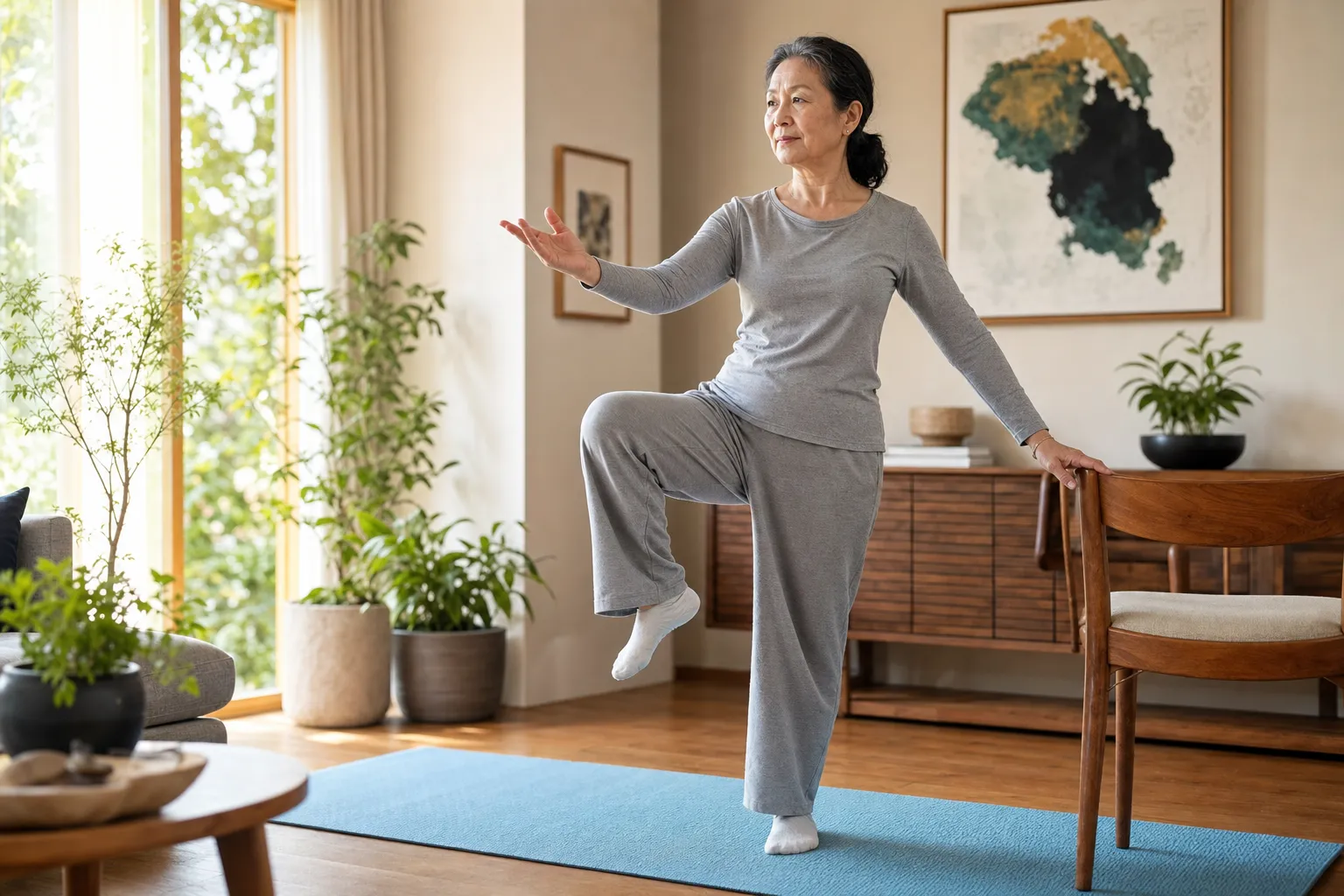
Core strength and balance flow sessions at home to boost mobility and prevent falls combine gentle abdominal and hip work with slow, connected movement patterns borrowed from yoga, tai chi, and Pilates. Done 2-4 times a week for 20-30 minutes, this style of training has been shown in multiple clinical reviews (including the Cochrane 2019 falls-prevention meta-analysis) to cut fall risk in older adults by roughly 20-30%. No gym required, just a sturdy chair, a mat, and a wall.
Key Takeaways
- Frequency matters more than intensity. Three sessions a week for 12 weeks is the sweet spot most research points to.
- Flow beats isolated reps. Linking movements (like a cat-cow into a bird-dog into a side plank) trains the nervous system to react, which is what actually prevents falls.
- A chair is the single most important tool. It doubles as support, a prop, and a resistance anchor.
- Core weakness shows up as poor posture, back pain, and difficulty rising from a chair, not just a soft belly.
- Static balance (holding still) and dynamic balance (moving through space) are different skills. You need both.
- Younger adults benefit too. Balance flow work restores mobility lost to desk jobs and reduces injury risk in sport.
- Most people notice improvements in 2-4 weeks; measurable fall-risk reduction typically appears by week 8-12.
- You do not need a trainer to start, but a one-time video assessment can catch bad form early.
What is core strength and balance training, and why does it prevent falls?
Core strength and balance training is a category of exercise that strengthens the muscles wrapping your trunk, hips, and pelvis, while simultaneously challenging your body's ability to sense and correct its position in space. It prevents falls because most falls happen when the body loses balance mid-movement (stepping off a curb, turning quickly, reaching for something) and the core is too slow or too weak to catch the shift.
Three systems keep you upright: your inner ear (vestibular), your eyes (visual), and your body's position sensors (proprioceptive). Balance flow sessions train all three at once. When you slowly transition from a standing pose to a lunge with your eyes tracking your hand, you're forcing those systems to talk to each other, the exact skill that fails during a real-world stumble.
The core isn't just abs. It's the diaphragm on top, pelvic floor on the bottom, and deep abdominal and back muscles wrapping around like a corset. Weakness anywhere in this cylinder makes balance harder.
How often should I do balance and core exercises to see results?
Aim for 2-4 sessions per week, 20-30 minutes each, for at least 12 weeks. Research on older adults consistently shows this is the minimum "dose" needed to reduce fall risk meaningfully. Fewer than two sessions a week produces mood benefits but limited physical change.
A realistic weekly template:
| Day | Session | Length |
|---|---|---|
| Monday | Core + slow balance flow | 25 min |
| Wednesday | Tai-chi-inspired dynamic flow | 20 min |
| Friday | Pilates-based core + wall balance | 30 min |
| Optional Sun | Gentle mobility walk-through | 15 min |
Choose more frequency (4x) if: you're recovering from a fall, have osteoporosis, or are over 70.
Choose less (2x) if: you're active in other sports and using this as maintenance.
Best core strength exercises for seniors at home
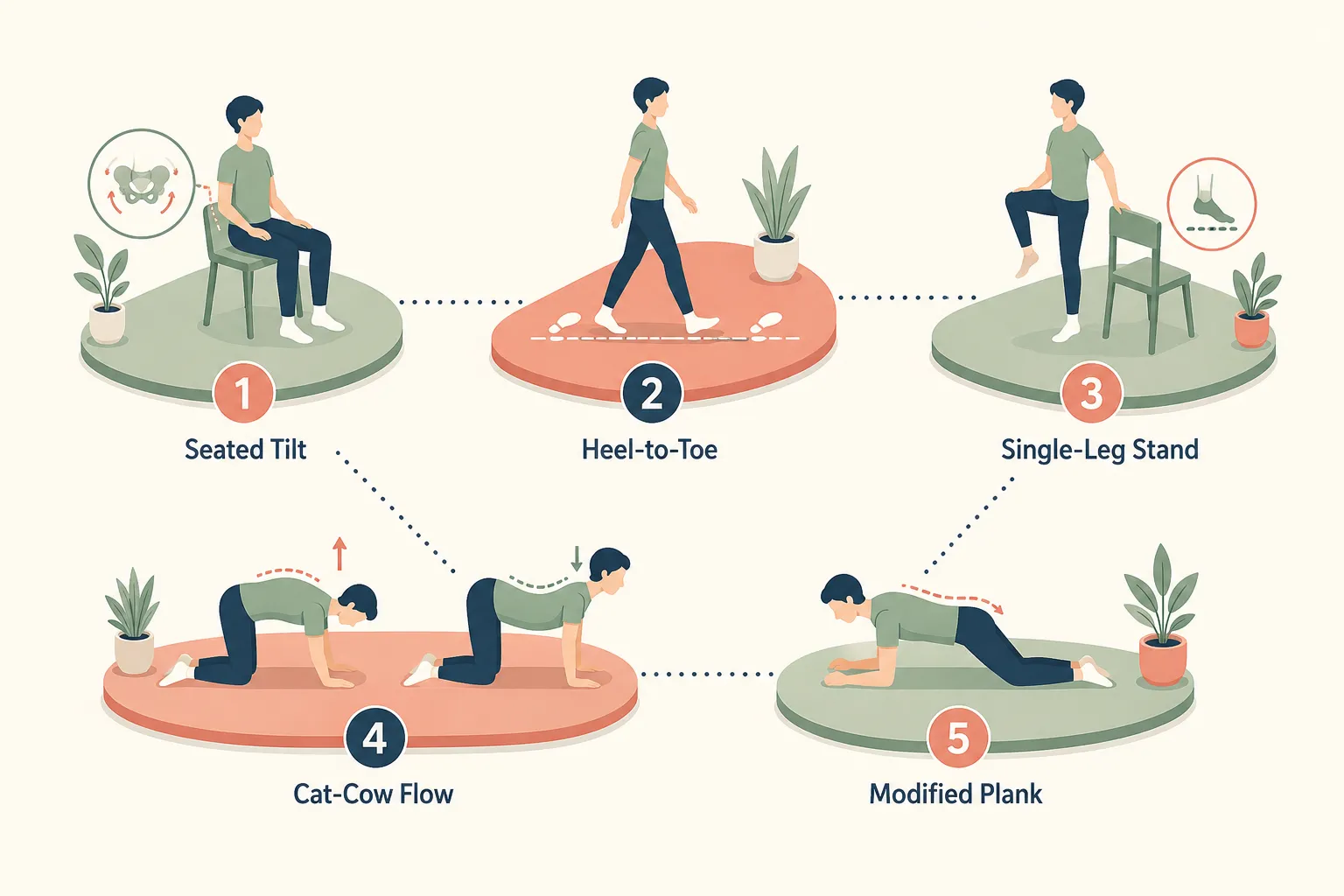
The best exercises are low-impact, chair-optional, and build from stable to unstable positions. Start with these five:
- Seated pelvic tilts, Sit tall, rock the pelvis forward and back 10 times. Wakes up the deep abdominal wall.
- Modified dead bug, Lie on your back, knees bent at 90°, lower one heel to tap the floor, alternate. 8 per side.
- Bird-dog (from hands and knees), Extend opposite arm and leg, hold 3 seconds. 6 per side.
- Standing marches with chair support, Lift knee to hip height, pause, lower. 10 per side.
- Wall sit with breath focus, Slide down a wall to a shallow squat, hold 20-30 seconds while breathing slowly.
)
The trick with older adults: quality over quantity. Six slow, focused reps beat twenty sloppy ones every time.
Can balance training really prevent falls, or does it just help with stability?
Yes, it genuinely prevents falls, not just stability in the moment. The Cochrane systematic review of exercise for fall prevention (Sherrington et al., 2019) analyzed over 100 trials and found that balance and functional training reduced the rate of falls by about 24% in community-dwelling older adults. Tai chi specifically showed roughly a 20% reduction.
The mechanism isn't just stronger legs. Balance flow work:
- Sharpens reaction time in the ankles and hips (the "ankle strategy" and "hip strategy" your brain uses to catch a stumble).
- Improves proprioception, your unconscious sense of where your limbs are.
- Reduces fear of falling, which itself is a major fall predictor. Fearful walkers shuffle, and shuffling causes falls.
Common mistake: People assume walking is enough. It isn't. Walking is linear and predictable; falls happen in unpredictable moments. You need training that mimics the chaos.
What equipment do I need for home balance and core workouts?
Very little. The five essentials:
- A sturdy, non-rolling chair (dining chair, not office chair)
- A yoga mat with grip
- A clear wall space at least 4 feet wide
- Comfortable, snug clothing (loose pants can trip you)
- Bare feet or thin, flexible shoes, cushioned running shoes actually reduce balance feedback
Optional upgrades once you're 4-6 weeks in:
- Balance pad or folded towel ($15-30) for unstable surface training
- Resistance loop bands ($10) for hip strength
- Light dumbbells (2-5 lb) for added core load
Skip: BOSU balls, wobble boards, and vibrating plates until you have a solid base. They're not beginner tools despite the marketing.
How long should a core and balance session be?
Twenty to thirty minutes is the sweet spot for most home practitioners. Shorter than 15 minutes and you can't cover warm-up, main work, and cool-down properly. Longer than 40 minutes and fatigue leads to sloppy form, which is when injuries happen.
A well-built session:
- 5 minutes warm-up: joint circles, gentle spinal rolls, breath work
- 10-15 minutes main flow: core activation → static balance → dynamic balance flow
- 5 minutes cool-down: stretching, floor work, breathing
If you only have 10 minutes, keep the warm-up and cut the main flow in half. Never skip the warm-up before balance work.
Is balance training safe if I already have balance problems?
Yes, but start seated and near support. People with existing balance issues benefit the most from this training, they just need to scale entry appropriately.
Safe-start rules:
- First 2 weeks: do everything seated or with two hands on a chair back.
- Weeks 3-4: progress to one hand on chair.
- Weeks 5+: fingertips only, then hover, then hands free.
Talk to a doctor first if you have: recent surgery, uncontrolled vertigo, severe osteoporosis, Parkinson's-related instability, or you've fallen more than twice in the past year. A physical therapist can screen you and clear you for home practice.
Edge case: If you have inner ear disorders (BPPV, Meniere's), certain head-turning movements can trigger dizziness. Modify by keeping the gaze forward and moving slowly.
Static balance exercises vs. dynamic balance flow, what's the difference?
Static balance is holding still, standing on one foot, tree pose, a plank. Dynamic balance is maintaining control while moving, walking heel-to-toe, transitioning between yoga poses, tai chi weight shifts. You need both, but dynamic balance flow is what most closely mimics real-life fall situations.
| Static Balance | Dynamic Balance Flow | |
|---|---|---|
| What it trains | Postural muscles, endurance | Reaction, coordination |
| Example | Tree pose, single-leg stand | Tai chi form, sun salutation |
| Best for | Beginners, foundation | Real-world fall prevention |
| Time to master | 2-3 weeks | 6-12 weeks |
Rule of thumb: Spend the first month mostly static. Layer in dynamic flow once you can hold single-leg stands for 20 seconds without wobbling.
Online balance classes vs. in-person: what's the cost difference?
Online core and balance classes typically run $10-30 per month for unlimited access (SilverSneakers On-Demand, Yoga with Adriene's free library, GetActive, Bold, Nymbl). In-person classes at a studio or Y average $15-25 per class or $80-150 per month for unlimited. Physical therapy sessions run $75-200 each but often include insurance coverage.
)
Choose online if: you're self-motivated, have basic fitness experience, and want flexibility.
Choose in-person if: you need accountability, have specific medical concerns, or benefit from social exercise.
Choose PT (at least short-term) if: you've fallen recently or have a diagnosed condition. Get cleared first, then transition to home practice.
Can younger people benefit from balance flow, or is it just for older adults?
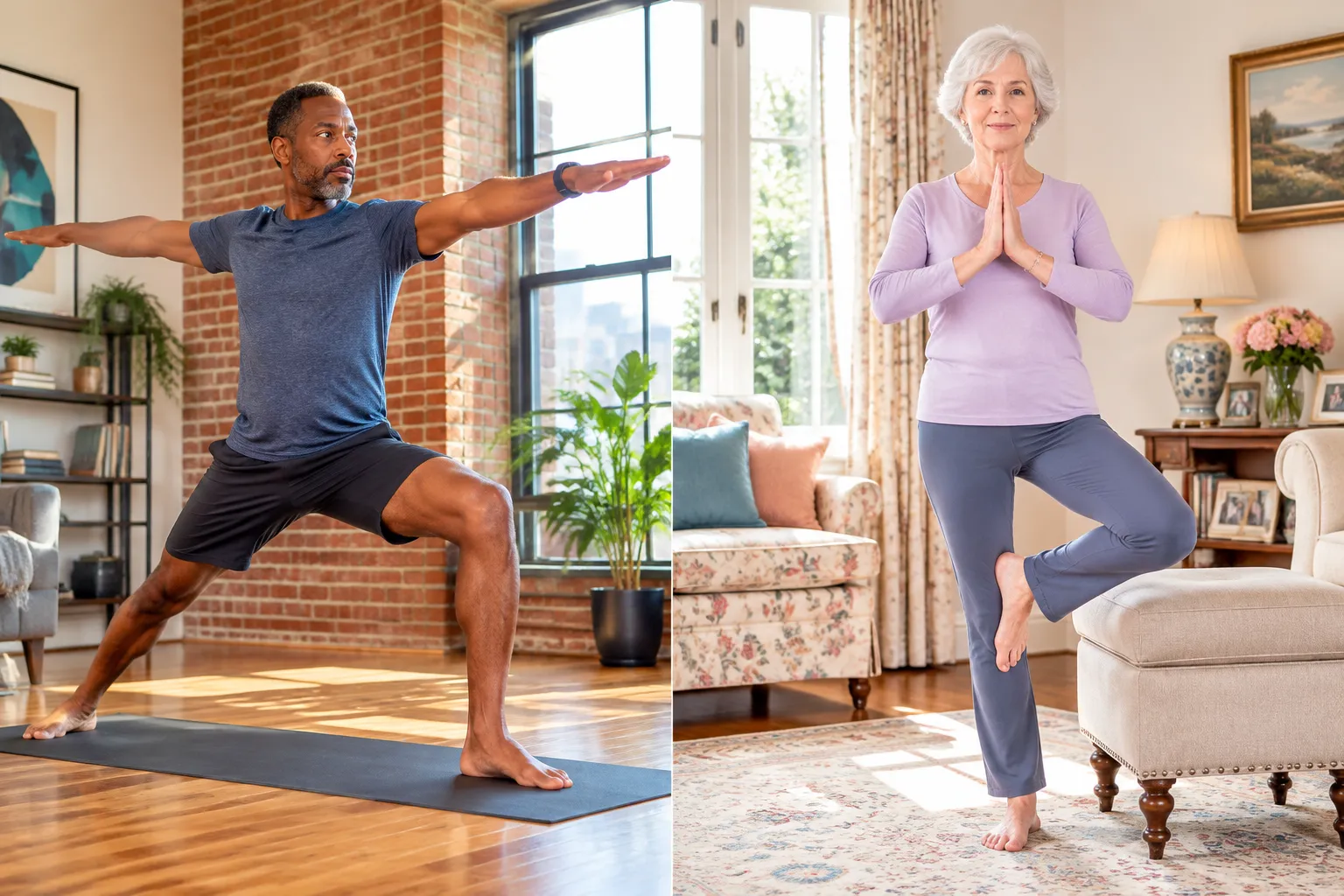
Balance flow benefits every age, it's marketed to seniors because they're the group with the highest fall risk, but adults in their 20s, 50s often have surprisingly poor balance from sedentary jobs. If you can't stand on one foot with eyes closed for 10 seconds, you're behind the curve.
For younger adults, balance flow specifically helps:
- Runners and cyclists, improves single-leg stability, reduces knee and ankle injuries
- Desk workers, reverses hip and thoracic stiffness
- Parents, restores the core control lost during pregnancy or from years of one-sided carrying
- Recreational athletes, sharpens agility and reaction time
The training just scales up: faster flows, less support, more single-leg work, added load.
How do I know if my core is weak and needs work?
Try these four quick self-tests. Struggling with two or more means your core needs attention:
- Sit-to-stand test: Rise from a chair without using your hands. Can you do it 5 times in under 15 seconds?
- Single-leg stand: Balance on one foot with eyes open. Under 20 seconds is a red flag if you're under 65.
- Plank hold: Forearm plank with a straight line from head to heels. Under 30 seconds signals weakness.
- Bend-and-reach: Bend to touch your toes and stand back up. Does your low back hurt or do you feel unstable?
Other signs: chronic low back pain, poor posture when tired, difficulty carrying groceries up stairs, needing hands to push off your thighs when standing.
What mistakes do people make starting balance training at home?
The five most common errors:
- Skipping the warm-up. Cold joints plus balance work equals sprained ankles. Always do 3-5 minutes of joint circles first.
- Progressing too fast. People see quick early gains and jump to advanced moves. The nervous system needs 4-6 weeks to consolidate before adding challenge.
- Holding the breath. Balance requires oxygen to the brain. Breath-holding is a top cause of dizziness during practice.
- Practicing on carpet. Deep pile carpet actually makes balance too unstable for beginners. Firm floor with a mat is better.
- Only training in one direction. Everyone does forward lunges and forgets side and rotational movement, but most real falls involve twisting or lateral shifts.
Do I need a trainer, or can I do core and balance flow on my own?
Most healthy adults can do this on their own using video classes and structured programs. But one or two sessions with a qualified trainer or physical therapist at the start will catch form errors that would otherwise become injuries or plateaus.
Consider a professional if:
- You've fallen in the past year
- You have osteoporosis, arthritis, or a joint replacement
- You're recovering from surgery or a stroke
- You feel dizzy or unstable doing basic moves
- You've been sedentary for over a year
Otherwise, well-structured video programs from certified instructors (look for CPT, PT, or E-RYT credentials) work well. YouTube channels focused on senior fitness, Pilates, and gentle yoga are legitimate starting points.
How quickly will I notice improvements in mobility and balance?
Week 1-2: You'll feel more aware of your body. Balance itself may not improve yet, but posture usually does.
Week 3-4: Single-leg stands get noticeably steadier. Getting out of chairs feels easier.
Week 6-8: Mobility improvements become obvious, reaching, turning, and stair-climbing feel smoother.
Week 8-12: Measurable fall-risk reduction appears in objective tests (Berg Balance Scale, Timed Up and Go).
Week 12+: Gains consolidate. Stopping now means losing progress within 4-6 weeks.
The key: consistency beats intensity. Three 20-minute sessions a week for 12 weeks outperforms one 90-minute weekend session.
FAQ
Q: Can I do balance flow if I use a cane or walker?
A: Yes. Start entirely seated, then progress to standing with two hands on a sturdy surface. Many chair yoga and seated tai chi programs are designed exactly for this.
Q: Will core work flatten my belly?
A: It may improve posture and reduce the visual "pooch" from weak deep abdominals, but visible fat loss requires nutrition changes. Core training is for function first, aesthetics second.
Q: Is yoga or tai chi better for fall prevention?
A: Tai chi has more direct fall-prevention research behind it. Yoga builds more strength and flexibility. A blended flow session gets the best of both.
Q: Can I do this if I have knee pain?
A: Yes, with modifications. Avoid deep squats and kneeling positions; substitute chair-based versions. Knee pain often improves as hip and core strength develop.
Q: What time of day is best?
A: Morning for most people, joints warm up during the session and you gain balance benefits throughout the day. Avoid right before bed if practice energizes you.
Q: Do I need to warm up if the flow is already gentle?
A: Yes. Even gentle balance work challenges the nervous system, and cold muscles react slowly. Five minutes of joint circles is non-negotiable.
Q: Can I combine this with strength training?
A: Absolutely. Do balance flow on strength-training rest days, or as a 10-minute warm-up before lifting.
Q: Will I feel sore?
A: Mild soreness in the deep abdominals, hips, and small stabilizer muscles is normal for the first 2 weeks. Sharp pain is not.
Conclusion: Your Next Steps
Start this week. Not with a 90-minute masterclass, but with one 20-minute session. Set a chair on your mat, watch a beginner-level balance flow video, and commit to three sessions this week.
Concrete action plan:
- Today: Do the four self-assessment tests. Write down your numbers.
- This week: Complete three 20-minute sessions. Any beginner tai chi, chair yoga, or Pilates fundamentals video works.
- Week 2-4: Add one new balance challenge per week (eyes closed briefly, one hand off the chair, a longer hold).
- Week 6: Retest yourself. Compare to week 1.
- Week 12: Reassess. Adjust your program based on what improved most.
Core strength and balance flow sessions at home to boost mobility and prevent falls aren't a quick fix, they're a lifelong maintenance practice, like brushing your teeth. Twenty minutes, three times a week, for the rest of your life is the actual prescription. The payoff, staying independent, mobile, and unafraid of falling, is worth every session.
