AI-Powered Fitness Apps for Seniors: How Movement Assessment Technology Personalizes Your Home Workouts

AI-Powered Fitness Apps for Seniors: How Movement Assessment Technology Personalizes Your Home Workouts

Last updated: August 22, 2026

Quick Answer

AI-powered fitness apps for seniors use your phone or tablet camera to watch how you move, then adjust each workout to match your strength, balance, and mobility. Movement assessment technology maps key joints in real time, flags risky form, and rebuilds your plan as you improve. For older adults exercising at home, this means safer sessions, fewer generic routines, and coaching that actually responds to a stiff hip or a shaky balance day.

Key Takeaways

  • Movement assessment technology uses pose estimation to track 17-33 body joints through a standard smartphone camera, no wearables required for most apps.
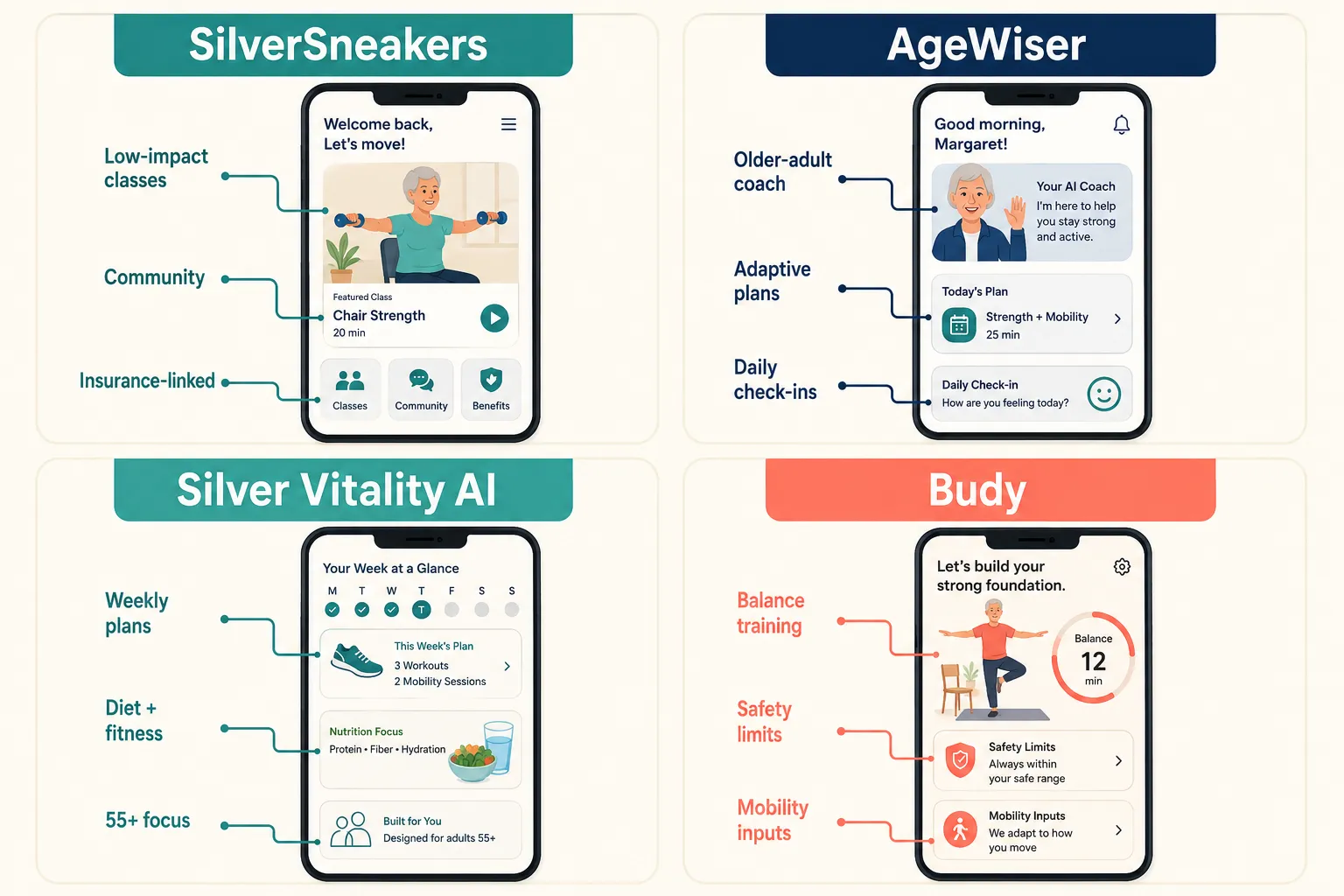
  • Senior-focused apps like AgeWiser, Silver Vitality AI, Budy, and SeniorFit build plans around age, mobility level, and balance status, not generic fitness scores [3][4][13][14].
  • AI form correction is helpful but not a replacement for a physical therapist, especially if you have a diagnosed condition or recent surgery.
  • Many quality options are free or under $15/month, including SilverSneakers (often covered by Medicare Advantage) and web-based tools like SeniorFit [1][13].
  • Apps with chair-based and low-impact modes (SitFit, Ageless Pilates, Tai Chi for Seniors) work well for arthritis, limited mobility, or balance concerns [1][2].
  • You need a phone or tablet with a working camera, roughly 6-8 feet of clear space, and steady lighting, that's it.
  • Best use case: general strength, balance, and mobility maintenance. Not appropriate for: post-op rehab, acute pain, or complex neurological conditions without a clinician's input.

What is movement assessment technology in fitness apps?

Movement assessment technology is computer vision software that watches you exercise through a camera and measures how your body moves in space. It identifies key points on your body, shoulders, hips, knees, ankles, wrists, and tracks how they shift frame by frame during a squat, a reach, or a balance hold.

The app then compares your movement pattern to a reference model and calculates things like:

  • Joint angles (is your knee bending to 90 degrees or only 60?)
  • Range of motion (how far can you rotate your shoulder?)
  • Tempo and symmetry (are both legs doing equal work?)
  • Stability (how much are you swaying during a single-leg stand?)

For seniors, the goal isn't athletic performance. It's catching compensations, like a hip that hikes up during a step-up, or a knee that collapses inward during a sit-to-stand, that predict falls or joint strain.
What is movement assessment technology in fitness apps?

How do AI fitness apps track your form and posture?

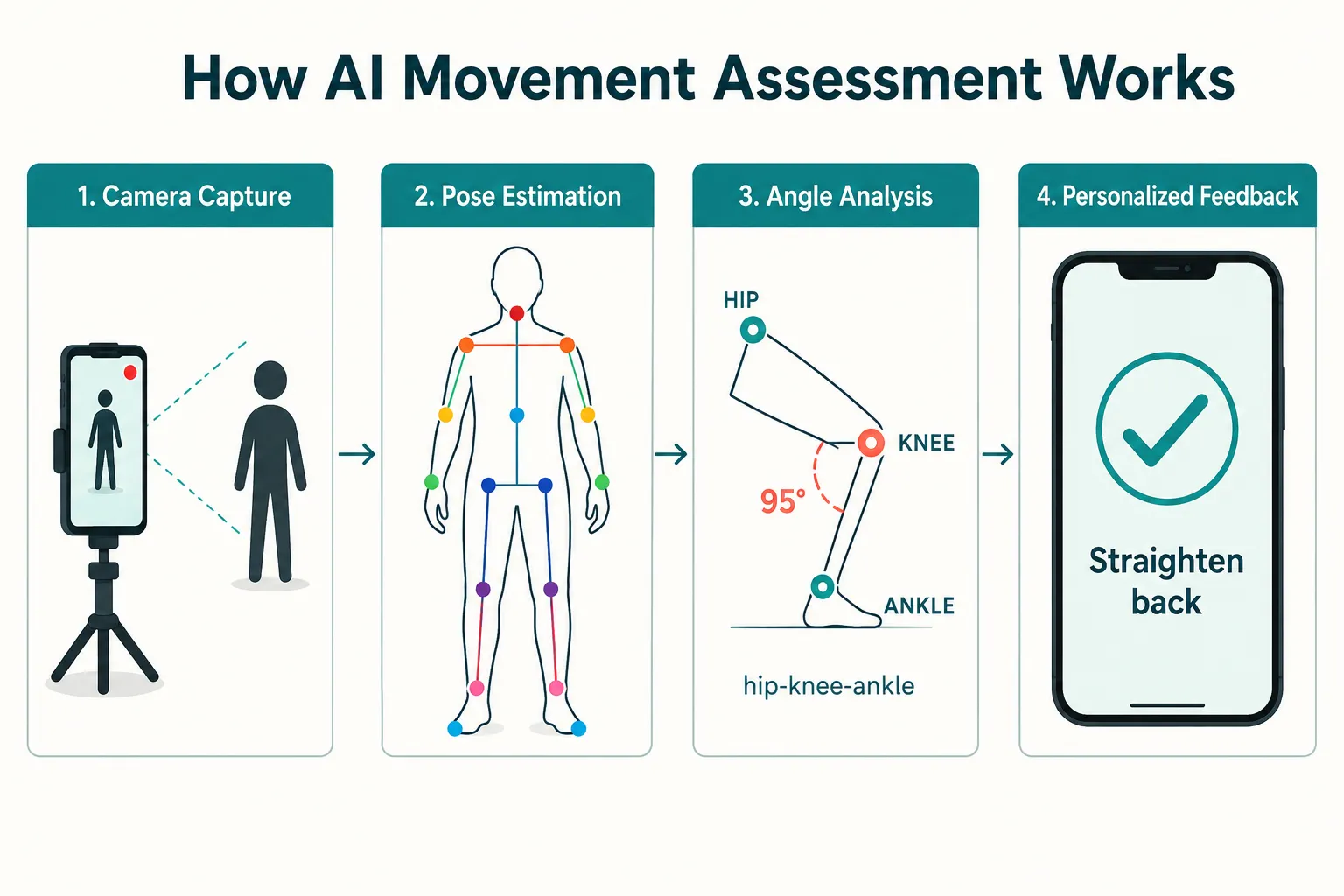
AI fitness apps track form using pose estimation models, the same family of computer vision tech behind gesture control and motion capture. Your phone camera captures 30 frames per second, and the model places digital "landmarks" on your joints in each frame.

Here's the simplified pipeline:

  1. Camera capture, a standard front or rear camera records you.
  2. Pose estimation, the AI locates 17 to 33 body keypoints in each frame.
  3. Angle and motion analysis, software calculates joint angles, velocity, and alignment.
  4. Rule-based or ML feedback, the app checks your numbers against safe ranges and delivers a cue like "straighten your back" or "hold for 2 more seconds."

Most senior-focused apps process this on-device, meaning video doesn't leave your phone. That matters for privacy, always check the app's data policy before use.

What's the difference between AI fitness apps and regular workout apps?

Regular workout apps show you a video and count reps. AI fitness apps watch you back and change what happens next based on how you moved.

Feature Regular Workout App AI-Powered Fitness App
Program design Fixed weekly plan Adaptive, adjusts to performance
Feedback None or manual logging Real-time form cues
Progression Preset weeks Based on your movement data
Injury awareness Generic warnings Flags risky patterns live
Cost Often free,$10/mo Free,$30/mo

For a 68-year-old with arthritic knees, the difference is meaningful. A regular app will keep prescribing lunges. An AI app notices the knee wobble on rep three, swaps to a supported split-squat, and shortens the range of motion automatically [14].

Best AI fitness apps for seniors with arthritis

For seniors with arthritis, the best AI fitness apps prioritize low-impact movement, joint-friendly ranges, and chair-based options. Top picks based on current 2026 offerings:

  • SilverSneakers, low-impact classes and personalized scheduling for older adults, often covered by Medicare Advantage plans [1].
  • Ageless Pilates, gentle mat and standing Pilates with age-appropriate progression [1].
  • SitFit, chair-based routines built for users with joint pain or limited standing tolerance [2].
  • Tai Chi for Seniors, slow, flowing movement that's easier on inflamed joints [1].
  • Reverse Health, adaptive plans for the 40+ and senior demographic with joint-friendly options [2].

Decision rule: If a movement causes sharp joint pain (not muscle fatigue), stop and switch to a seated or supported version. Most of these apps offer that swap built in.
Best AI fitness apps for seniors with arthritis

Can AI fitness apps prevent injury during workouts?

AI fitness apps can reduce injury risk, but they can't guarantee prevention. They help by catching common form errors in real time, rounded backs during hinges, knees caving during squats, holding breath during exertion, that lead to strains and falls over time.

What they do well:

  • Flag deteriorating form as you fatigue
  • Suggest scaled versions when a movement looks unstable
  • Enforce rest days when performance drops
  • Apply "conservative progression and safety boundaries" for older adults [14]

What they can't do:

  • Diagnose pain or medical conditions
  • Detect subtle neurological changes
  • Replace clinical judgment after surgery or injury
  • Sense pain you don't report

If you have a recent injury, hip or knee replacement, or a diagnosed balance disorder, use AI apps as a supplement to a physical therapist's plan, not a replacement.

How much do senior fitness apps with AI cost?

Senior AI fitness apps range from free to about $30 per month, with most quality options between $10 and $20 monthly. Some are covered by Medicare Advantage or supplemental insurance.

General pricing landscape (2026):

  • Free tiers: SeniorFit (web-based, home assessment), FitOn (ad-supported), Workout.cool [1][13]
  • Insurance-linked: SilverSneakers, free with many Medicare Advantage plans [1]
  • Low-cost subscriptions: Daily Yoga, Tai Chi for Seniors, Ageless Pilates, typically $10,$15/month [1]
  • Premium AI coaches: AgeWiser, Silver Vitality AI, Budy, usually $15,$25/month with annual discounts [3][4][14]

Annual billing usually cuts the price 30-50%. Most apps offer 7-day free trials, use them to check whether the interface actually works for you before committing.

Free AI fitness apps for older adults

Yes, several free AI fitness options exist for seniors. The tradeoff is usually fewer personalized features or ad interruptions, but the core movement tracking still works.

Notable free options:

  • SeniorFit, web-based AI assessment with personalized senior exercises, no equipment required [13].
  • FitOn, free classes with optional AI coaching upgrade, includes senior-appropriate categories [1].
  • SilverSneakers, free if your Medicare Advantage plan includes it (check with your insurer) [1].
  • Workout.cool, open catalog of free workouts with basic personalization [1].

Common mistake: Downloading five free apps at once. Pick one, use it for two weeks, then decide. Jumping between apps means none of them build enough movement data to actually personalize your plan.

Do I need special equipment for AI movement tracking?

No special equipment is required for most AI fitness apps beyond a smartphone or tablet with a working camera. That's the appeal, the phone in your pocket is the sensor.

Helpful but optional:

  • A phone stand or tripod ($15,$25) so you're not propping the phone against a book
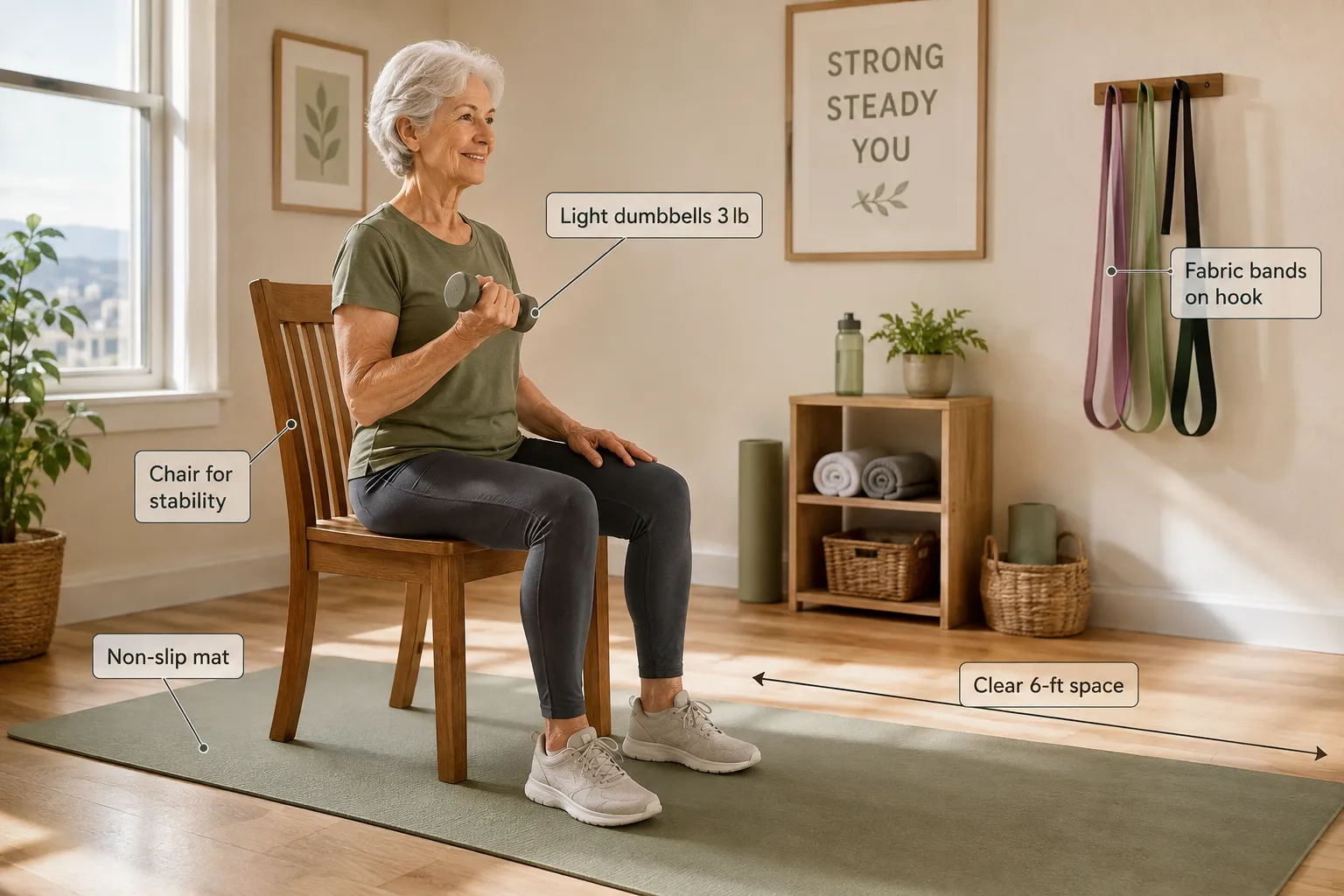
  • A sturdy chair for supported exercises and balance work
  • A non-slip mat for floor exercises
  • Good lighting, a bright room or lamp facing you (backlighting confuses the camera)

Some premium apps integrate with Apple Watch, Fitbit, or Garmin for heart rate data, but wearables aren't required. Web-based tools like SeniorFit run in a browser without any app install [13].

How accurate is AI form correction for seniors?

AI form correction is reasonably accurate for gross movement patterns, squat depth, arm angle, whether you're leaning too far forward, but less accurate for subtle issues like scapular positioning or foot pronation. Accuracy also depends heavily on camera angle and lighting.

What affects accuracy:

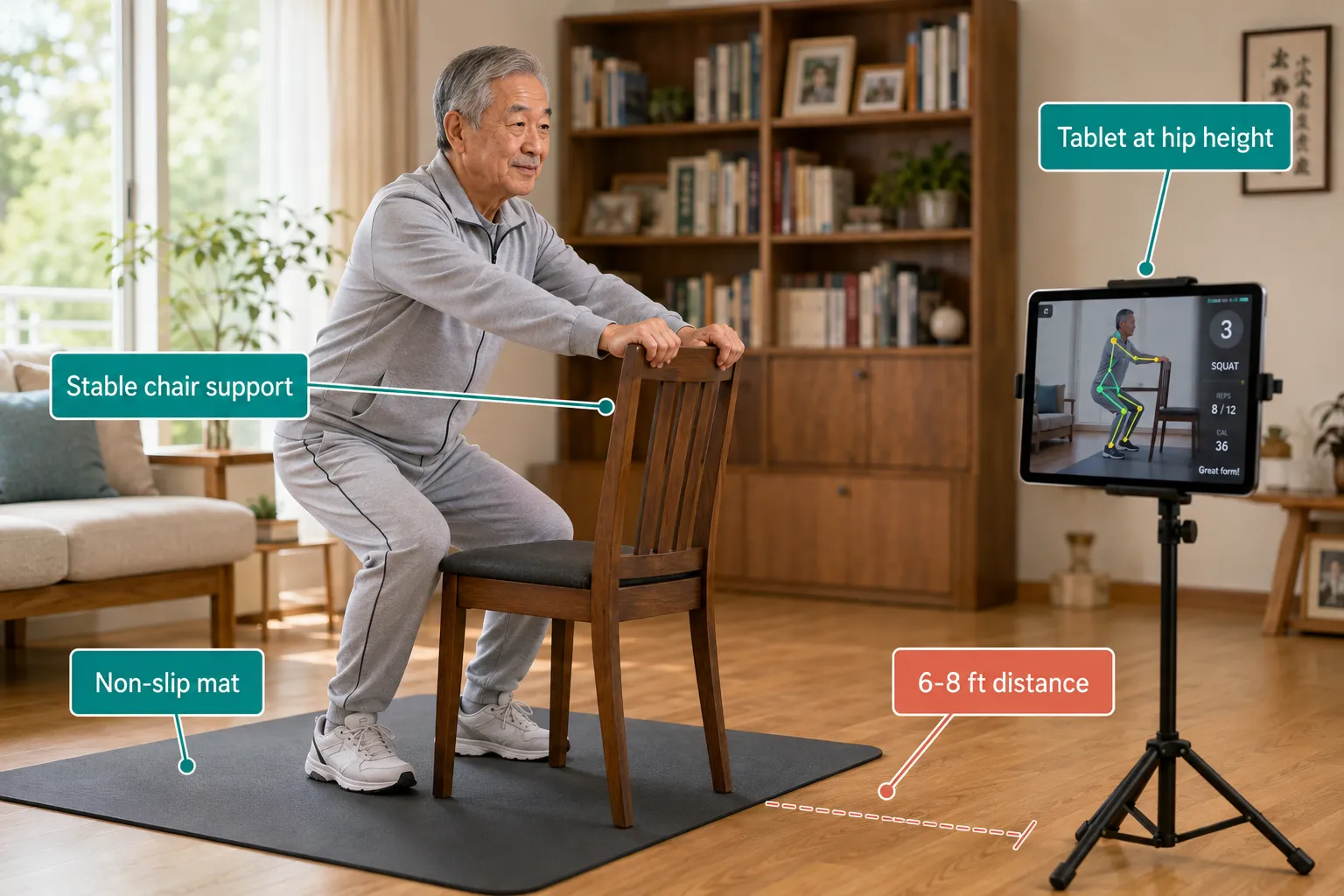
  • Camera placement, hip height, 6-8 feet away, side view for most exercises
  • Lighting, even, front-facing light works best
  • Clothing, loose or matching-background clothing reduces accuracy
  • Body size and shape, pose estimation was historically trained on younger, average-sized bodies; newer models handle diverse bodies better

For seniors, treat AI cues as helpful reminders, not diagnostic verdicts. If the app says your knee is misaligned but you feel stable and pain-free, the cue might be a false positive. If it flags something and you also feel discomfort, listen to it.

Are AI fitness apps good for seniors with limited mobility?

Yes, several AI fitness apps are specifically built for limited mobility, offering chair-based routines, bed exercises, and supported standing options. Apps like SitFit, Ageless Pilates, and Tai Chi for Seniors provide seated variations tracked by AI [1][2].

Budy's app for older adults explicitly uses "mobility level, balance status, available equipment, and health notes" to build plans, meaning the AI knows to skip floor exercises if you can't get down safely [14]. Silver Vitality AI and AgeWiser take similar age-aware approaches [3][4].

Choose a chair-based AI app if you:

  • Use a walker, cane, or mobility aid
  • Have trouble getting up from the floor
  • Recover from surgery or a fall
  • Experience fatigue that limits standing time

Skip AI-only programs if you need hands-on physical assistance to move safely, those situations call for in-person care.

Can seniors use AI fitness apps without smartphones?

Yes, some AI fitness options run on tablets, smart TVs, or web browsers, so a smartphone isn't strictly required. SeniorFit is browser-based, meaning any laptop with a webcam will work [13]. Several apps also support Amazon Fire tablets and larger iPad screens, which many seniors find easier to see and tap.

Options without a smartphone:

  • Web browser + laptop webcam, SeniorFit and similar portals [13]
  • Tablet apps, most iOS and Android fitness apps also run on tablets
  • Smart TV apps, SilverSneakers and FitOn have TV apps for Roku, Apple TV, Fire TV
  • Voice assistants, Alexa and Google Assistant offer some senior workout routines, though without visual form tracking

A larger screen is often better for older adults regardless. A tablet propped on a stand shows form feedback more clearly than a small phone.

What happens if the app can't recognize your movements?

If the AI can't see you clearly, most apps pause the workout or show a "reposition camera" prompt. Common causes are poor lighting, being too close or too far from the camera, or clothing that blends with your background.

Quick fixes:

  • Move the camera 6-8 feet away at roughly hip height
  • Face a light source rather than a window behind you
  • Wear contrasting clothing (dark against light walls, or vice versa)
  • Clear the frame, no pets, family members, or clutter behind you

If the app repeatedly fails to track you, it may not have been trained on your body type, mobility aid, or environment. In that case, use the app's audio-only or video-only mode and skip the AI tracking. You'll still get a decent workout without the personalization layer.
What happens if the app can't recognize your movements?

How do I set up movement tracking in my home?

Setting up AI movement tracking takes about 10 minutes. Here's a clean checklist:

  1. Pick a room with at least 6 feet of clear space and even lighting.
  2. Place the camera at hip height, 6-8 feet from where you'll stand. A tripod or stack of books works.
  3. Angle the camera for a side view for most strength exercises, front view for balance work.
  4. Remove obstacles, rugs that slip, low tables, pet toys.
  5. Add a sturdy chair within arm's reach for balance backup.
  6. Wear contrasting clothing so the AI can find your outline.
  7. Do a test rep before starting, confirm the app draws the skeleton overlay on your body correctly.
  8. Enable audio cues so you can hear feedback without looking at the screen mid-exercise.

Once it's set up, leave the tripod in place. Consistency helps the AI build a movement baseline it can compare against week to week.

Is AI fitness technology safe for people with balance issues?

AI fitness apps can be safe for people with balance issues if the app is designed for that population and you have a sturdy chair or wall nearby. Apps like Budy include balance status as a planning input and apply "conservative progression and safety boundaries" specifically to protect fall-prone users [14].

Safety guidelines for balance issues:

  • Choose apps with explicit senior or balance-focused modes (Budy, AgeWiser, SilverSneakers, Tai Chi apps) [1][3][14]
  • Always exercise with a stable support, chair back, kitchen counter, or wall, within arm's reach
  • Start with seated or supported standing exercises before progressing to free-standing
  • Skip eyes-closed balance work unless cleared by a clinician
  • Have a phone within reach in case you need help

If you've fallen in the past year or been diagnosed with a balance disorder, talk to your doctor or physical therapist before starting any AI program. Bring the app on your phone to the appointment and show them what it prescribes.

Frequently Asked Questions

Do AI fitness apps work for seniors over 80?
Yes, especially chair-based and low-impact apps like SitFit, Tai Chi for Seniors, and AgeWiser [1][2][3]. Start with 10-minute sessions and prioritize apps that let you disable jumping, floor work, and fast transitions.

Can I use an AI fitness app after a hip or knee replacement?
Only with your surgeon's or physical therapist's clearance, and typically not for the first 6-12 weeks post-op. AI apps are for maintenance, not rehab.

Will the AI report my data to my doctor?
Most consumer apps don't share data with clinicians automatically. Some let you export summaries you can share manually. Check the app's privacy policy.

Does the app watch me all the time?
No. The camera activates only during workouts, and most apps process video on-device without uploading it. Confirm this in the app's privacy settings.

What if I get frustrated with the technology?
Start with one 10-minute session, three times a week. Use audio-only cues if the visual feedback feels overwhelming. Ask a family member for help with the first setup, after that, it's usually just tapping "start."

Are there AI apps specifically for seniors with dementia or cognitive decline?
Not many. Most AI fitness apps assume the user can follow multi-step verbal cues. For cognitive impairment, seated group classes with a live instructor generally work better than app-based coaching.

How long until I see results?
Most seniors notice better balance and easier daily movement (getting up from a chair, climbing stairs) in 4-6 weeks of consistent 3x weekly sessions. Strength gains take 8-12 weeks.

Can I use these apps if I've never exercised before?
Yes. Apps like Silver Vitality AI and AgeWiser build in beginner assessments and start conservatively [3][4]. Tell the app honestly about your fitness level, overstating it triggers harder workouts than your body is ready for.

Conclusion

AI-powered fitness apps for seniors have moved past gimmicks. Movement assessment technology now delivers something genuinely useful: home workouts that adapt to your stiff mornings, your good balance days, and the slow build of strength over months. The best apps in 2026, AgeWiser, Silver Vitality AI, Budy, SeniorFit, SilverSneakers, and chair-based options like SitFit, treat older bodies as the design center, not an afterthought [1][3][4][13][14].

Your next steps:

  1. Pick one app based on your primary goal (balance, arthritis, general fitness) and mobility level.
  2. Use the free trial for at least 7 days before paying.
  3. Set up a dedicated corner with a chair, tripod, and good lighting.
  4. Commit to three 15-minute sessions per week for a month before judging results.
  5. Check with your doctor if you have any diagnosed condition, recent surgery, or history of falls.

The technology is helpful. Your consistency is what makes it work.

References

[1] Ai Workout App For Seniors – https://aitoolsbakery.com/blog/ai-workout-app-for-seniors/
[2] Best Chair Yoga And Tai Chi Apps For Seniors In 2026 Tested Ranked – https://aijourn.com/best-chair-yoga-and-tai-chi-apps-for-seniors-in-2026-tested-ranked/
[3] AgeWiser on Google Play – https://play.google.com/store/apps/details?id=com.tgi.agewiser&hl=en-US
[4] Silver Vitality AI on App Store – https://apps.apple.com/us/app/silver-vitality-ai/id6758680602
[9] AgeWiser AI Senior Care App – https://apps.apple.com/us/app/agewiser-ai-senior-care-app/id6468810140
[13] SeniorFit – referenced via industry roundups [1]
[14] Budy AI Workout App for Older Adults – referenced via industry roundups [1]

Top Wearables for Tracking Strength, Mobility, and Fall Risk in Seniors

Top Wearables for Tracking Strength, Mobility, and Fall Risk in Seniors

Last updated: August 20, 2026

Quick Answer

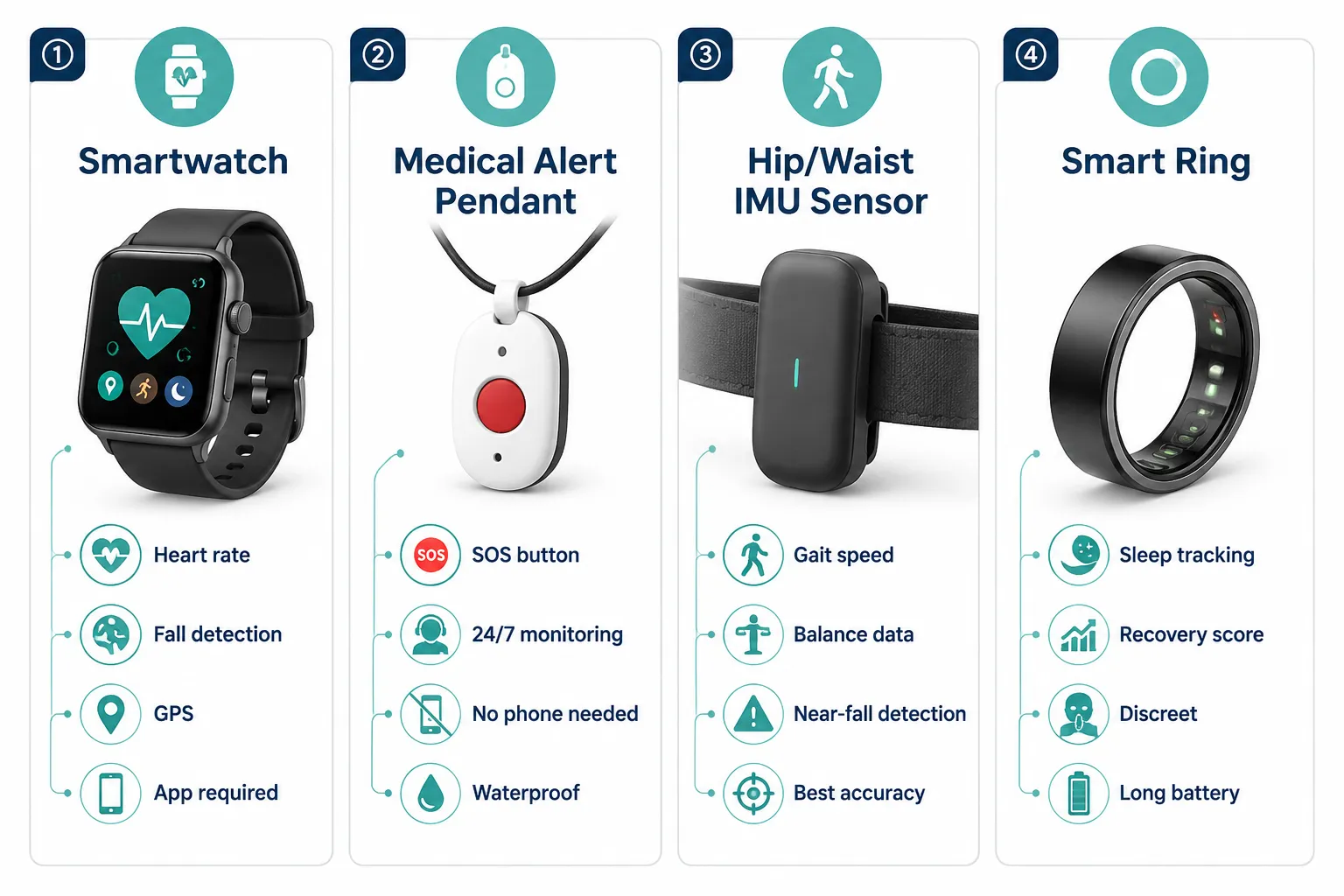
The top wearables for tracking strength, mobility, and fall risk in seniors in 2026 fall into three buckets: smartwatches (Apple Watch Series 9/SE, Google Pixel Watch 2, Samsung Galaxy Watch 6) for active seniors, dedicated medical alert wearables (Lively Mobile Plus, Bay Alarm SOS Smartwatch, Medical Guardian MGMove) for hands-off safety, and research-grade IMU sensors (hip- or ankle-worn devices) for the most accurate gait and near-fall detection. Choose based on tech comfort, cellular needs, and whether the priority is fitness coaching or emergency response.

Key Takeaways

  • Gait speed, double-support time, and vertical oscillation captured by a single wearable are validated proxies for muscle strength and sarcopenia risk in older adults.[1]
  • Hip, ankle, and lower-back sensors outperform wrist-worn devices for detecting near-falls, with multi-sensor systems reaching up to 100% sensitivity in controlled tests.[5]
  • Fall detection automatically calls for help after an impact; fall alert requires the user to press a button. Both matter, and the best devices offer both.
  • Apple Watch fall detection works for seniors but is calibrated for users over 55 and can miss slow, sliding falls or generate false alarms during vigorous activity.
  • Wearable-supported exercise programs produce meaningful gains in lower-limb strength and balance compared with unstructured activity.[2]
  • Under $200 options exist and work well: Fitbit Inspire 3, Amazon Halo View, and Bay Alarm's basic pendant all deliver core tracking without a monthly fee (in some cases).
  • The best senior wearables combine sensor data with self-reported and clinical inputs, pure sensor models miss psychological and social frailty factors.[3]

What wearables can track fall risk in elderly people?

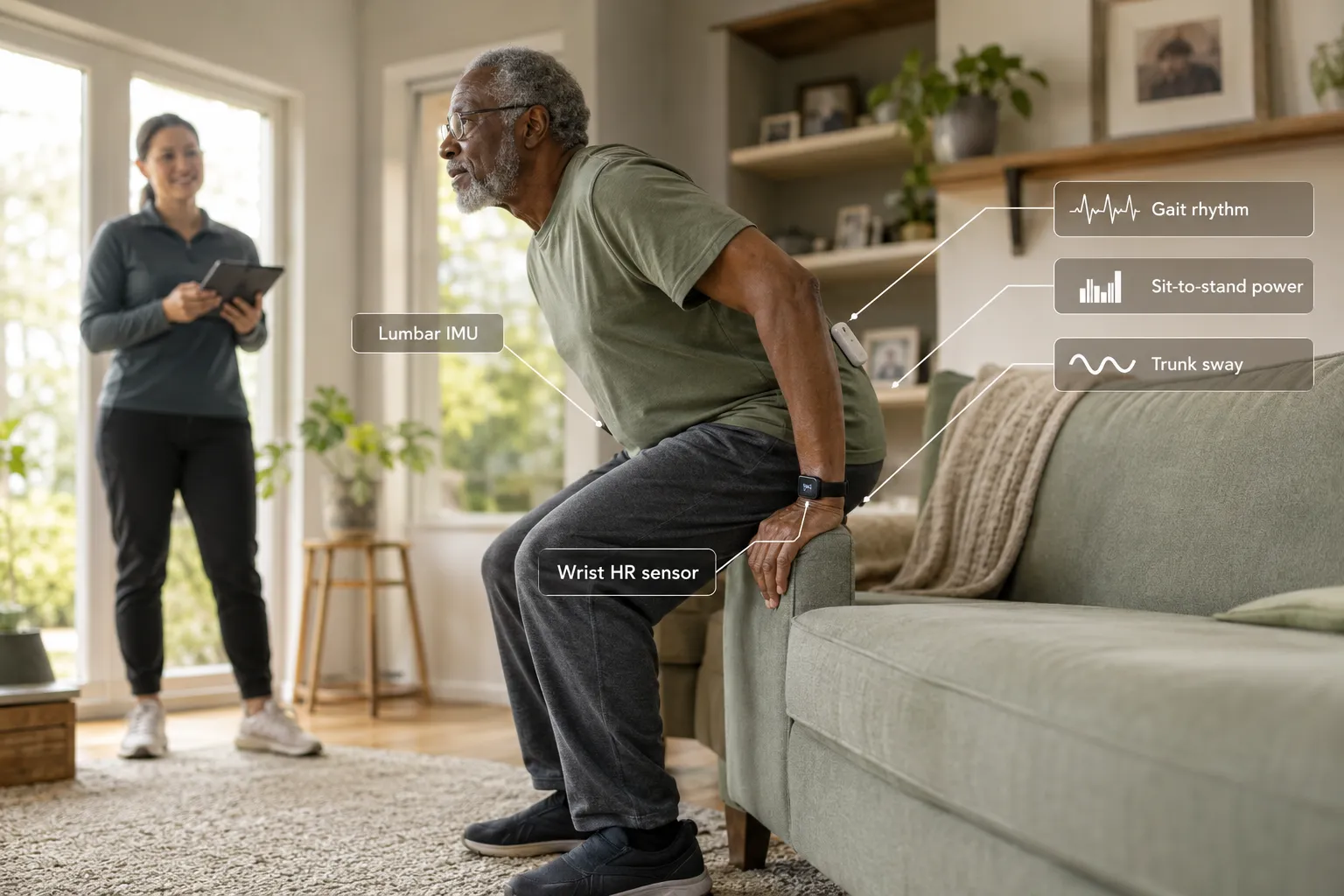
Fall-risk wearables use inertial measurement units (IMUs), a mix of accelerometers, gyroscopes, and sometimes magnetometers, to record how a person walks, turns, and shifts weight. From that data, they extract gait speed, stride length, step symmetry, and postural sway, all of which predict future fall risk.

The strongest 2026 options for fall-risk tracking specifically:

  • Apple Watch Series 9 / Ultra 2, hard-fall detection, irregular gait notifications via third-party apps, and walking steadiness metric in the Health app.
  • Google Pixel Watch 2, fall detection with automatic emergency SOS, Fitbit gait and cardio load metrics.
  • Bay Alarm Medical SOS Smartwatch, cellular, fall detection, no smartphone required.
  • Kanega Watch (UnaliWear), designed specifically for seniors, always-on cellular, fall detection, medication reminders.
  • Research-grade lumbar IMUs (used by clinics), most accurate for near-fall detection.[5]

What wearables can track fall risk in elderly people?

Choose a fall-risk wearable if: the user has fallen in the past year, uses a cane or walker, takes four or more medications, or lives alone.

Best fitness trackers for seniors with mobility issues

For seniors with mobility limitations, the best fitness trackers prioritize simple displays, gentle activity goals, and metrics that matter more than step counts, like walking steadiness, active minutes, and heart-rate recovery.

Top picks in 2026:

Device Best for Fall detection Standalone cellular
Apple Watch SE (2nd gen) Balanced value + safety Yes (age 55+) Optional
Fitbit Charge 6 Simple daily tracking No No
Google Pixel Watch 2 Android users Yes Optional
Bay Alarm SOS Smartwatch Non-tech seniors Yes Yes
Kanega Watch Seniors without smartphones Yes Yes
Garmin Vivosmart 5 Long battery life No No

For users with arthritis or dexterity issues, prioritize devices with larger touch targets, physical buttons, and voice control. The Kanega Watch and Bay Alarm SOS both use speak-to-activate SOS, which matters when small screens become hard to tap.

How do strength tracking wearables work for older adults?

Strength tracking wearables estimate muscle function indirectly by measuring how the body moves, not by measuring force output directly. Sensors detect sit-to-stand power, gait speed, and vertical oscillation, all validated proxies for lower-body strength and sarcopenia risk.[1]

A 2025 study of community-dwelling older adults found that gait metrics from a single wearable correlated strongly with handgrip strength, muscle mass, and standard physical performance tests, meaning one sensor can flag likely sarcopenia without a clinic visit.[1]

How do strength tracking wearables work for older adults?

How the estimation works in practice:

  1. The sensor captures raw acceleration and rotation data during daily movement.
  2. Algorithms extract gait speed, cadence, stride variability, and turn duration.
  3. Machine-learning models compare those values to age- and sex-matched norms.
  4. The app or clinician dashboard flags decline over weeks and months.

A 2026 systematic review found that wearable-supported exercise programs produced small-to-moderate but significant gains in lower-limb strength and balance compared with control groups, confirming these devices can drive behavior change, not just measure it.[2]

Smartwatch vs dedicated fall detection device for seniors

A smartwatch is better for active, tech-comfortable seniors who want fitness plus safety. A dedicated fall detection device is better for frail, cognitively impaired, or non-tech-savvy seniors who need one-button emergency response.

Choose a smartwatch (Apple Watch, Pixel Watch, Galaxy Watch) if:

  • The user already owns and uses a smartphone
  • Fitness tracking, notifications, and coaching matter
  • They can charge a device daily
  • Falls are a possible but not imminent risk

Choose a dedicated device (Medical Guardian, Bay Alarm, Lively) if:

  • The user is 80+ or has cognitive decline
  • Battery life must last days or weeks, not hours
  • 24/7 professional monitoring is desired
  • The user doesn't want or can't manage a smartphone

The dedicated devices route to a live monitoring center, while smartwatches typically call emergency contacts or 911 directly. For someone who might not remember to charge a watch or who lives alone with no nearby contacts, the monitoring center model is safer.

Affordable wearables for senior health monitoring under $200

Under $200 in 2026, seniors can get solid tracking without sacrificing safety features. The tradeoff is usually no cellular, no monitoring service, or a smaller display.

Best value picks under $200:

  • Fitbit Inspire 3 (~$100), step, sleep, heart rate; needs phone for alerts.
  • Apple Watch SE 2nd gen (~$189 refurbished), fall detection, HR, ECG on some models; needs iPhone.
  • Bay Alarm Medical In-Home Pendant (~$30/mo, no upfront), one-button SOS, fall detection add-on.
  • Amazfit Bip 5 (~$90), long battery, basic activity, no fall detection.
  • Kanega Watch (subscription-based, hardware often included in plan under $200 first-month equivalent), cellular, fall detection.

Common mistake: buying a cheap tracker with no fall detection and no cellular for a high-risk senior. If the user has fallen before, spend the money on a device that can call for help without a phone nearby.

Can Apple Watch detect falls in seniors?

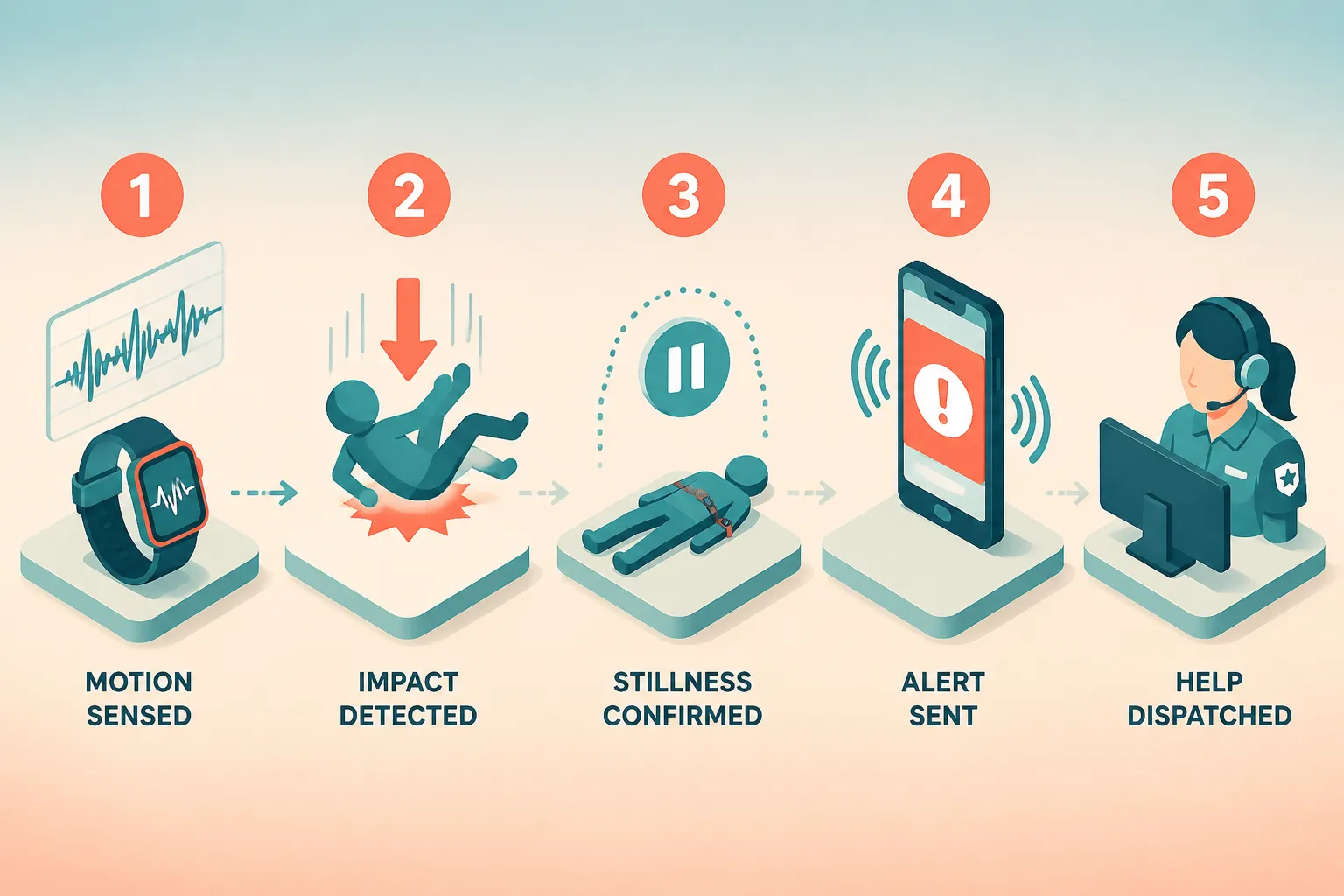
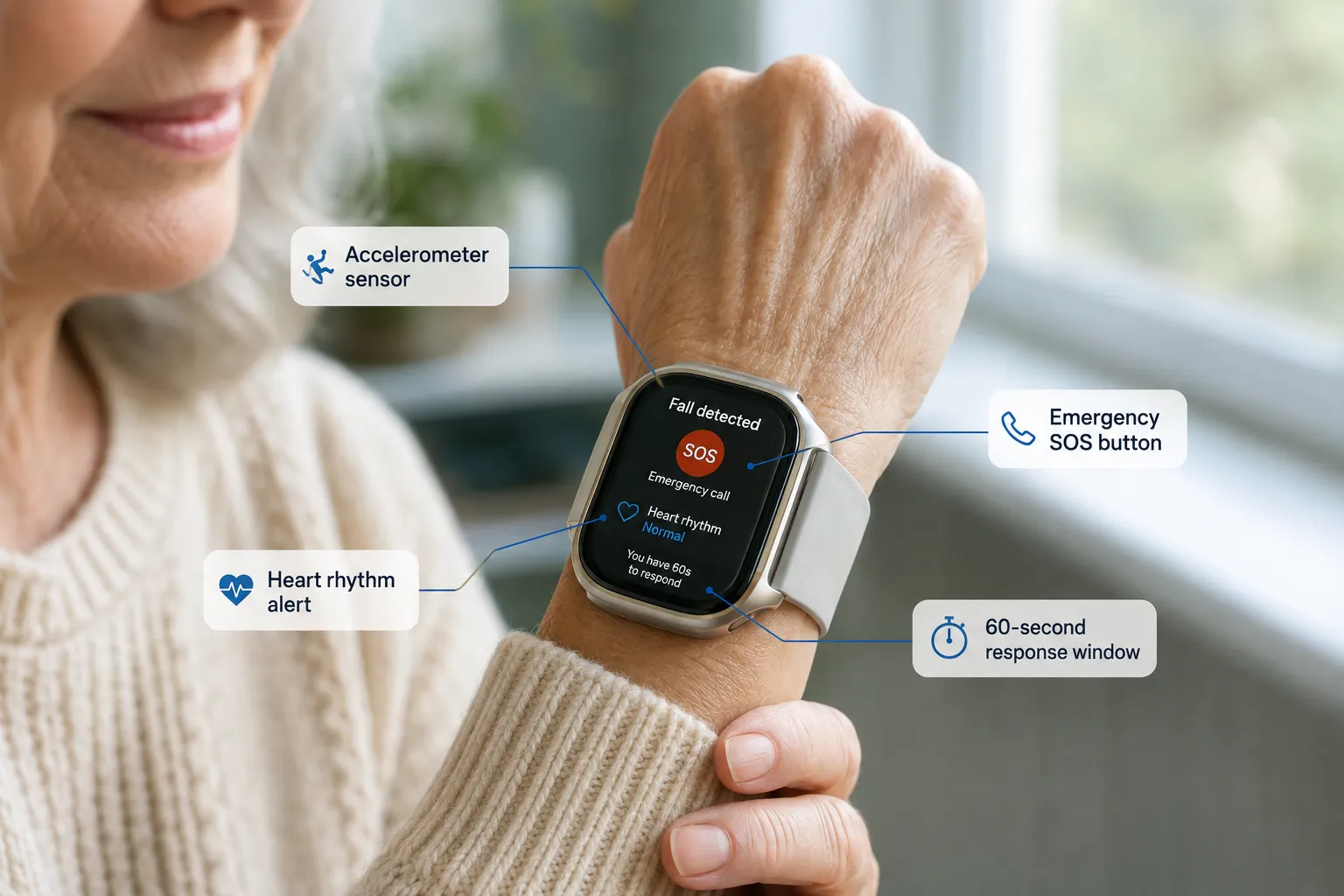
Yes, Apple Watch Series 4 and later can detect hard falls and automatically call emergency services if the wearer is immobile for about 60 seconds. Fall detection is on by default for users 55 and older when they set up the watch with an age above that threshold.

What it does well:

  • Detects hard impact falls (slipping on stairs, tripping forward)
  • Calls 911 and notifies emergency contacts with GPS location
  • Works during workouts too, with a raised sensitivity threshold

What it misses or gets wrong:

  • Slow slides to the floor (common in frail seniors easing down when losing balance)
  • Falls onto soft surfaces (beds, sofas)
  • False positives during vigorous gardening, clapping, or sudden arm drops

For seniors with severe mobility issues, Apple Watch alone isn't enough. Pair it with a hip-clipped IMU or a dedicated pendant for full coverage.

What's the difference between fall alert and fall detection wearables?

Fall alert wearables require the user to press a button to summon help. Fall detection wearables automatically sense a fall and initiate a call without any user action. Fall detection is critical when the user is unconscious, disoriented, or unable to reach a button.

What's the difference between fall alert and fall detection wearables?

Most premium devices in 2026 offer both: an SOS button for user-initiated help and automatic detection as backup. Fall detection accuracy varies, a 2026 systematic review reported single-sensor systems hitting 80-98% sensitivity, with multi-sensor setups reaching up to 100% sensitivity and 99% specificity in controlled testing.[5] Real-world home performance is typically lower because everyday activities like sitting down heavily can mimic fall signatures.

Do seniors actually need wearables for tracking strength and balance?

Not every senior needs one, but wearables provide meaningful value for adults over 65 with any of these: a fall in the past year, unsteady gait, sarcopenia risk, chronic disease that limits activity, or living alone. For healthy, active 65-year-olds, a basic tracker is enough; frailty screening becomes useful around age 75+.

The evidence base is strong. A April 2026 primary-care study combined wearable IMUs, force-platform balance testing, and grip-strength gauges with WHO ICOPE frailty screening, the resulting frailty estimates broadly matched general practitioner ratings over six months.[3] The catch: pure sensor data missed the psychological and social components of frailty, so wearables complement but don't replace clinical assessment.[3]

Wearables that work without a smartphone for elderly users

Standalone cellular wearables are the answer for seniors who don't own or use a smartphone. These devices have their own SIM (usually 4G LTE) and connect directly to monitoring centers or emergency contacts.

Top no-phone-needed options in 2026:

  • Kanega Watch (UnaliWear), cellular, fall detection, voice commands, medication reminders, no smartphone ever required.
  • Bay Alarm Medical SOS Smartwatch, cellular, GPS, fall detection, 24/7 monitoring center.
  • Medical Guardian MGMove, cellular smartwatch with SOS, step tracking, weather.
  • Lively Mobile Plus, pendant style, urgent response button, fall detection.
  • Apple Watch with Cellular, technically works phone-free after setup but requires a smartphone for initial pairing.

Battery life ranges from about 20 hours (Apple Watch cellular) to multiple days (Kanega, MGMove). For someone who forgets to charge, longer battery matters more than features.

How accurate are wearable fall detection sensors really?

In controlled lab studies, top wearable fall detection systems achieve 95-100% sensitivity, but real-world home accuracy drops to roughly 70-90% because everyday movements produce fall-like signals. Wrist-worn devices are less accurate than hip, ankle, or lower-back sensors for detecting near-falls and actual falls.[5]

Key accuracy takeaways from a June 2026 systematic review:[5]

  • Sensor location matters more than brand, lower-body placements capture cleaner linear acceleration signatures.
  • Multi-sensor systems (e.g., watch + hip clip) approach 100% accuracy in labs.[5]
  • Single wrist sensors miss slow falls and generate false positives during arm swings.
  • Real-home validation is limited, most published sensitivity numbers come from staged falls with young participants.[4]

Practical takeaway: no wearable is perfect. Combine automatic detection with a manual SOS button and, ideally, a monitoring center subscription.

Best wearable for tracking daily mobility and activity in seniors

For daily mobility tracking specifically, the Apple Watch SE 2nd gen and Fitbit Charge 6 lead for tech-comfortable seniors, while the Kanega Watch wins for seniors who need standalone cellular and simpler interfaces.

Metrics that matter more than step count for older adults:

  • Walking steadiness (Apple Health), low/OK/very-low categories flag fall risk.
  • Cardio load and readiness (Fitbit/Pixel Watch), balances activity with recovery.
  • Active Zone Minutes, more meaningful than raw steps for seniors with slower gait.
  • Stand hours / hourly movement reminders, reduce sedentary time.

A 2025 trial using wearable-assisted walking in older adults with sarcopenia showed measurable gains in handgrip strength, sit-to-stand performance, and skeletal muscle index, evidence that structured wearable programs beat unstructured step counting.[2]

Can you wear fall detection wearables in the shower or pool?

Most 2026 senior wearables are shower-safe but not all are pool-safe. Bathroom falls are among the most common and most serious for older adults, so shower compatibility is non-negotiable.

Quick water rating guide:

  • Apple Watch Series 9 / SE / Ultra, swim-proof (WR50 / 100m).
  • Kanega Watch, shower-safe (IPX7).
  • Bay Alarm SOS Smartwatch, shower-safe.
  • Medical Guardian MGMove, shower-safe (IPX7).
  • Lively Mobile Plus pendant, shower-safe.
  • Fitbit Charge 6, swim-proof (50m).

Common mistake: taking off a wearable before showering "just in case." Bathrooms account for a large share of senior falls. Confirm the IPX or WR rating and wear it in the shower.

What features matter most in senior health wearables?

The five features that matter most in 2026: automatic fall detection, one-button SOS, GPS location sharing, standalone cellular (if no smartphone), and long battery life. Fitness metrics are secondary to safety and reliability.

Priority feature checklist:

  1. Automatic fall detection with adjustable sensitivity
  2. Manual SOS button that's physically distinct and easy to press
  3. GPS or location services so responders find the user
  4. Cellular (LTE) option for phone-free operation
  5. Water resistance to at least IPX7 (shower-safe)
  6. Battery life of at least 18 hours; ideally days
  7. Heart rate and irregular rhythm alerts (bonus)
  8. Medication reminders (bonus)
  9. Caregiver dashboard / family app for remote monitoring
  10. Large, high-contrast display for aging eyes

Are medical alert systems better than wearable trackers for fall risk?

For high-risk seniors, traditional medical alert systems with 24/7 monitoring centers are more reliable than consumer fitness wearables because a trained operator responds within seconds, not minutes. But modern hybrid smartwatches (Kanega, MGMove, Bay Alarm SOS) close much of that gap while adding activity tracking.

Quick decision guide:

  • Traditional medical alert (Life Alert, Philips Lifeline, Medical Guardian classic pendant), best for cognitively impaired seniors, users who won't wear a watch, or those wanting the lowest monthly cost with a monitoring center.
  • Hybrid medical smartwatch (Kanega, MGMove, Bay Alarm SOS), best when the user wants safety plus activity tracking and cellular independence.
  • Consumer smartwatch (Apple Watch, Pixel Watch), best for tech-comfortable, active seniors who accept some monitoring gaps in exchange for full fitness features.

FAQ

Do Medicare or Medicare Advantage plans cover senior wearables?
Traditional Medicare does not cover wearables. Some Medicare Advantage plans reimburse for medical alert devices or offer discounts on Apple Watch or Fitbit through wellness benefits, check plan-specific details.

What's the best wearable for a senior with dementia?
A dedicated GPS pendant or smartwatch with geofencing and standalone cellular, like the Theora Connect or Medical Guardian Mobile 2.0. Consumer smartwatches are usually too complex for later-stage dementia.

Can wearables predict falls before they happen?
Not reliably yet, but gait-instability trends over weeks can flag rising risk. Near-fall detection research is advancing quickly, with 2026 studies showing 80-98% sensitivity for single-sensor near-fall detection in labs.[5]

How often should the data be reviewed?
Caregivers should check trends weekly. Clinicians typically review at 3- or 6-month intervals when using wearables for frailty monitoring.[3]

Do these devices work without Wi-Fi?
Cellular-enabled devices (Kanega, MGMove, Apple Watch Cellular) work anywhere with LTE coverage. Non-cellular trackers need either Wi-Fi or a paired phone.

Is a smart ring like Oura useful for seniors?
Smart rings track sleep, heart rate, and recovery well but do not offer fall detection or SOS. They complement rather than replace a fall-risk device.

How long do the batteries last?
Apple Watch and Pixel Watch: 18-36 hours. Fitbit Charge 6: 5-7 days. Kanega and MGMove: 1-2 days. Traditional pendants: 3-5 years (non-rechargeable).

Can family members monitor the data remotely?
Yes. Apple Health sharing, Fitbit family accounts, and dedicated caregiver dashboards from Kanega, Bay Alarm, and Medical Guardian all support remote monitoring with the senior's consent.

Conclusion

The top wearables for tracking strength, mobility, and fall risk in seniors in 2026 aren't one-size-fits-all. Active seniors get the most from an Apple Watch SE or Pixel Watch 2. Frail or non-tech seniors are safer with a Kanega Watch, Bay Alarm SOS, or Medical Guardian device. High-risk users benefit from combining a wrist wearable with a hip- or lower-back IMU sensor, which the research clearly shows is more accurate for gait and near-fall detection.[5]

Next steps:

  1. Assess risk first. Ask: has the senior fallen in the past year? Do they live alone? Do they use a smartphone daily?
  2. Match device to risk level. Low risk → consumer smartwatch. Moderate risk → hybrid medical smartwatch. High risk → dedicated system with monitoring center.
  3. Enable fall detection during setup. It's often off by default under age 55.
  4. Set up caregiver sharing so family sees trends, not just emergencies.
  5. Review data quarterly with a clinician who can pair sensor data with a full frailty assessment.[3]

The best wearable is the one the senior actually wears every day, including in the shower. Prioritize comfort, simplicity, and reliable emergency response above feature count.

References

[1] Metrics – https://formative.jmir.org/2025/1/e63928/metrics
[2] PMC12978260 – https://pmc.ncbi.nlm.nih.gov/articles/PMC12978260/
[3] formative.jmir – https://formative.jmir.org/2025/1/e63928/PDF
[4] Full – https://www.frontiersin.org/journals/aging/articles/10.3389/fragi.2026.1695517/full
[5] pubmed.ncbi.nlm.nih.gov – https://pubmed.ncbi.nlm.nih.gov/40604455/

Best Balance Aids and Tools for Seniors: From Simple Supports to Smart Gadgets

Best Balance Aids and Tools for Seniors: From Simple Supports to Smart Gadgets

Last updated: August 18, 2026

Quick Answer

The best balance aids for seniors combine a properly fitted physical support (cane, rollator, or grab bar) with a smart safety device (fall-detection watch or pendant) and, when needed, at-home training tools like stability pads or smart balance trainers. Choose based on how much support you need, whether you fall or feel unsteady, and your comfort with technology. Most older adults benefit from layering simple supports with a monitored fall-detection device, since falls affect about 1 in 4 U.S. adults 65+ every year.[2]

Key Takeaways

  • About 14 million U.S. adults 65+ fall each year, and fall death rates rose 21% between 2018 and 2024.[1][2]
  • Canes suit mild unsteadiness; rollators are better for longer distances and outdoor stability.
  • Stability pads and balance boards build ankle strength but should be used seated or with a wall/chair for safety.
  • Smart balance trainers use sensors and apps to coach posture and detect drift in real time.
  • Apple Watch and dedicated medical-alert devices offer automatic fall detection with 24/7 alerts.
  • Balance aids work best inside a broader fall-prevention plan that includes exercise and medication review.[3][5]
  • Medicare covers medically necessary walkers and canes with a doctor's prescription; smart gadgets are usually out-of-pocket.
  • Physical therapy is often more effective than any single device for restoring true balance function.[5]

What Are the Best Balance Aids for Seniors?

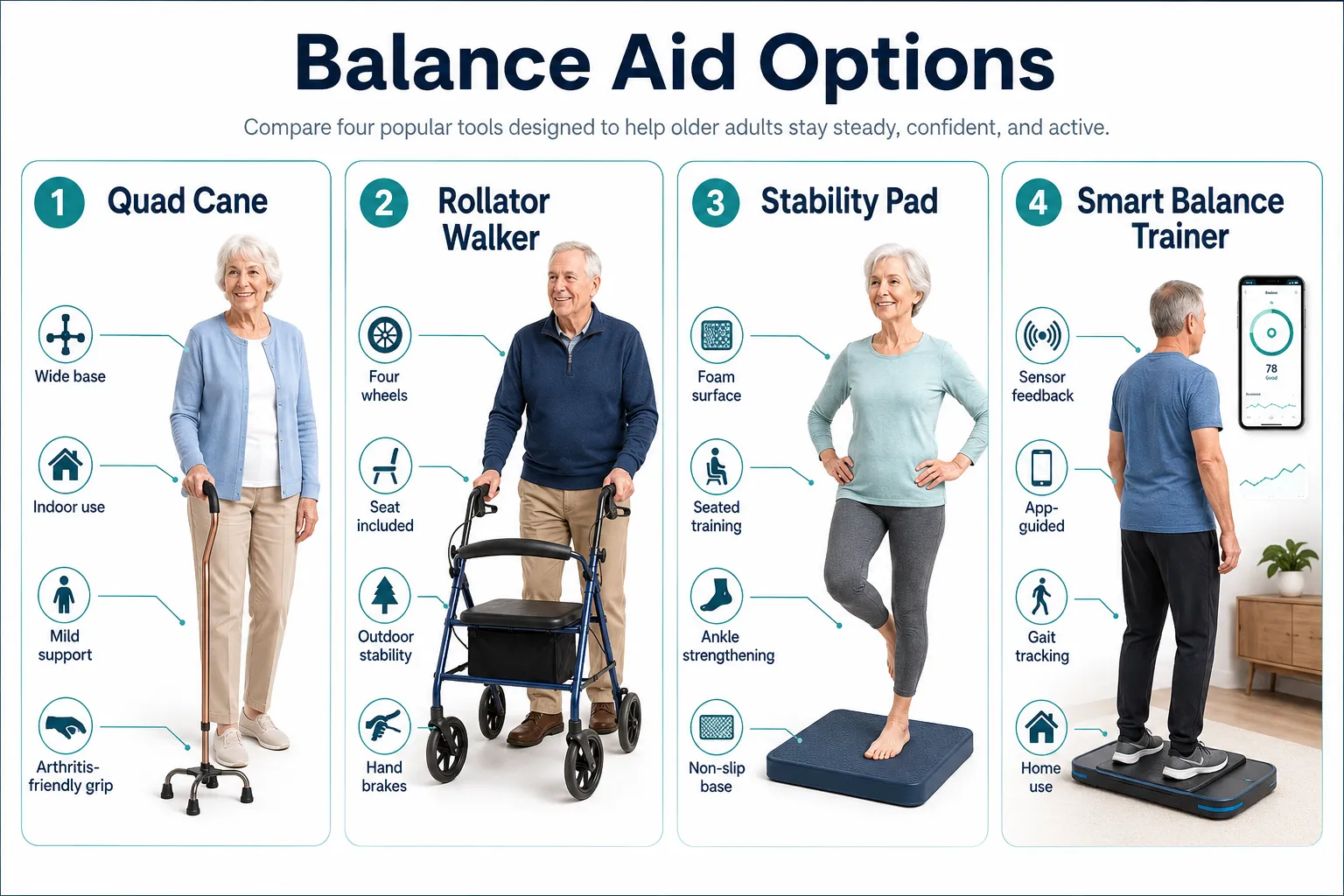
The best balance aids for seniors fall into four categories: simple mobility supports (canes, walkers, rollators), training tools (balance boards, stability pads), smart mobility gadgets (canes with built-in stabilizers, sensor-equipped walkers), and smart safety wearables (fall-detection watches and pendants). Which one is "best" depends on the user's strength, gait, cognitive comfort with tech, and whether the goal is daily support, training, or emergency backup.

What Are the Best Balance Aids for Seniors?

Here's how the four main categories compare:

Category Best for Example tools Typical cost
Simple supports Daily walking, weight-bearing Quad cane, rollator, grab bars $20,$300
Training tools Ankle strength, proprioception Foam pad, wobble board $20,$80
Smart mobility Gait tracking, outdoor safety AI cane, sensor walker $150,$600
Smart safety wearables Fall detection, emergency alerts Apple Watch, medical-alert pendant $30,$85/mo

Choose simple supports if: you feel occasionally unsteady but walk on your own most days.
Choose smart wearables if: you live alone, have fallen before, or worry about not reaching a phone after a fall.
Choose training tools if: your therapist has cleared you for home balance exercises.

How Do Balance Aids Help Prevent Falls in Older Adults?

Balance aids prevent falls by widening the base of support, offloading weight from weakened joints, and giving the user a stable point of contact that compensates for slower reflexes. Smart devices add a second layer: they detect a fall in progress and call for help faster than a human could dial 911.

Falls are the leading cause of injury-related death for U.S. adults 65+, and the age-adjusted fall death rate rose from 64.7 per 100,000 in 2018 to 78.4 per 100,000 in 2024.[1] Every year, roughly 3 million older adults visit emergency departments after a fall.[2] A well-fitted cane or rollator reduces sway and gives users confidence to keep moving, which matters, because inactivity from fear of falling is itself a major risk factor.

The NICE NG249 guideline (updated 2025) and APTA Geriatrics clinical practice guideline both recommend assistive devices as part of a multifactorial prevention plan that also includes strength/balance exercise, medication review, and home hazard checks.[3][5] Aids alone are not enough, but skipping them raises risk.

Difference Between a Cane, Walker, and Rollator for Balance

A cane offers light support for one side; a walker offers heavy four-point support but must be lifted or pushed; a rollator rolls on wheels, includes hand brakes and usually a seat, and works best for people who tire quickly.

  • Single-point cane: minimal support, best for mild unsteadiness or offloading one sore knee.
  • Quad cane: four-tipped base, stands on its own, good for post-stroke or one-sided weakness.
  • Standard walker (no wheels): maximum stability, but slow and requires upper-body strength to lift.
  • Two-wheel walker: slides forward, easier than lifting, moderate stability.
  • Rollator (3 or 4 wheels): fastest and most versatile; hand brakes required; includes a seat for rest breaks.

Decision rule: If you can walk without holding furniture but feel wobbly, start with a cane. If you need both hands for support or feel your legs "give," use a walker. If you go longer distances but need to sit often, choose a rollator.

Common mistake: using a cane on the same side as the weak leg. The cane should go in the opposite hand from the weaker leg to properly shift weight.

Best Smart Balance Devices for Seniors with Technology

The best smart balance devices for seniors in 2026 include the Apple Watch Series 11 and Ultra 3 (built-in fall detection with no extra fee), dedicated medical-alert watches like the Kanega Watch, AI-enabled smart canes like the Wander On Assist 01 and Lgenie voice-activated cane, and smart balance trainers that pair a sensor pad with a phone app for guided workouts.

Best Smart Balance Devices for Seniors with Technology

Key smart features to look for:

  • Automatic fall detection using accelerometers and gyroscopes
  • Multi-step alert workflow: local alarm → contact family → escalate to 911
  • GPS location sharing for outdoor safety
  • Long battery life (multi-day or easy overnight charging)
  • Comfort: wrist wear improves adherence over neck pendants for most users

Independent testing found that the Medical Guardian MGMini Lite detected about 80% of test falls and connected to help in roughly 8 seconds, while Bay Alarm Medical's SOS pendant detected about 70%. Apple Watch's fall detection triggers emergency calls if the user doesn't respond within 60 seconds after a hard fall.

A 2026 systematic review of near-fall wearable sensors found IMU-based systems achieved 80-98% sensitivity with a single sensor, and up to 100% sensitivity with multi-sensor setups, evidence that smart wearables are becoming genuinely predictive, not just reactive.

How Much Do Balance Aids Cost for Seniors?

Balance aid costs range from about $20 for a basic cane to $600+ for AI-enabled smart canes, plus monthly fees of $30,$85 for monitored fall-detection services.

Typical price ranges:

  • Standard cane: $15,$50
  • Quad cane: $25,$70
  • Rollator: $80,$300
  • Grab bars (installed): $30,$150 each
  • Foam stability pad: $20,$60
  • Balance board: $25,$100
  • Apple Watch SE (with fall detection): ~$249, no monthly fee for fall detection
  • Medical-alert pendant with fall detection: monitoring plans typically ~$30,$45/mo, with fall detection often a ~$10/mo add-on
  • Kanega Watch: subscription plans around $65,$85/mo, fall detection included
  • AI smart canes (Lgenie, Wander On Assist 01): $200,$600 one-time

Common mistake: assuming fall detection is included in every medical-alert plan. Most brands charge it as an add-on.

Balance Aids for Seniors with Arthritis or Joint Pain

For seniors with arthritis, the best balance aids feature cushioned or ergonomic grips, shock-absorbing tips, and light frames that reduce hand and shoulder strain. Rollators are often preferred over standard walkers because they don't require lifting.

Recommendations by joint issue:

  • Hand/wrist arthritis: foam or gel palm grips, offset canes that distribute pressure across the palm
  • Knee arthritis: rollator with a seat for rest breaks, or a cane in the opposite hand to offload the sore knee
  • Hip arthritis: four-wheel rollator to reduce twisting, plus a raised toilet seat and shower chair at home
  • Shoulder pain: avoid standard walkers (require lifting); choose two-wheel or four-wheel models

Look for canes with shock-absorbing shafts, several smart canes now include this feature alongside built-in stabilizer bases.

What Balance Aid Is Best for Someone Just Starting to Need Support?

For someone just starting to feel unsteady, the best first balance aid is usually a properly fitted single-point cane paired with a fall-detection smartwatch or pendant. This combination provides light physical support without over-relying on equipment, plus a safety net if a fall happens.

Start-up checklist:

  1. Get a physical therapy or primary care assessment first, NICE guidelines recommend this before choosing a device.[3]
  2. Have the cane sized: top of the cane should reach the crease of your wrist when arms hang straight.
  3. Practice on level ground before using stairs or uneven surfaces.
  4. Add a smart safety wearable if you live alone or have fallen in the past year.
  5. Start balance exercises 2-3 times per week (chair-supported at first).

Choose a rollator instead if: you need to sit down often, get short of breath, or feel your legs might buckle.

Can Balance Aids Help with Vertigo or Dizziness in Seniors?

Balance aids can help seniors manage vertigo and dizziness by providing a stable point of contact during episodes, but they don't treat the underlying cause. Anyone with recurring vertigo should also see a doctor to rule out inner-ear disorders, medication side effects, or blood pressure issues.

Useful tools during dizzy spells:

  • Rollator with brakes and seat: lets you sit immediately if a spell hits
  • Grab bars in bathroom and near the bed: most dizzy episodes happen during position changes
  • Bedside cane or walker: for the first steps after standing up
  • Smart balance trainers with app guidance: vestibular exercises (like head-turn drills) may reduce vertigo frequency when prescribed by a therapist

Edge case: if dizziness comes with sudden hearing loss, chest pain, or slurred speech, call 911, that's not a balance-aid problem.

Balance Aids for Seniors Living Alone at Home

Seniors living alone need redundant safety layers: a physical support device, a fall-detection wearable worn continuously, and home modifications that reduce fall risk in the first place.

Priority setup for solo living:

  • Wearable with automatic fall detection (Apple Watch, Kanega Watch, or monitored pendant)
  • Grab bars in shower, next to toilet, and by the bed
  • Non-slip mats in bathroom, no throw rugs anywhere
  • Motion-activated night lights on the path to the bathroom
  • Rollator or walker kept at bedside if nighttime steadiness is poor
  • Smart speaker (Amazon Echo, Google Home) with emergency contacts programmed for voice-activated calling

A wearable that stays on the wrist beats a pendant left on the nightstand. Adherence matters more than sensor accuracy.

Common Mistakes Seniors Make When Using Balance Aids

The most common mistakes with balance aids are using the wrong height, holding the cane in the wrong hand, not replacing worn rubber tips, and treating the aid as a substitute for exercise rather than a supplement to it.

Top mistakes to avoid:

  1. Cane too tall or too short, check that your elbow bends about 15-20 degrees when holding it.
  2. Cane on the weak side, always use it in the hand opposite the weaker leg.
  3. Leaning too far forward on a walker, this shifts your center of gravity outside the frame and increases fall risk.
  4. Worn rubber tips, replace every 6-12 months; worn tips slip on smooth floors.
  5. Skipping strength training, no device replaces stronger leg and core muscles.
  6. Wearing a fall-detection pendant only during the day, most falls happen at night or in the bathroom.
  7. Not locking rollator brakes before sitting, a moving seat is a serious fall hazard.

Balance Aids vs Physical Therapy for Improving Senior Balance

Physical therapy improves the underlying balance system (strength, proprioception, reaction time), while balance aids provide external support for tasks the body can't yet handle safely. The two work together, they're not substitutes.

Balance Aids vs Physical Therapy for Improving Senior Balance

APTA Geriatrics' 2025 clinical practice guideline recommends structured physical therapy for gait, strength, and balance in community-dwelling adults 65+, combined with environmental changes and assistive devices as needed.[5] Therapy typically produces measurable gains in 8-12 weeks; a cane produces stability instantly but doesn't rebuild the muscles.

Choose therapy first if: you're deconditioned but medically stable and can attend sessions.
Choose an aid first if: you're actively at high fall risk and can't wait 8+ weeks to feel steadier.
Best result: do both, therapy plus properly prescribed aids.

Best Balance Aids for Seniors with Limited Upper Body Strength

Seniors with limited arm or grip strength should choose lightweight rollators, wheeled walkers, or canes with ergonomic grips rather than standard walkers that require lifting.

Top picks by strength limitation:

  • Weak grip: foam-padded or molded ergonomic cane grips; loop-style rollator brakes instead of squeeze levers
  • Weak arms: four-wheel rollator (no lifting required), or a wheeled walker with glide skis
  • Weak shoulders: avoid pendulum-style standard walkers; use rollators with forearm supports if needed
  • Poor coordination: rollator with locking brakes and a wide, stable base

Some AI smart canes now include voice control so users don't need to reach for a phone to summon help, helpful when hands are already busy stabilizing.

Do Insurance or Medicare Cover Balance Aids for Seniors?

Medicare Part B typically covers medically necessary canes, walkers, and rollators as durable medical equipment (DME) when prescribed by a doctor and supplied by a Medicare-enrolled provider. You'll usually pay 20% after the deductible. Smart gadgets, medical-alert subscriptions, and balance trainers are generally not covered by Original Medicare, though some Medicare Advantage plans include limited allowances.

Coverage snapshot:

  • Covered (with prescription): standard canes, quad canes, walkers, rollators, commode chairs, grab bars in some cases
  • Sometimes covered by Advantage plans: medical-alert systems, home modification allowances
  • Rarely covered: smart canes, Apple Watch, balance boards, stability pads
  • Veterans: the VA often covers a wider range of assistive devices; check with your VA benefits coordinator

Tip: always ask your doctor for a written prescription and get the equipment from a Medicare-approved supplier, otherwise the claim will be denied.

Balance Aids for Outdoor Use vs Indoor Use for Seniors

Indoor balance aids prioritize maneuverability in tight spaces (single-point canes, narrow walkers), while outdoor aids need larger wheels, better brakes, and weather-resistant materials to handle sidewalks, curbs, and gravel.

Indoor aids:

  • Single-point or quad cane
  • Narrow-frame two-wheel walker
  • Grab bars, bed rails, raised toilet seats

Outdoor aids:

  • Four-wheel rollator with 8-inch or larger wheels
  • All-terrain rollator for grass and gravel
  • Smart cane with GPS and fall detection
  • Fall-detection watch with cellular connection (works away from home Wi-Fi)

Decision rule: if you use the same device inside and out, pick a rollator with medium wheels (6-7 inches) as a compromise, but expect it to feel slightly bulky indoors.

FAQ

What's the safest first balance aid for a senior who has never used one?
A properly fitted single-point cane, chosen with input from a physical therapist or doctor. Add a fall-detection wearable if the senior lives alone.

Are smart canes worth the money?
For tech-comfortable seniors who walk outdoors and want gait tracking or voice-activated help, yes. For basic indoor support, a standard cane at a fraction of the cost is fine.

Can Apple Watch really detect a fall?
Yes. Apple Watch Series 4 and newer include automatic fall detection that calls emergency services if you don't respond within 60 seconds after a hard fall.

Do I need a prescription for a walker or rollator?
Not to buy one, but Medicare requires a doctor's prescription to cover it.

How often should rubber cane tips be replaced?
Every 6-12 months, or immediately if the tread looks worn or the tip feels slick on smooth floors.

Are balance boards safe for seniors?
Only with supervision or a sturdy support (chair, wall) within reach. Many seniors do better with foam stability pads, which are safer than wobble boards.

What's the difference between a medical-alert pendant and a smartwatch with fall detection?
Pendants connect to a 24/7 monitoring center; smartwatches usually contact preset emergency contacts and 911 directly. Both work, adherence and comfort determine which is better for you.

Can balance aids fully prevent falls?
No device eliminates fall risk. The best results come from combining aids with exercise, medication review, vision checks, and home safety changes.[3][5]

Conclusion

The best balance aids and tools for seniors aren't picked from a top-10 list, they're matched to the person. Start with an honest assessment of unsteadiness, then layer supports: a properly fitted cane or rollator for daily use, a fall-detection watch or pendant for emergencies, and simple training tools if a therapist clears you for home practice. Medicare covers the basics; smart gadgets are usually worth their extra cost only if they'll actually be worn every day.

Next steps this week:

  1. Book a fall-risk assessment with your doctor or a physical therapist.
  2. Check that any current cane or walker is the right height and has fresh tips.
  3. Add one home safety upgrade, grab bar, night light, or non-slip mat.
  4. Decide on a fall-detection wearable and set up emergency contacts today.
  5. Start 10 minutes of chair-supported balance exercises three times a week.

Falls are common, but they're not inevitable. The right mix of simple supports and smart tools, used consistently, alongside exercise and good medical care, dramatically shifts the odds in your favor.

References

[1] Falls Data and Research – https://www.cdc.gov/falls/data-research/index.html
[2] Older Adult Falls Facts and Stats – https://www.cdc.gov/falls/data-research/facts-stats/index.html
[3] NICE Guideline NG249: Falls in older people – https://www.nice.org.uk/guidance/ng249
[4] APTA: Falls in Older People (NICE NG249) – https://www.apta.org/patient-care/evidence-based-practice-resources/cpgs/falls-in-older-people-assessing-risk-and-prevention-nice-ng249
[5] APTA: Physical Therapy Management of Fall Risk in Community-Dwelling Older Adults – https://www.apta.org/patient-care/evidence-based-practice-resources/cpgs/physical-therapy-management-of-fall-risk-in-community-dwelling-older-adults
[6] WHO: Falls Fact Sheet – https://www.who.int/news-room/fact-sheets/detail/falls
[7] CDC STEADI Patient Resources – https://www.cdc.gov/steadi/patient-resources/index.html
[9] NSC: Older Adult Falls – https://injuryfacts.nsc.org/home-and-community/safety-topics/older-adult-falls/
[10] CDC: Common Injuries As We Age – https://www.cdc.gov/still-going-strong/about/common-injuries-as-we-age.html

Best Balance Boards and Stability Tools for Older Adults: Improve Mobility and Prevent Falls

Best Balance Boards and Stability Tools for Older Adults: Improve Mobility and Prevent Falls

Last updated: August 16, 2026

Quick Answer

The best balance boards and stability tools for older adults are low-profile rocker boards, foam balance pads, and inflatable wobble cushions, used 5 to 10 minutes, three times per week, near a countertop or sturdy chair for hand support. Peer-reviewed research shows structured 4 to 9 week balance-board programs improve standing balance, mobility, and Timed Up and Go scores, and can cut fall risk by roughly 23 to 28 percent when combined with strength work.[1][5][10] Start with the most stable tool that still challenges you, and progress slowly over weeks, never days.

Key Takeaways

  • Foam pads and wobble cushions are the safest entry points; rocker boards suit intermediate users; multi-axis wobble boards are for confident, mobile seniors only.[4][11]
  • 10 minutes, 3 times per week is the evidence-supported dose for measurable balance gains on a wobble board.[9][10]
  • Structured 4 to 9 week programs improve Berg Balance Scale and Timed Up and Go scores in older adults.[1][13][15]
  • Multicomponent training (strength + aerobic + balance board) prevents falls better than any single tool.[3]
  • Always train near a countertop, sturdy chair, or grab rail, and skip balance boards entirely if you have active vertigo or a recent fall.[2][7]
  • A basic home kit (foam pad, wobble cushion, half-dome trainer, grab rail) typically runs $150 to $250.[14]
  • Consult a physician or physical therapist before starting if you have arthritis, neuropathy, or a history of falls.[7]

What Is a Balance Board and How Does It Help Older Adults?

A balance board is a flat platform mounted on an unstable base, a curved rocker, a rounded dome, or a spherical pivot, that forces small stabilizing muscles in the ankles, hips, and core to work continuously to keep the body upright. For older adults, this trains proprioception (the body's sense of position), reaction time, and postural control, all of which decline with age and are directly linked to fall risk.[1][15]

Peer-reviewed evidence shows that short, regular balance-board sessions improve standing balance, Timed Up and Go scores, and Berg Balance Scale results in seniors.[1][9][13] The Mayo Clinic notes these tools can enhance balance, coordination, and lower-limb strength, and may reduce fall risk when used correctly.[2]

What Is a Balance Board and How Does It Help Older Adults?

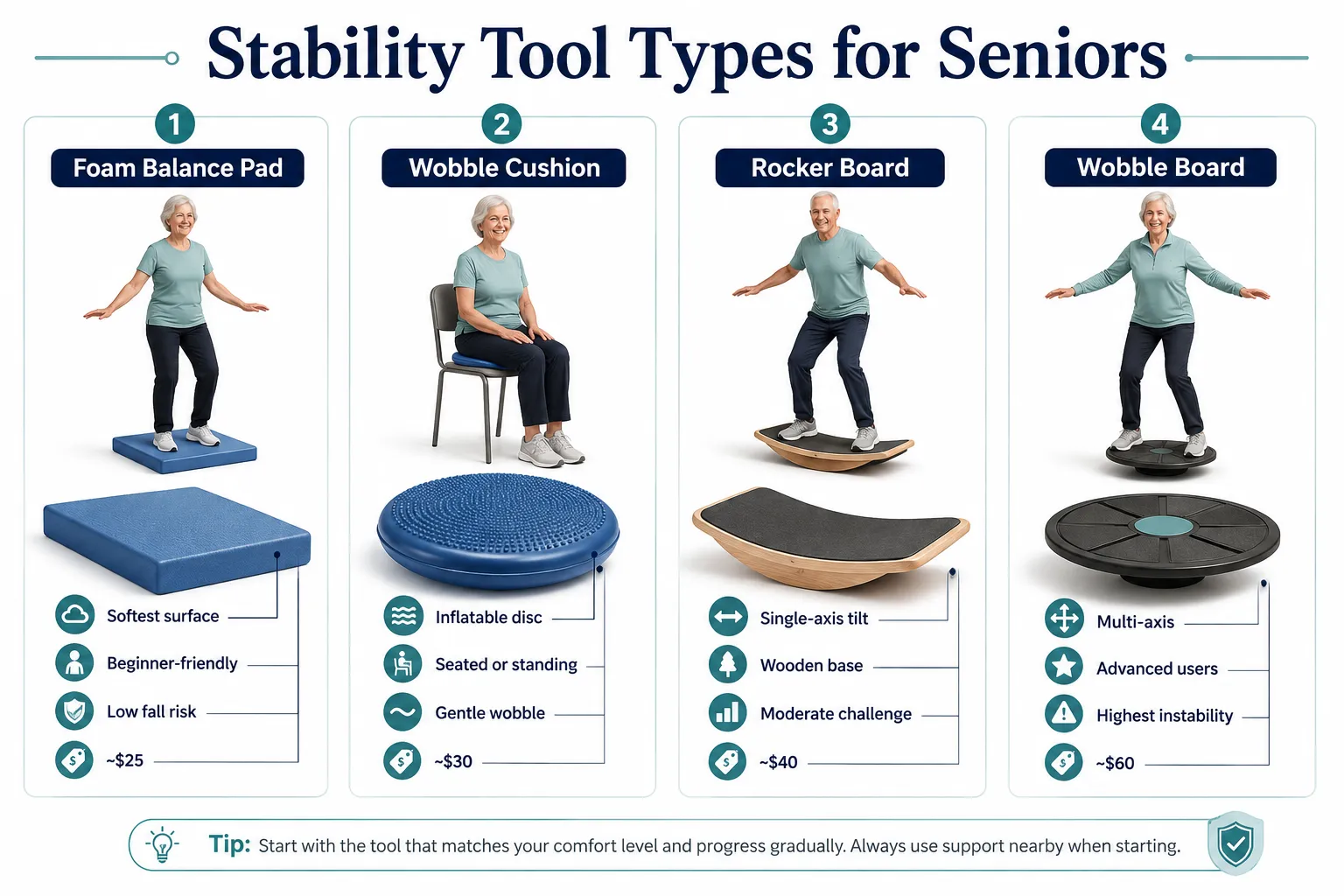
Types of stability tools covered in this guide:

Tool Instability level Best for Typical price
Foam balance pad Very low Beginners, arthritis, post-surgery $20,$35
Wobble cushion (disc) Low Seated core work, mild standing $25,$40
Rocker board (single-axis) Moderate Intermediate users $30,$55
Half-dome trainer (BOSU-type) Moderate, high Confident seniors $80,$130
Multi-axis wobble board High Advanced, no fall history $40,$70

Best Balance Boards for Seniors with Arthritis

For seniors with arthritis, the safest options are foam balance pads and inflatable wobble cushions, because they provide gentle instability without forcing sharp ankle or knee angles. A low-profile rocker board with a wide, non-slip surface is the next step up once joint pain is under control.

What to look for:

  • Wide platform (16 inches or more) so feet can sit shoulder-width apart
  • Low height (under 3 inches) to reduce the drop if balance is lost
  • Gentle curvature, steep rockers force painful ankle dorsiflexion
  • Non-slip textured top for bare or socked feet
  • Weight capacity clearly rated above your body weight

Avoid hard plastic multi-axis boards, small round wobble discs used standing, and any tool that requires deep knee bend to stabilize. Seated wobble-cushion work is an excellent arthritis-friendly starting point.[4][7]

Balance Board vs Stability Ball for Elderly Users

A balance board is generally safer and more practical than a stability ball for most older adults. Balance boards keep the feet on a stable floor and challenge ankle and hip stabilizers in a controlled range. Stability balls require sitting or lying on a large, rolling sphere, a setup with significantly higher fall risk for anyone with reduced grip strength, hip mobility, or reaction speed.

Use a balance board if the goal is standing balance and fall prevention. Use a stability ball only in seated form (as a chair alternative for core engagement) and only with a wall behind you or a chair frame around the ball. Never do bridges or supine exercises on a full-size stability ball without supervision.

How Often Should Older Adults Use Balance Boards?

Three sessions per week of 10 minutes each is the evidence-supported dose. A 2026 analysis of multi-axis Indo Balance Board training found this schedule produced significant Berg Balance Scale improvements in older adults.[9][10] A separate review recommends roughly 30-minute sessions 2 to 3 times weekly for at least 3 weeks to see measurable gains, aligning with American Geriatrics Society falls-prevention guidance.[10]

Sample weekly schedule:

  • Monday: 10 min balance board + 10 min chair squats
  • Wednesday: 10 min balance board + short walk
  • Friday: 10 min balance board + light resistance band work

Gains are typically maintained for at least three months after a structured program ends, but stopping entirely leads to gradual loss of balance improvements.[1][15]

Balance Board Exercises for Fall Prevention

Start every session near a countertop or sturdy chair. Do each exercise for 30 to 60 seconds, rest, and repeat two to three times.

  1. Two-foot static hold, stand on the board with feet shoulder-width, one hand on support, hold steady.
  2. Weight shifts, slowly rock side to side, then front to back, controlled.
  3. Mini squats, bend knees 15 to 20 degrees while keeping the board level.
  4. Single-hand support, progress from two hands to one hand to fingertip support.
  5. Head turns, while balanced, slowly turn head left and right to train vestibular integration.
  6. Heel-to-toe rock, deliberate small tilts to train ankle strategy.

Balance Board Exercises for Fall Prevention

Progression rule: advance only when the current exercise feels easy for a full week. Fall-prevention programs including wobble-board work have been associated with 23 to 28 percent lower fall risk when performed consistently.[5][3]

Can Balance Boards Help with Vertigo in Seniors?

Balance boards are generally not recommended as a self-treatment for active vertigo. Their intentionally unstable surface can worsen dizziness and increase fall risk in people with vestibular disorders.[2] Mayo Clinic-affiliated guidance is explicit: unstable-surface training may itself trigger falls in those with significant balance problems or dizziness.[2]

That said, a physical therapist may prescribe carefully progressed foam-pad exercises as part of vestibular rehabilitation once acute vertigo resolves. This should always be clinician-supervised, never self-directed. If you have BPPV, Meniere's, or unexplained dizzy spells, get medical clearance before touching any stability tool.[7]

Balance Boards for People with Limited Mobility

For seniors with limited mobility, seated stability training on a wobble cushion is the highest-value starting point. Place an inflatable disc on a sturdy dining chair and sit on it during daily activities, reading, meals, TV. This activates core stabilizers without any standing risk.

Options for limited mobility:

  • Wobble cushion on chair, passive core training, zero fall risk
  • Foam pad while holding parallel bars or a walker, supervised only
  • Seated foot-on-board work, sit in a chair, place feet on a rocker board, tilt slowly to train ankle mobility
  • Half-dome trainer flat side up, provides a slightly unstable but very controlled standing surface

A physical therapist can adapt any of these to wheelchair users or those recovering from hip or knee surgery.[13]

How Much Does a Good Balance Board Cost?

A quality senior-friendly balance board costs $30 to $70. Foam pads run $20 to $35, wobble cushions $25 to $40, rocker boards $30 to $55, and half-dome trainers $80 to $130. A complete home fall-prevention kit, foam pad, wobble cushion, half-dome trainer, and grab rail, typically totals $150 to $250.[14]

One 2026 industry analysis estimates such a kit can reduce fall risk by roughly 24 percent over 12 months when used at least 10 minutes daily, though this estimate reflects program outcomes rather than any single device.[14] Spending more than $100 on a single board rarely produces better outcomes for a senior beginner.

Are Balance Boards Safe for People Over 70?

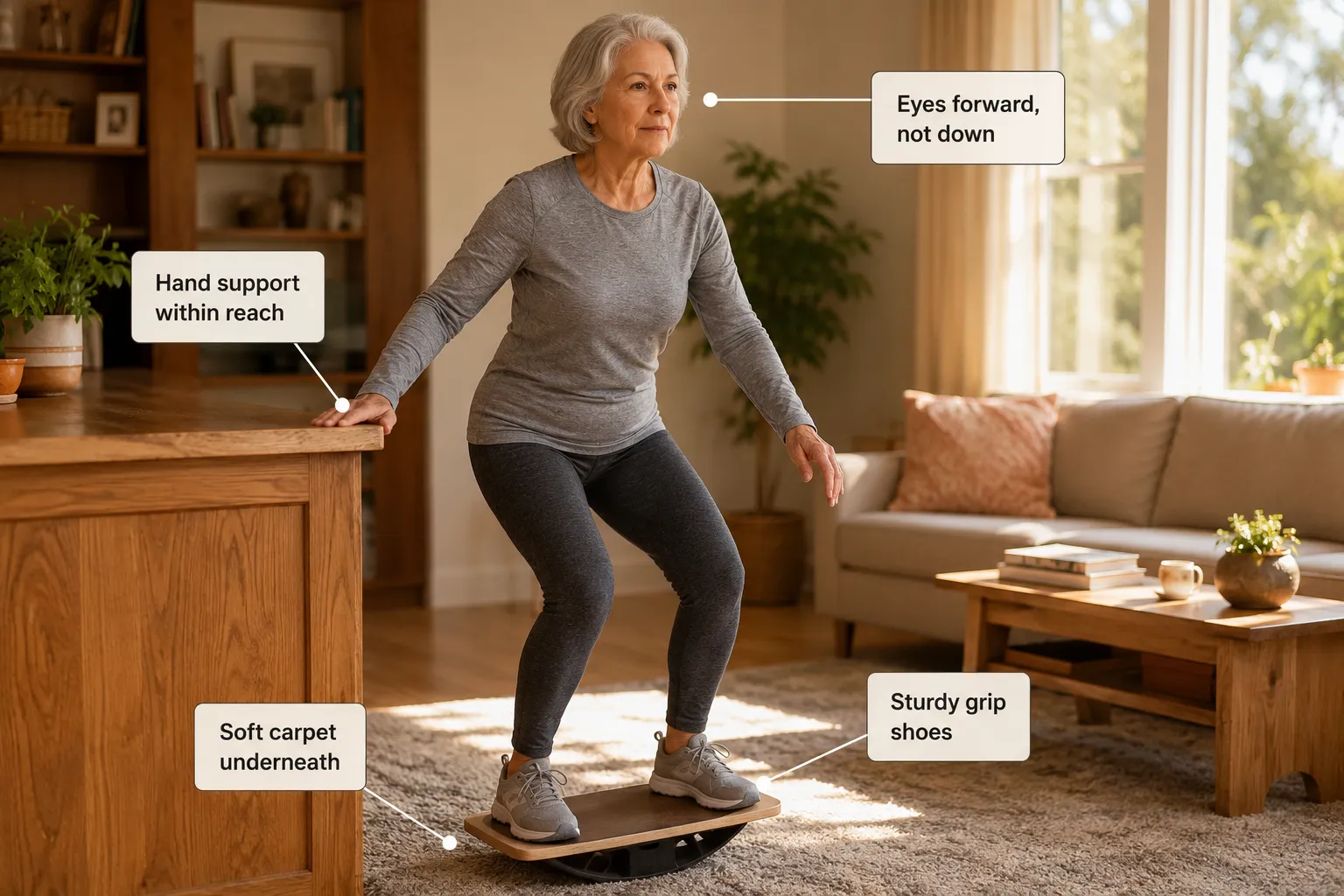
Balance boards can be safe for people over 70, but only with the right tool, setup, and medical clearance. The Mayo Clinic notes the same instability that trains balance can also cause falls if misused.[2] A 2025 medical-alert advisory recommends consulting a physician or physical therapist first, avoiding boards after a recent fall, wearing sturdy shoes, and always training near a grab bar or countertop.[7]

Safety checklist before your first session:

  • Medical clearance obtained
  • Board placed on carpet or a non-slip mat
  • Sturdy countertop, chair back, or grab rail within arm's reach
  • Sturdy closed-toe shoes with grip soles
  • Someone else in the home during initial sessions
  • Session limited to 5 minutes on day one

Seniors with peripheral neuropathy, severe osteoporosis, or recent joint replacement should get therapist guidance before starting.[7]

Balance Board Alternatives for Seniors

Not every older adult needs, or should use, a balance board. Effective alternatives include:

  • Tai chi, strong evidence for fall reduction, no equipment needed
  • Standing yoga, chair-supported variations are widely accessible
  • Heel-to-toe walking along a hallway with wall support
  • Single-leg stands at a kitchen counter
  • Resistance band lower-body work, builds the strength that balance depends on
  • Aquatic exercise, low-fall-risk environment with resistance

The strongest evidence for fall prevention supports multicomponent programs combining strength, aerobic exercise, and balance challenge, not any single tool.[3]

Do Balance Boards Actually Prevent Falls?

Yes, when used in structured programs, but not on their own. Peer-reviewed evidence shows 4 to 9 week balance-board programs improve standing balance, functional mobility, and Timed Up and Go scores in older adults.[1][13][15] Fall-prevention programs incorporating wobble-board training report roughly 23 to 28 percent lower fall risk with consistent use.[5][3]

However, the most reliable falls-prevention effect comes from multicomponent training, strength, aerobic work, and proprioceptive challenge together.[3] A balance board alone, used sporadically, produces modest gains. A balance board used three times weekly alongside squats, walking, and resistance work produces measurable fall-risk reduction.

Best Balance Boards for Small Spaces

A round wobble cushion or a 15-inch square foam pad works in any room and stores under a couch. Rocker boards with a 16 to 18 inch footprint fit beside most dining chairs. Avoid large half-dome trainers (24 inches or wider) if floor space is tight.

Space-saving picks:

  • Inflatable wobble disc, 14 inches, deflates for travel
  • Square foam pad, stacks flat against a wall
  • Wooden rocker board, 17 x 6 inches, stores vertically
  • Small round pivot board, 15 inch diameter, but higher instability

Train in a doorway or beside a kitchen counter to combine hand support with a small footprint.

Balance Board Training Programs for Older Adults

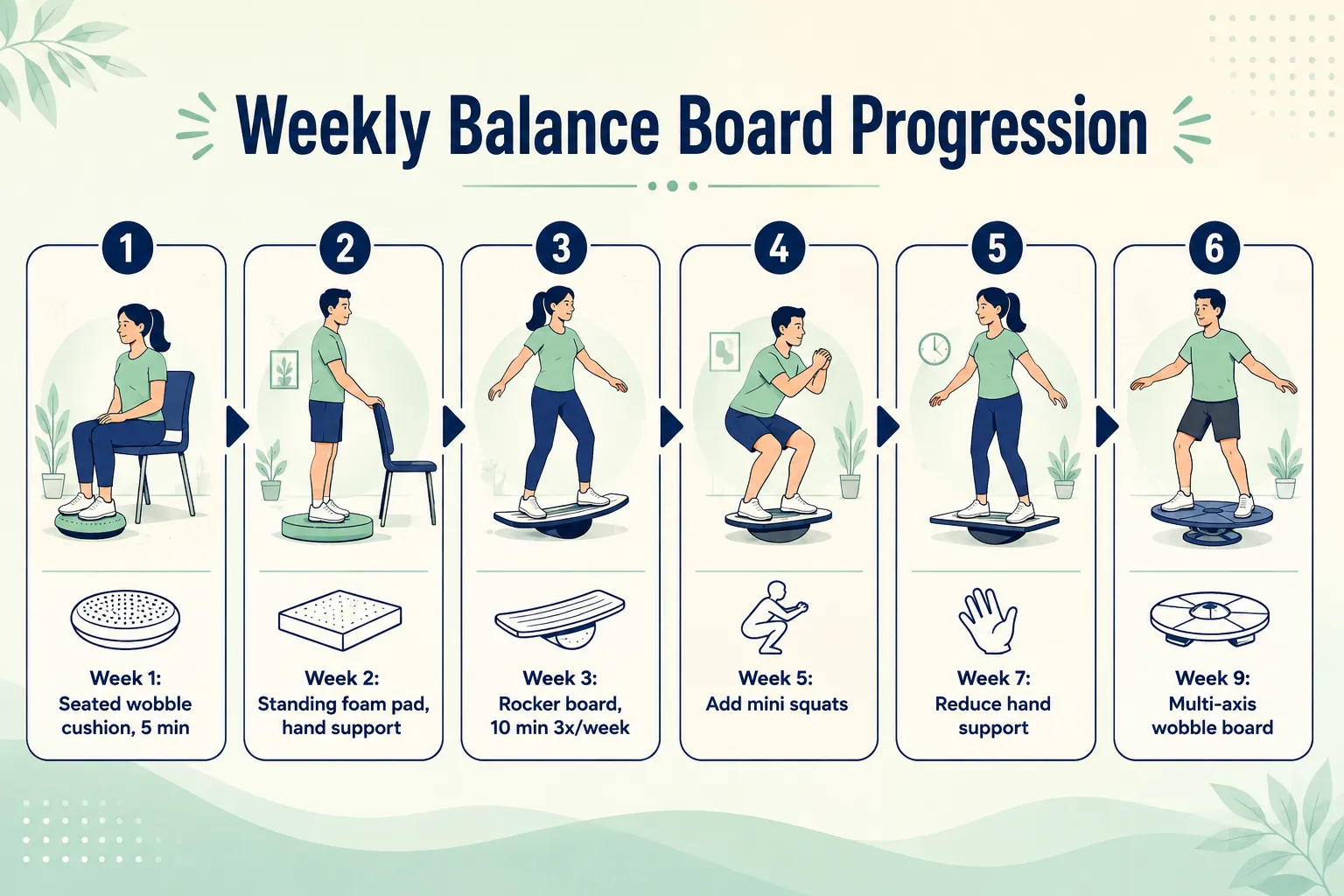
A structured program beats random practice. Below is an evidence-informed 9-week progression combining findings from wobble-board and multi-axis balance research.[1][9][10][13]

Balance Board Training Programs for Older Adults

Weeks 1-2: Seated wobble cushion, 5 minutes daily. Standing foam pad with two-hand support, 3 min, 3x/week.

Weeks 3-4: Rocker board with two-hand support, 10 min, 3x/week. Add slow weight shifts.

Weeks 5-6: Rocker board with one-hand support. Add mini squats and head turns.

Weeks 7-8: Reduce to fingertip support. Introduce 30-second single-leg attempts on a foam pad.

Week 9+: Consider a multi-axis board only if all prior weeks felt controlled. Continue 3x/week indefinitely, gains regress if training stops.[1][15]

Community centers, senior fitness classes, and physiotherapy clinics increasingly offer supervised versions of these programs.[6][15]

What to Avoid When Using a Balance Board as a Senior

The instability that makes a balance board effective is the same instability that can cause a serious fall. Respect the tool.

Avoid these mistakes:

  • Training alone during the first two weeks, have someone nearby
  • Barefoot on slippery hardwood, always use grip or a mat
  • Skipping hand support too early, progress support reduction over weeks
  • Long sessions, more than 15 minutes increases fatigue-related falls
  • Multi-axis boards as a beginner, start with foam or rocker
  • Training when tired, dizzy, or on new medication, postpone
  • Ignoring pain, sharp knee, hip, or ankle pain means stop
  • Using the board on stairs or near sharp furniture edges

Never use a balance board within 48 hours of a fall, and get clearance from a physician before restarting.[7]

Frequently Asked Questions

Can I use a balance board if I use a cane?
Only with therapist guidance. Cane users typically start with seated wobble-cushion work rather than standing on a board.[7]

How long until I see improvement?
Peer-reviewed programs show measurable gains at 4 to 9 weeks with 3 sessions per week.[1][13]

Should I close my eyes on the board?
Not as a beginner. Eyes-closed training is an advanced progression that should only be attempted with full hand support and after weeks of stable practice.

Are cheap balance boards safe?
Look for a weight rating well above your body weight, a non-slip surface, and a wide base. Inexpensive foam pads and rocker boards from reputable brands are generally safe.[11]

Can balance boards help after a hip replacement?
Only under a physical therapist's direction, and typically not within the first several months post-surgery.[7]

Do I need shoes on the board?
Sturdy closed-toe shoes with grip soles are recommended for standing work. Bare feet may be acceptable on foam pads with therapist approval.[5]

Will a balance board help with knee pain?
It can strengthen supporting muscles, but active knee pain should be evaluated first. Start with seated or very stable options.[4]

Is a BOSU ball better than a balance board?
Not for beginners. Half-dome trainers are moderately unstable and better suited to confident, mobile seniors. Start with a foam pad or rocker.

Can I use a balance board daily?
Yes, in short sessions. Most evidence supports 3 dedicated training days weekly, with light seated wobble-cushion use on other days.[9][10]

What if I feel dizzy on the board?
Stop immediately, sit down, and don't retry that day. Persistent dizziness needs medical evaluation before continuing.[2]

Conclusion

Balance boards and stability tools work, but only when matched to ability level and used consistently within a structured plan. Start with a foam pad or wobble cushion, train three times per week for 10 minutes near a countertop, and progress to a rocker board only when the basics feel controlled. Pair balance work with strength training and walking, get medical clearance if you have any fall history or vestibular issues, and treat every session with the respect an intentionally unstable device deserves.

Your next steps:

  1. Talk with your physician or physical therapist this week
  2. Order a low-profile foam pad or wobble cushion (under $40)
  3. Set up a safe training spot near a countertop or sturdy chair
  4. Follow the 9-week progression, three sessions per week
  5. Re-evaluate at week 4 and week 9 with your Timed Up and Go time or Berg score

Balance is trainable at any age. The tools are inexpensive, the time commitment is small, and the payoff, staying on your feet, independent, and mobile, is enormous.

References

[1] Balance Board Seniors Fall Prevention – https://www.bellenae.com/blogs/news/balance-board-seniors-fall-prevention
[2] Maintaining Equilibrium: The Benefits of Balance Boards – https://mcpress.mayoclinic.org/nutrition-fitness/maintaining-equilibrium-the-benefits-of-balance-boards/
[3] Physical Activity Programs for Balance and Fall Prevention in Elderly – https://pmc.ncbi.nlm.nih.gov/articles/PMC6635278/
[4] Balance Board For Seniors – https://neverleavetheplayground.com/balance-board-for-seniors/
[5] Fall Prevention Exercises – https://slides.neverleavetheplayground.com/fall-prevention-exercises.html
[6] Balance Boards For Seniors: A Fun And Effective Way To Improve Stability – https://fallpreventionfoundation.org/2025/02/07/balance-boards-for-seniors-a-fun-and-effective-way-to-improve-stability/
[7] Balance Boards For Seniors: Can They Reduce Fall Risk – https://www.medicalalertadvice.com/articles/balance-boards-for-seniors-can-they-reduce-fall-risk/
[8] Wobble-board training in older adults – https://pubmed.ncbi.nlm.nih.gov/10470668/
[9] Indo Balance Board Program in Older Adults – https://pmc.ncbi.nlm.nih.gov/articles/PMC6189151/
[10] Wobble-Board Training in Older Adults: Review – https://www.tandfonline.com/doi/full/10.1080/10833196.2021.1987042

Best Home Strength Training Equipment for Seniors: Safe, Space-Saving Options Reviewed

Best Home Strength Training Equipment for Seniors: Safe, Space-Saving Options Reviewed

Last updated: August 15, 2026

Quick Answer

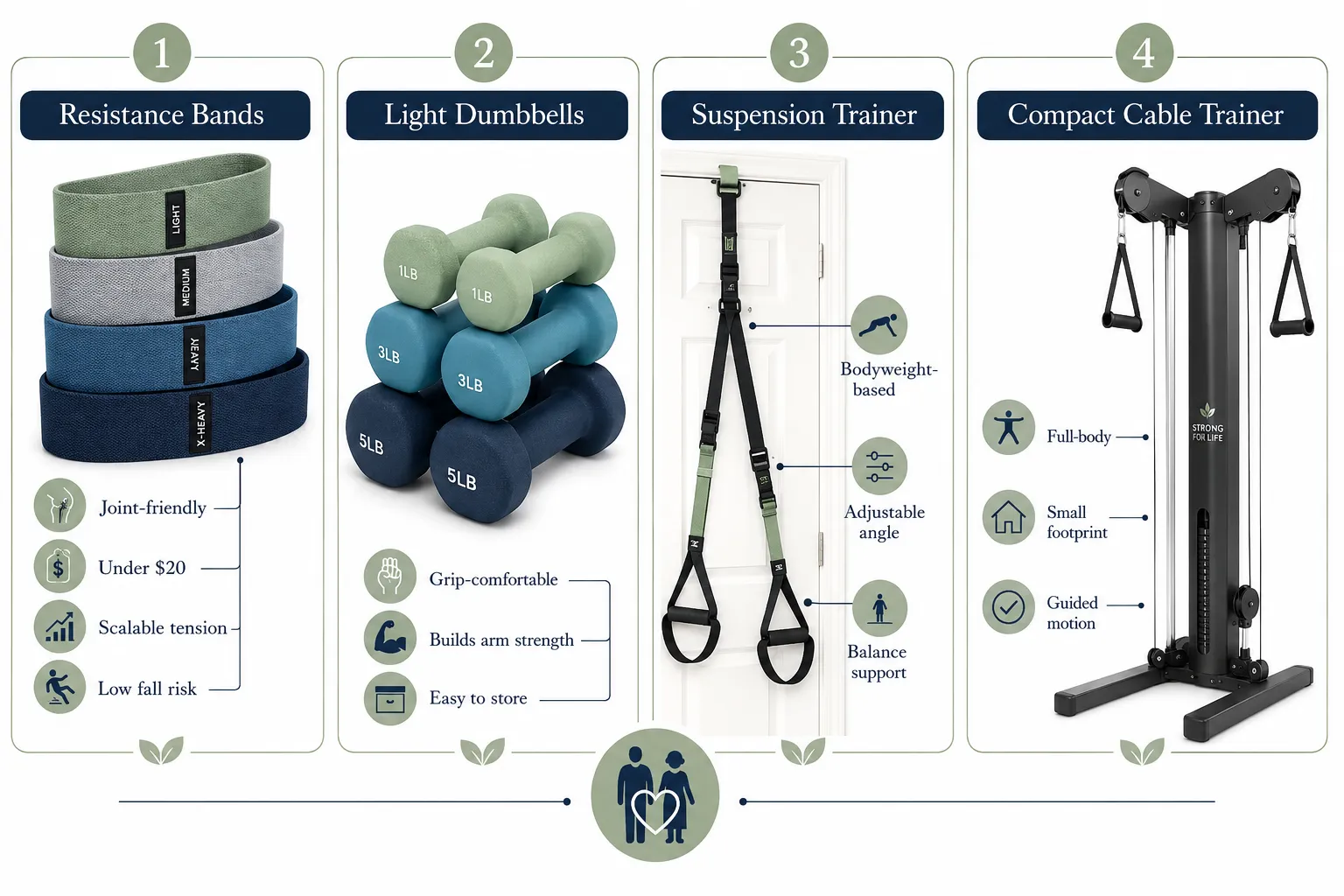
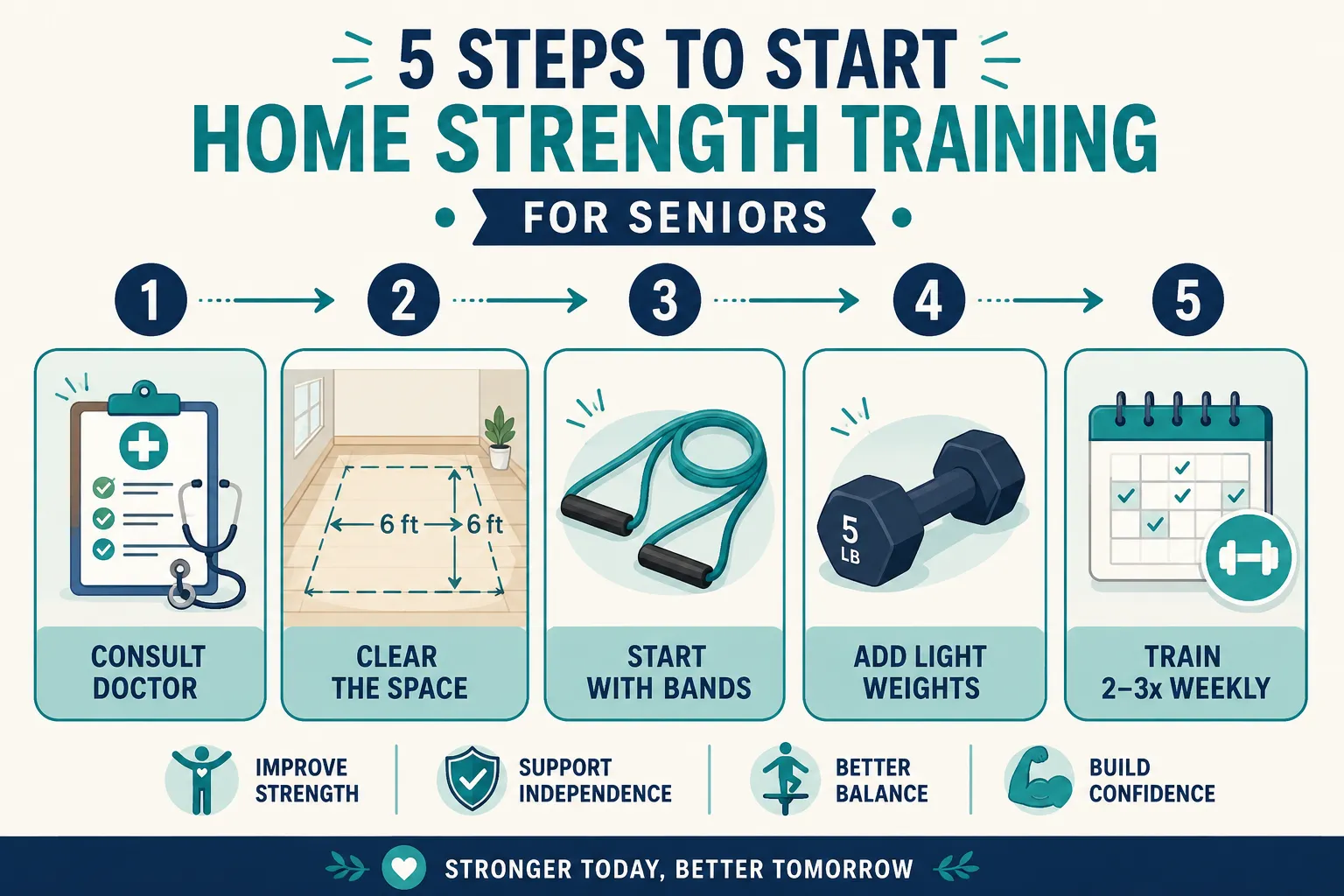
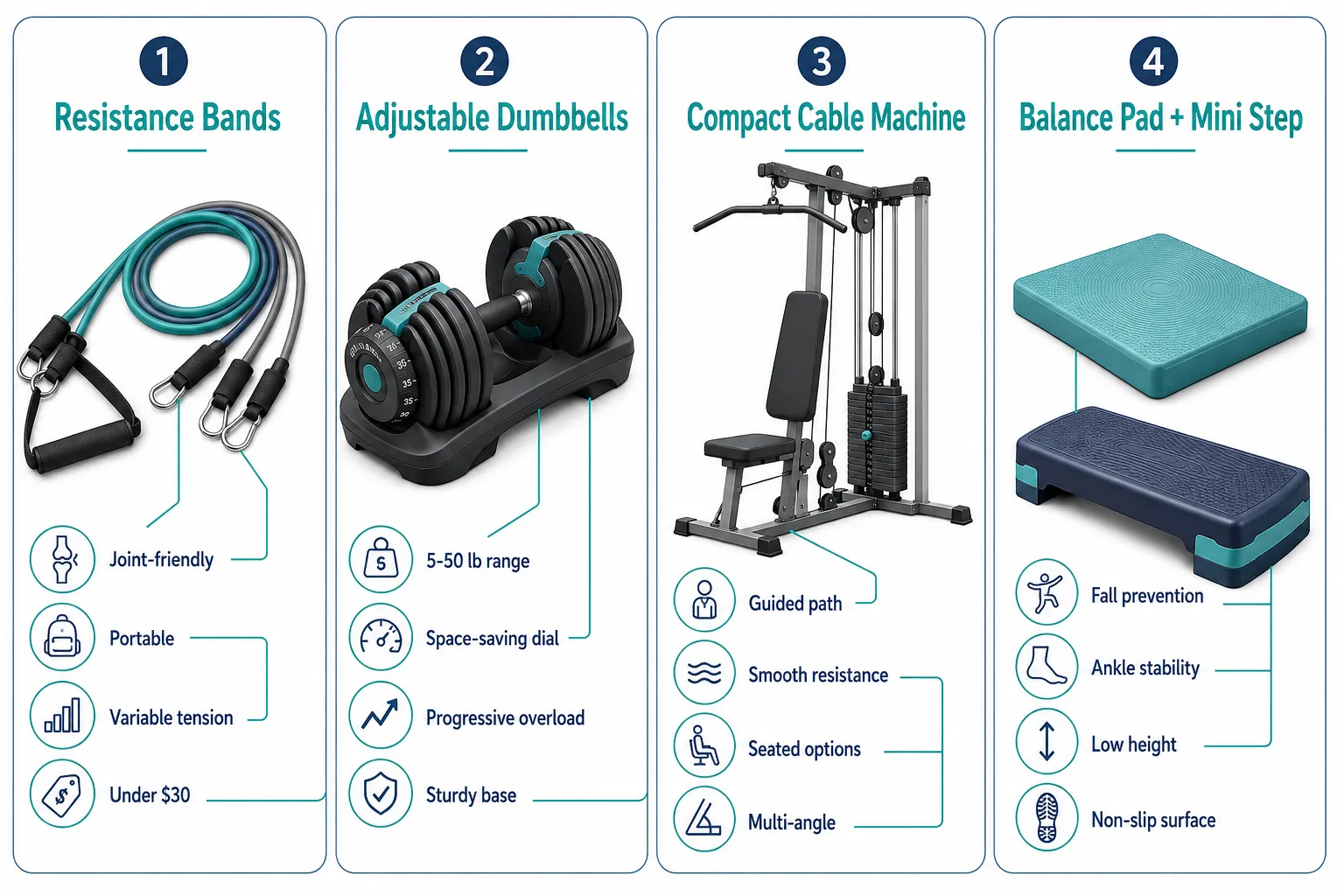
The best home strength training equipment for seniors combines safety, low joint impact, and small footprint. For most older adults, a starter kit of fabric resistance bands, light dumbbells (1-5 lb), a thick yoga mat, and a sturdy chair covers 90% of needs for under $55 [5][8]. Add adjustable dumbbells, a suspension trainer, or a compact cable system as strength improves. Resistance bands are widely called the "gold standard" for senior strength work because they're joint-friendly, scalable, and take up almost no space [10].

Key Takeaways

  • Start small: Bands + mat + light dumbbells cost $30,$55 and support strength, balance, and flexibility [5][8].
  • Bands beat dumbbells for most beginners due to gentler joint load and no drop risk [10].
  • Train 2 days a week minimum, hitting all major muscle groups [10].
  • Adjustable dumbbells (PowerBlock, Bowflex SelectTech) save the most space if you outgrow fixed weights [6].
  • Fabric bands over rubber, less snap risk and more comfort on skin [8].
  • Seated equipment (pedal exercisers, mini-ellipticals) works well for limited mobility [9][14].
  • Suspension trainers offer bodyweight resistance that scales with foot position, ideal for balance-focused strength.
  • Budget $150,$300 for a fully equipped senior home gym [8].
  • Consult a doctor before starting if you have heart, joint, or balance conditions [8].

What Strength Training Equipment Is Safe for Seniors?

The safest strength equipment for seniors shares three traits: low fall risk, controlled resistance, and forgiving joint load. Resistance bands, light dumbbells (1-5 lb), suspension trainers, and seated cable machines top the list because they let older adults build muscle without heavy loads dropping on feet or awkward barbell positions [1][10].

Safest categories for most seniors:

  • Fabric resistance bands, no snap risk, gentle on skin, scalable tension [8]
  • Light neoprene or hex dumbbells, coated grip, stable when set down [6]
  • Suspension trainers (TRX-style), resistance changes with body angle, no free weights overhead
  • Seated pedal exercisers and mini-ellipticals, zero fall risk, foldable [9][14]
  • Compact cable/functional trainers, guided motion path prevents form breakdown [3]

Avoid or delay: Olympic barbells, kettlebell swings, and plyo boxes over 12 inches unless you already train with a coach. The injury risk outweighs the benefit for most beginners over 65.

Best Compact Home Gym Equipment for Small Spaces

The best space-saving options for seniors fit in a closet or under a bed and still enable full-body strength work. Fabric bands, adjustable dumbbells, and door-anchored suspension trainers deliver the highest strength return per square foot [3][6].

Best Compact Home Gym Equipment for Small Spaces

Top compact picks for 2026:

Equipment Footprint Price Best For
Fabric resistance band set Drawer-size $15,$25 Beginners, arthritis [8]
Amazon Basics neoprene dumbbells Shelf ~$35 Fixed light weights [6]
Yes4All adjustable dumbbells Small floor space ~$79 Progressing lifters [6]
PowerBlock Elite adjustable 1 sq ft ~$299 Serious home gym, small space [6]
Bowflex SelectTech 552 1 sq ft ~$349 Convenience-focused [6]
Compact cable trainer Corner unit $400,$900 Full-body variety [3]

If you have less than 20 square feet, prioritize bands and one pair of adjustable dumbbells. That combo covers curls, presses, rows, squats, and deadlifts without ever needing a rack.

How Much Does Home Strength Training Equipment Cost?

Expect to spend $30,$50 to start and $150,$300 for a well-equipped senior home gym [8]. You do not need to spend more than that for excellent results.

Cost breakdown by tier:

  • Bare essentials ($30,$55): 3-4 fabric bands, yoga mat, light ankle weights [5][8]
  • Starter kit ($75,$150): Add fixed dumbbells (1, 3, 5 lb pairs) and a sturdy chair
  • Complete home gym ($150,$300): Add adjustable dumbbells or a suspension trainer, plus a stability ball [8]
  • Premium compact ($300,$700): PowerBlock or Bowflex adjustables, a foldable bench, and a mini cable system [6]

Decision rule: Spend on resistance tools first, cardio second. A June 2026 budget guide called dumbbells, bands, and racks the "big rocks" that deliver the most strength benefit per dollar [13].

Resistance Bands vs Dumbbells for Seniors: Which Is Better?

For most seniors, resistance bands win on safety and cost; dumbbells win on measurable progress. The right answer for you depends on grip strength, joint health, and how you like to track progress.

Choose resistance bands if you:

  • Have arthritis, weak wrists, or grip pain
  • Live in a very small space
  • Are new to strength training
  • Want the lowest injury risk [10]

Choose dumbbells if you:

  • Have healthy joints and good grip
  • Like seeing pound-by-pound progress
  • Prefer classic exercises (curls, presses, rows)
  • Already have a sturdy shelf for storage [1]

Most experts recommend using both. Bands handle rotator cuff work, lateral raises, and rehab-style moves. Dumbbells handle heavier compound lifts as strength grows [15].

Pull quote: "Resistance bands are the gold standard for senior strength training because they are joint-friendly, scalable, and space-saving." [10]

What Weight Should Seniors Lift at Home?

Most seniors should start with 1-5 lb dumbbells and light-to-medium resistance bands, then progress based on the "last 2 reps rule": the final two reps of a set should feel challenging but doable with good form [1][15].

Starter loads by exercise:

  • Biceps curls: 2-5 lb
  • Shoulder press: 1-3 lb
  • Triceps extensions: 1-3 lb
  • Bent-over rows: 3-8 lb
  • Squats (holding weight): bodyweight first, then 3-5 lb

Progress by adding 1-2 lb only after you can do 12-15 clean reps for two sets. There is no reward for lifting heavy at the cost of form, the goal is muscle preservation and function, not a personal record.

Can Seniors Build Muscle With Bodyweight Exercises?

Yes. Seniors can absolutely build muscle with bodyweight alone, especially in the first 6-12 months of training. Sit-to-stands, wall push-ups, step-ups, glute bridges, and modified planks stimulate the same muscle fibers that dumbbells do, just at a lower absolute load.

High-value bodyweight moves for seniors:

  • Sit-to-stand from a chair (functional squat)
  • Wall push-ups (chest, shoulders, triceps)
  • Step-ups on a low, stable step (legs, balance)
  • Glute bridges on the floor or mat
  • Bird-dog (core stability)

Add a $15 resistance band to any of these and you effectively double the training options. Bodyweight is the smartest starting point when equipment budget is zero.

Best Home Strength Training Equipment for Arthritis

For seniors with arthritis, the best equipment reduces gripping force, avoids impact, and allows partial ranges of motion. Fabric bands with padded handles, foam-covered light dumbbells, and seated cable machines top the list [2][8].

Best Home Strength Training Equipment for Arthritis

Arthritis-friendly gear:

  • Fabric resistance bands with soft handles, no white-knuckle gripping
  • Neoprene-coated dumbbells, softer than iron, easier on hands [6]
  • Wrist and ankle weights, attach without gripping [5]
  • Pedal exercisers, seated, uses foot straps, not hands [14]
  • Foam rollers and stability balls, supported mobility work [2]

Skip: Kettlebells (thumb strain), thick barbell grips, and pull-up bars if you have shoulder or hand arthritis.

How to Set Up a Small Home Gym for Seniors

Setting up a senior home gym takes about 6 by 6 feet of floor space, good lighting, and one sturdy anchor point. Prioritize a non-slip surface and a chair for stability before adding any equipment [8].

How to Set Up a Small Home Gym for Seniors

Five-step setup checklist:

  1. Clear a 6×6 ft area with no rugs, cords, or clutter
  2. Add a non-slip mat (thick enough for floor exercises)
  3. Place a sturdy chair nearby for balance and seated exercises
  4. Install one wall hook for hanging bands and a suspension trainer
  5. Keep water and a phone within reach for hydration and safety

Lighting matters: Poor lighting causes falls. If your space is dim, add a lamp before you add equipment.

Best Home Strength Training Equipment for Seniors: Safe, Space-Saving Options Reviewed

Below are the top-rated space-saving picks for 2026, organized by budget and skill level.

Under $50, Beginner essentials:

  • Fabric resistance band set (3-4 tensions): $15,$25 [8]
  • Thick yoga mat: $20
  • Ankle weights (1-2 lb pair): $15 [5]

$50,$150, Intermediate additions:

  • Amazon Basics neoprene dumbbells (2, 3, 5 lb pairs): ~$35 [6]
  • Yes4All adjustable dumbbells: ~$79 [6]
  • CAP Barbell coated hex dumbbell set: ~$99 [6]
  • Stability ball: $25

$150,$400, Complete senior home gym:

  • PowerBlock Elite adjustable dumbbells: ~$299 (best for space saving) [6]
  • Bowflex SelectTech 552: ~$349 [6]
  • BalanceFrom foam plyo box (for step-ups): ~$100 [7]

$400+, Premium compact systems:

  • Compact cable/functional trainer: $500,$900 [3]
  • Foldable weight bench + adjustable dumbbells combo [4]

For most seniors, the best home strength training equipment for seniors: safe, space-saving options reviewed here comes down to a $150 kit, fabric bands, one pair of adjustable dumbbells, a mat, and a stability ball. That covers strength, balance, and flexibility for years.

Is Strength Training Safe for Seniors Over 70?

Yes, strength training is not just safe, it's essential, for adults over 70, provided you start light and get medical clearance if you have heart, joint, or balance issues [8][10]. Research consistently shows resistance training helps preserve independence, reduce fall risk, and maintain bone density into the 80s and beyond.

Safety rules for 70+:

  • Warm up 5 minutes before every session (marching in place works)
  • Never hold your breath during a lift, exhale on effort
  • Use a chair or wall for balance during standing exercises
  • Stop immediately if you feel chest pain, dizziness, or sharp joint pain
  • Rest 48 hours between sessions targeting the same muscles

Common Mistakes Seniors Make With Home Workouts

The most common home-workout mistakes among seniors are skipping warm-ups, choosing weights that are too heavy or too light, and training inconsistently. Each one blunts progress or invites injury.

Top mistakes to avoid:

  • Skipping warm-ups, cold muscles tear more easily
  • Ego-lifting, using 10 lb when 3 lb would be better form
  • Under-loading forever, sticking with 1 lb bands for months without progression
  • Ignoring the legs, arms get all the love, but legs prevent falls
  • Training once a week, below the 2x/week minimum for results [10]
  • No rest days, muscles grow during recovery, not during the workout
  • Poor form on squats, knees caving in, back rounding

How Often Should Seniors Do Strength Training at Home?

Seniors should strength train at least 2 days per week, targeting all major muscle groups, with 48 hours between sessions on the same body part [10]. Three sessions a week is ideal for most; four is fine if you split upper and lower body.

Sample weekly schedule:

  • Monday: Full-body strength (30 min)
  • Tuesday: Walk + balance work
  • Wednesday: Full-body strength (30 min)
  • Thursday: Rest or gentle stretching
  • Friday: Full-body strength (30 min)
  • Weekend: Active recovery (walk, garden, swim)

Each session should include 6-8 exercises, 2 sets of 10-15 reps. That's it. More is not better at this stage, consistency is.

Alternatives to Expensive Home Gym Equipment

You do not need a $2,000 rack to build strength at 65+. Effective alternatives cost under $100 combined and use household items you already own.

Household strength "equipment":

  • Full water bottles (1 liter ≈ 2.2 lb), DIY dumbbells
  • Canned goods, light hand weights for shoulder work
  • A sturdy kitchen chair, squats, step-ups, tricep dips
  • A backpack loaded with books, weighted squats and rows
  • Bath towels, DIY sliders for core work on hard floors
  • Stairs, the best free cardio and leg trainer

Pair these with a $20 band set and you have a functional home gym for under $40.

What if I Have Limited Mobility? Can I Still Strength Train at Home?

Yes. Seniors with limited mobility can build meaningful strength using seated equipment and supported exercises. Pedal exercisers, mini-ellipticals, resistance bands anchored to a chair, and light dumbbells performed while seated are all effective [9][14].

Best equipment for limited mobility:

  • RYGEO pedal exerciser (~4 lb, 5 resistance levels, arms or legs) [14]
  • Sunny or MERACH foldable mini-ellipticals (12-16 resistance levels, 300 lb capacity) [14]
  • Seated resistance band routines anchored under chair legs
  • Light dumbbells for seated curls, presses, and rows [1]

Focus on frequency over intensity. Even 10 minutes twice a day of seated resistance work preserves muscle and improves circulation.

FAQ

Q: What is the single best piece of strength equipment for a senior beginner?
A: A fabric resistance band set. It's under $25, joint-friendly, scalable, and enables 30+ exercises [8][10].

Q: Are adjustable dumbbells worth it for seniors?
A: Yes, if you plan to train for more than 6 months. PowerBlock or Bowflex adjustables replace 5-8 pairs of fixed dumbbells and save closet space [6].

Q: How long until seniors see results from home strength training?
A: Most seniors notice strength gains in 4-6 weeks and visible muscle tone in 8-12 weeks with 2-3 sessions per week.

Q: Do I need a weight bench?
A: No. A sturdy chair covers 90% of what a bench does for seniors. Add a foldable bench only if you outgrow chair-based exercises.

Q: Are smart home gyms like Tonal good for seniors?
A: They can work well for tech-comfortable seniors, but the $3,000+ price is hard to justify when a $150 kit produces similar strength results.

Q: Can I strength train if I have osteoporosis?
A: Yes, and you should, with medical clearance. Focus on controlled resistance band work and light dumbbells; avoid heavy loaded spinal flexion [8].

Q: How much space do I really need?
A: A 6×6 foot area is enough for a complete senior home gym setup.

Q: Are ankle weights safe for walking?
A: Only for exercise sets, not for daily walking. Continuous walking with ankle weights can strain hips and knees.

Conclusion

The best home strength training equipment for seniors is whatever you'll actually use twice a week. For most older adults, that starts with a $30,$55 kit of fabric bands, a mat, and light dumbbells, and grows only when you outgrow it. Adjustable dumbbells, suspension trainers, and compact cable systems are worthwhile upgrades, but they're not the entry point.

Your next steps:

  1. Clear a 6×6 ft area at home this week
  2. Order a fabric band set and one pair of light dumbbells (under $50)
  3. Schedule two 30-minute sessions on your calendar
  4. Get medical clearance if you have any chronic conditions
  5. Track your reps for 8 weeks, you'll be surprised what changes

Start light, stay consistent, and the equipment will earn its keep many times over.

References

[1] The Best Home Workout Equipment For Seniors – https://sonoffood.com/2026/04/16/the-best-home-workout-equipment-for-seniors/
[2] Best – https://www.theseniorlist.com/exercise/best/
[3] The Best Home Gym Equipment For Seniors In 2025 – https://gym-mikolo.com/blogs/home-gym/the-best-home-gym-equipment-for-seniors-in-2025
[4] Best Home Gyms – https://www.garagegymreviews.com/best-home-gyms
[5] Best Fitness Equipment Seniors – https://silverbloomhealth.com/supplements/fitness/best-fitness-equipment-seniors/
[6] 7 Best Home Gym Equipment For Seniors – https://homefitnessspace.com/7-best-home-gym-equipment-for-seniors/
[7] 14 Best Home Gyms For Older Adults In 2026 – https://babazam.com/vetted/14-best-home-gyms-for-older-adults-in-2026/
[8] Exercise Equipment For Seniors – https://vitalspage.com/articles/exercise-equipment-for-seniors
[9] Best Core Workout Equipment For Seniors – https://rebootedbody.com/best-core-workout-equipment-for-seniors/
[10] Best Home Fitness Equipment For Seniors – https://www.senioreaseguide.com/best/best-home-fitness-equipment-for-seniors

Top Home Exercise Equipment for Seniors Who Want Strength, Not Impact

Top Home Exercise Equipment for Seniors Who Want Strength, Not Impact

Last updated: August 13, 2026

Quick Answer

The best home exercise equipment for seniors who want strength without impact is a small, focused kit: resistance bands, adjustable dumbbells, a sturdy bench, a balance pad, and a compact cable or selectorized machine. This setup builds functional muscle, protects joints, and supports fall prevention, the three goals that matter most after 60. Most older adults can start well-equipped for under $300, and national guidelines back moderate-to-heavy resistance training as core to healthy aging [6][8].

Key Takeaways

  • Resistance bands and adjustable dumbbells are the highest-value tools for senior strength training at home, cheap, quiet, and joint-friendly [1][4].
  • Seniors can and should lift heavier than "light toning weights." Position statements from the NSCA endorse moderate-to-vigorous loads for older adults when progressed safely [6][8].
  • A balance pad and mini-step turn a strength routine into a fall-prevention routine at almost no cost [9].
  • Skip high-impact equipment like plyometric boxes, heavy barbells without a rack, and treadmills used for running [3].
  • A complete senior home gym costs roughly $150,$800 depending on whether you add a cable machine or bench [1][3].
  • Train strength 2-3 days per week, with 8-12 reps per set, using a load that feels challenging by the last two reps [5].
  • Recumbent bikes and ellipticals support cardio and joint health, but they don't replace resistance work for muscle [7].
  • Common mistakes: going too light forever, skipping warm-ups, and buying equipment that requires floor work every session [4].

What home exercise equipment is best for seniors building strength

The best equipment for seniors building strength at home is adjustable dumbbells, resistance bands with handles, and a stable bench, in that order. These three tools cover every major muscle group, allow gradual progression, and keep impact on knees, hips, and spine to a minimum [1][4].

What home exercise equipment is best for seniors building strength

Ranked by how well they support functional strength, mobility, and fall prevention:

  1. Adjustable dumbbells (5-50 lb range), the single best purchase. One pair replaces an entire rack and lets you progress from very light to genuinely challenging loads.
  2. Loop and tube resistance bands, near-zero joint stress, ideal for shoulders, hips, and rotator cuff work.
  3. Sturdy adjustable bench, unlocks seated presses, supported rows, and step-ups.
  4. Balance pad + mini-step, direct fall-prevention training.
  5. Compact cable machine or functional trainer, smooth, guided resistance for anyone with shoulder or wrist issues [10].
  6. Ankle weights (1-5 lb), for hip and glute work that protects the lower back.

Choose adjustable dumbbells if you only buy one thing. Choose bands first if you have grip issues, arthritis in the hands, or a very tight budget.

Low impact strength training equipment for older adults

Low-impact strength equipment for older adults is anything that loads muscle without loading joints through jarring, jumping, or ballistic motion. The core categories are resistance bands, dumbbells used in controlled tempo, cable machines, and selectorized weight-stack machines [8][10].

What makes equipment low-impact:

  • Smooth resistance curves (cables and bands) instead of sudden drops.
  • Seated or supported positions that remove balance risk from the movement itself.
  • Adjustable range of motion so painful angles can be avoided.
  • No airborne phase, feet stay planted.

Selectorized machines (pin-loaded stacks) are having a moment in 2026 senior home gyms because they combine guided paths with instant load changes, no plates to lift onto a bar [10]. Compact versions like wall-mounted functional trainers fit in a spare bedroom.

How do resistance bands compare to weights for seniors

Resistance bands and dumbbells both build strength for seniors, but they excel at different jobs. Bands are best for shoulder health, warm-ups, travel, and joint-friendly high-rep work. Dumbbells are best for building real muscle mass and bone density because they load bones under gravity [4][6].

Feature Resistance Bands Adjustable Dumbbells
Cost $15,$60 $150,$400
Joint stress Very low Low with good form
Bone-loading effect Modest Strong
Progression Change band Turn dial
Best for Shoulders, hips, mobility Chest, back, legs, arms
Storage Drawer Small footprint

Decision rule: Own both. Bands for warm-ups and shoulders, dumbbells for the main lifts. If forced to pick one, choose adjustable dumbbells for anyone who can safely grip them.

Best home gym setup for seniors with arthritis

The best home gym setup for seniors with arthritis prioritizes grip-friendly handles, seated support, and machines with smooth, guided motion. Cable machines, bands with padded handles, and selectorized equipment all reduce hand and wrist strain compared to Olympic barbells [10].

Recommended arthritis-friendly setup:

  • Compact cable machine with rotating handles
  • Neoprene-coated dumbbells (softer grip than steel)
  • Resistance bands with thick foam handles
  • Recumbent bike for cardio without wrist load [7]
  • Non-slip mat and padded bench

Avoid: fixed-grip Olympic barbells, kettlebells with narrow handles, and pull-up bars. These force your wrists and fingers into positions inflamed joints don't tolerate.

Can seniors build muscle without high impact exercise

Yes, seniors can absolutely build muscle without any high-impact exercise. Muscle grows in response to progressive tension, not impact. Studies summarized by the National Strength and Conditioning Association confirm that older adults training with machines, dumbbells, and bands at moderate-to-vigorous intensity build meaningful muscle and reverse sarcopenia [6][8].

Can seniors build muscle without high impact exercise

The mechanism is simple: muscle fibers respond to being challenged near their limit, whatever the source of resistance. A slow, controlled 12-rep set of dumbbell rows produces adaptation similar to any traditional strength method, without a single jump or drop landing.

"The old advice to stick with light weights after 50 has been replaced. Current guidance says older adults benefit from heavier loading, safely progressed." [5][6]

What equipment should seniors avoid for joint safety

Seniors should generally avoid equipment that demands impact, extreme range of motion, or unsupported balance under load. This isn't about age fear, it's about risk-to-reward ratio [3][4].

Skip or use with caution:

  • Plyo boxes and jump ropes, high impact on knees and ankles
  • Treadmills used for running (walking is fine)
  • Heavy barbell back squats without a rack and spotter
  • Ab wheels and roman chairs, hard on the lumbar spine
  • Cheap vibration plates, poor evidence for strength
  • BOSU balls loaded with heavy weights, fall risk outweighs benefit

The pattern: anything that combines heavy load with unstable base, or that requires airborne landings, belongs in an athlete's gym, not a senior's.

How much does a home gym for seniors cost

A functional senior home gym costs $150 to $800 depending on how far you go. Bare essentials, bands, a mat, ankle weights, can come in under $55 as of April 2026 [9]. A complete setup with adjustable dumbbells, bench, and a balance pad lands around $400,$600 [1][3].

Tiered budgets:

  • Starter ($55,$150): Resistance band set, yoga mat, 2 lb ankle weights, balance pad
  • Standard ($300,$600): Add adjustable dumbbells (5-50 lb), foldable bench, mini-step
  • Premium ($800,$2,500): Add a compact cable machine or selectorized multi-station [10]

A quality adjustable dumbbell pair often replaces $500+ worth of fixed dumbbells and saves square footage, usually the best single line item on the receipt.

Stationary bikes vs recumbent bikes for senior strength

Neither bike is primarily a strength tool, but recumbent bikes win for seniors because the seated, back-supported position removes pressure from the lower spine and wrists [7]. Upright stationary bikes work fine for fit seniors with no back issues.

For actual leg strength, though, bikes are a supplement, not the main event. Loaded step-ups, banded squats to a chair, and dumbbell deadlifts build far more functional lower-body strength than pedaling. Use the recumbent bike for warm-ups, cardio days, and joint-friendly conditioning, not as a replacement for resistance work [7].

Does a rowing machine work for seniors with back pain

A rowing machine can work for seniors with back pain, but only if the person has good hip mobility and is coached on form. The row is a hip-hinge, not a lower-back pull. Poor form turns it into repeated lumbar flexion under load, exactly what most back-pain sufferers should avoid [4].

Does a rowing machine work for seniors with back pain

Safer alternatives for back-pain seniors:

  • Seated cable rows (chest supported)
  • Banded rows with feet against a wall
  • Chest-supported dumbbell rows on an incline bench

If you love rowing, use a magnetic-resistance rower, keep the damper low, and stop the moment form breaks.

What weight should seniors start with for home training

Seniors should start with a weight that lets them complete 8-12 clean reps with 2 reps still in reserve. For most healthy older beginners, that's 3-8 lb dumbbells for shoulder work and 8-20 lb dumbbells for rows, presses, and squats to a chair [5].

The 2026 Harvard Health resistance prescription for older adults is straightforward:

  • 2-3 sessions per week
  • 8-12 reps per set
  • 2-3 sets per exercise
  • Rest 60-90 seconds between sets
  • Increase weight when 12 reps feels easy

The mistake isn't starting too heavy, it's staying too light forever. Progress the load every 2-3 weeks [5][6].

How often should seniors do strength training at home

Seniors should strength train two to three non-consecutive days per week, with each session lasting 30-45 minutes. This frequency is enough to build muscle and preserve bone density without overloading recovery [6][8].

A sample week:

  • Monday: Full-body strength (dumbbells + bench)
  • Tuesday: Balance + recumbent bike, 20 min
  • Wednesday: Rest or gentle walk
  • Thursday: Full-body strength (bands + cable)
  • Friday: Balance pad work + mobility
  • Saturday: Optional light strength or walk
  • Sunday: Rest

Balance training deserves its own slot 2-3 times a week, it's the single biggest fall-prevention lever [9].

Cable machines vs free weights for senior safety

Cable machines are generally safer than free weights for seniors because the resistance path is guided and the load can't fall on you. Free weights build more stabilizer strength but require better balance and technique [10].

Choose cable machines if you train alone, have shoulder impingement, or have any fall history.

Choose free weights if you have good balance, a training partner nearby, and want maximum functional carryover to daily life (carrying groceries, lifting grandkids).

Best of both worlds: a compact functional trainer at home covers 80% of what a commercial gym does, in a 4×4 ft footprint [10].

Common mistakes seniors make with home exercise equipment

The most common mistakes are buying too much, going too light, and neglecting warm-ups. Each one quietly kills results [4][5].

Top mistakes to avoid:

  • Buying a treadmill and calling it strength training. It isn't.
  • Sticking with 3 lb dumbbells for years. Muscle needs progressive challenge.
  • Skipping the 5-minute warm-up. Cold joints don't like sudden load.
  • Training the same muscles daily. Recovery is when muscle grows.
  • Ignoring the legs. Lower-body weakness predicts falls better than almost any other marker [9].
  • No balance work. Strength without balance still leaves fall risk on the table.

What if I have limited space for senior workout equipment

Limited space isn't a barrier, a full senior strength routine fits in 9 square feet. The key is choosing tools that stack, fold, or hide in a closet [3].

Small-space essentials:

  • One pair of adjustable dumbbells (footprint: 2 ft x 1 ft)
  • Resistance band set (fits in a drawer)
  • Foldable bench (stores vertically)
  • Balance pad (leans against the wall)
  • Wall-mounted cable trainer (uses zero floor space when folded)

Apartment dwellers should prioritize quiet gear. Bands, dumbbells on rubber mats, and cable machines make almost no noise, no dropped plates, no impact through the floor [1].

Conclusion

The strongest, safest home setup for older adults isn't a wall of machines, it's a focused kit built around adjustable dumbbells, resistance bands, a bench, and a balance pad. This is the top home exercise equipment for seniors who want strength, not impact, because every piece loads muscle without punishing joints. Add a compact cable machine if the budget allows and you want maximum arthritis-friendly versatility [10].

Actionable next steps:

  1. Start with a $150 kit: adjustable-tension bands, a mat, and a balance pad.
  2. Add adjustable dumbbells within 30 days once you know you'll stick with it.
  3. Train 2-3 days a week, 8-12 reps, and progress the weight every 2-3 weeks [5].
  4. Add balance-pad work to at least three sessions per week.
  5. Reassess your load every month, if 12 reps feels easy, it's time to go heavier.

Strength after 60 isn't optional, it's the closest thing there is to a longevity drug. The equipment above makes it accessible from a spare corner of any room.

FAQ

Is it too late to start strength training at 70 or 80?
No. Research consistently shows adults in their 70s, 80s, and 90s gain muscle and function from resistance training [6][8]. Start light, progress slowly, and see a doctor first if you have cardiac or orthopedic issues.

Are resistance bands enough on their own?
For beginners and anyone with joint issues, yes, for a while. Bands build real strength for the first 6-12 months. After that, most seniors benefit from adding dumbbells or a cable machine to keep progressing [4].

Do I need a personal trainer to start?
Not required, but 2-3 sessions with a senior-focused trainer or physical therapist to check form is one of the best investments you can make.

How long until I see results?
Most seniors feel stronger in daily tasks (stairs, groceries, getting up from chairs) within 4-6 weeks of consistent training [5].

What's the single best exercise for fall prevention?
Loaded step-ups combined with balance-pad standing work. They train the exact muscles and reflexes used to catch yourself [9].

Can I use household items instead of equipment?
Yes, water jugs, canned goods, and a sturdy chair cover basic movements. But adjustable equipment eventually becomes worth the cost because progression is smoother [1].

Should I do cardio or strength first?
For seniors focused on muscle and fall prevention, do strength first, cardio second. Cardio before heavy lifting fatigues the legs and increases fall risk during the strength session [7].

Is soreness normal?
Mild soreness for 1-2 days is normal for beginners. Sharp joint pain is not, stop and reassess form or load.

References

[1] Best Home Gym Equipment For Seniors – https://www.ritfitsports.com/blogs/article/best-home-gym-equipment-for-seniors
[2] Best – https://www.theseniorlist.com/exercise/best/
[3] Home Gym For Seniors – https://garagegymbuilders.com/guides/home-gym-for-seniors/
[4] Best Strength Training Equipment For Seniors – https://rebootedbody.com/best-strength-training-equipment-for-seniors/
[5] Strength Training After 50 Guidelines – https://dailycrunch.org/articles/strength-training-after-50-guidelines
[6] Resistance Training For Older Adults – https://www.nsca.com/about-us/position-statements/resistance-training-for-older-adults/
[7] Best Ellipticals For Seniors – https://barbend.com/best-ellipticals-for-seniors/
[8] Resistance Training For Older Adults Position.1 – https://www.nsca.com/contentassets/2a4112fb355a4a48853bbafbe070fb8e/resistance_training_for_older_adults__position.1.pdf
[9] Best Low Impact Senior Gym Gear – https://www.fuelingfitnessandfindingfocus.com/2026/04/best-low-impact-senior-gym-gear.html
[10] Best Resistance Training Machines For Seniors – https://www.ofzenandcomputing.com/best-resistance-training-machines-for-seniors/

Functional strength training for older adults at home

Functional strength training for older adults at home

{"cover":"Professional landscape format (1536×1024) editorial hero image with bold text overlay 'Functional Strength at Home' in crisp white sans-serif on a warm-toned semi-transparent panel, centered with 8% safe margins. Background: bright natural-light photograph of an active 70-year-old woman in athletic wear performing a sit-to-stand exercise from a sturdy wooden chair in a sunlit living room, resistance band nearby on hardwood floor, houseplants and large window with soft morning light, warm color grade, magazine cover polish, shallow depth of field, inspiring and dignified mood.","content":["Bright editorial photograph in landscape format (1536×1024) of a diverse group of three older adults (Asian man in his 70s, Black woman in her 60s, white man in his 80s) doing bodyweight squats and wall push-ups in a sunlit home living room, wearing casual athletic clothing, resistance bands and light dumbbells on a yoga mat nearby, natural window light streaming in, warm neutral palette, high editorial quality, candid and encouraging atmosphere, shallow depth of field","Split-screen editorial landscape image (1536×1024): left half shows an older woman in her late 60s carrying grocery bags up porch steps with confident posture in bright outdoor daylight; right half shows the same style of woman performing a farmer's carry with two small dumbbells in a bright home kitchen, symbolizing how functional training translates to daily life; warm natural lighting, magazine editorial polish, no text overlays, clean composition","Flat vector infographic in landscape format (1536×1024) showing a weekly functional training schedule for seniors: seven day-of-week icons across the top, with small illustrated exercise icons (chair squat, wall push-up, heel raise, band row, single-leg stand) mapped to three training days, rest and walking icons on other days; soft sage green, cream, and terracotta palette, short labels max 3 words each, generous 8% safe margins, clean modern design, save-worthy Pinterest infographic quality"}

Professional landscape hero image () with a reading "Functional Strength Training for Older". CRITICAL TYPOGRAPHY RULES:

Last updated: August 11, 2026

Strength-focused programs for seniors have climbed into the top worldwide fitness trends this year, and most of that momentum is happening in living rooms, not gyms. The reason is simple: home-based routines using resistance bands, light dumbbells, and bodyweight moves deliver the same fall-prevention and independence benefits as commercial gym programs, without the commute, cost, or intimidation factor.

Quick Answer

Quick Answer

Functional strength training for older adults at home means practicing movements that mirror real daily tasks, standing up from a chair, climbing stairs, carrying groceries, reaching overhead, using bodyweight, resistance bands, or light dumbbells. Most adults over 60 should aim for 2 to 3 sessions per week, 20 to 40 minutes each, targeting the legs, hips, core, and upper body. Done consistently, it reduces fall risk, protects independence, and produces visible strength gains within 6 to 12 weeks.

Key Takeaways

  • Functional training beats traditional lifting for seniors because it trains movement patterns used in daily life, not isolated muscles.
  • 2 to 3 non-consecutive days per week is the sweet spot for most older adults.
  • A sturdy chair, a wall, and a set of resistance bands are enough to start, no gym required.
  • Fall risk drops significantly when programs include balance work alongside strength (backed by decades of research from the CDC and WHO guidelines).
  • Arthritis is not a reason to avoid strength training, in most cases, it's a reason to start.
  • Expect noticeable strength gains in 6 to 8 weeks and functional improvements (easier stairs, better balance) within 4 weeks.
  • Progression matters more than intensity, small weekly increases work better than pushing hard once.
  • A physical therapist is ideal for anyone recovering from injury or surgery; a trainer is optional for healthy beginners.

)

What Is Functional Strength Training and Why Does It Matter for Seniors

Functional strength training is exercise designed around real-world movements, squatting, pushing, pulling, hinging, carrying, and rotating, rather than isolated muscle work like bicep curls. For older adults, it matters because it directly protects the abilities that keep people independent: getting off the toilet, climbing into a car, catching yourself when you trip, lifting a grandchild.

After age 30, adults lose roughly 3-8% of muscle mass per decade, and that rate accelerates after 60. This loss (called sarcopenia) is the single biggest predictor of losing independence in later life. Functional training slows and often reverses it while also training the nervous system to coordinate movement, the piece that pure weight machines miss.

The goal isn't to look strong. It's to still be able to do what you love at 85.

Functional Strength Training vs Regular Weight Lifting for Older Adults

The short answer: Functional training is usually the better default for adults over 60, but traditional lifting still has a place, especially for building raw strength in specific muscles.

Here's how they compare:

Feature Functional Strength Training Traditional Weight Lifting
Movement pattern Multi-joint, real-life motions Often single-joint, isolated
Equipment needed Minimal (bands, bodyweight, light weights) Machines, barbells, gym access
Balance component Built-in Usually absent
Injury risk (untrained) Lower Higher
Best for Daily independence, fall prevention Peak strength, bodybuilding goals
Home-friendly Excellent Limited

Choose functional training if your goal is staying independent, preventing falls, or moving better in daily life. Add traditional lifting if you already have a strength base and want to target specific weak areas (like grip or shoulder strength).

Best Functional Strength Exercises You Can Do at Home Without Equipment

The most effective home routine covers five movement patterns. Start with these bodyweight versions:

1. Sit-to-stand (chair squat), Sit on a sturdy chair, feet flat, arms crossed. Stand up without using hands. Sit back down with control. Trains the same muscles used to get off the toilet or out of a car. Start with 2 sets of 8-10.

2. Wall push-up, Stand arm's length from a wall, hands at shoulder height. Bend elbows to bring your chest toward the wall, then push back. Builds pushing strength for getting up from the floor. 2 sets of 8-12.

3. Heel raises, Stand behind a chair, hold the back for balance. Rise onto the balls of your feet, then lower slowly. Strengthens calves and ankles for stairs and walking. 2 sets of 12-15.

4. Standing hip hinge, Stand tall, hands on hips. Push hips back like closing a car door with your rear, keeping your back flat. Return upright. Trains the pattern for picking things up safely. 2 sets of 10.

5. Single-leg stand, Hold a counter, lift one foot slightly. Balance for 10-30 seconds. Switch sides. The single best fall-prevention drill. 3 times per leg.

Do the whole circuit 2-3 times per week. Add 1-2 reps per week as it gets easier.

How Often Should Older Adults Do Functional Strength Training

Two to three sessions per week, on non-consecutive days. That's the standing recommendation from the World Health Organization and the American College of Sports Medicine for adults 65 and older.

A practical week looks like this:

  • Monday: 30-minute strength session
  • Tuesday: Walking or light activity
  • Wednesday: Rest or gentle stretching
  • Thursday: 30-minute strength session
  • Friday: Walking
  • Saturday: Optional third strength session or balance work
  • Sunday: Rest

Muscles need 48 hours to recover and rebuild, which is why back-to-back strength days aren't ideal for beginners. If you're feeling more energetic, add walking or gentle mobility on off days, not more lifting.

Can Functional Strength Training Help Prevent Falls in Seniors

Can Functional Strength Training Help Prevent Falls in Seniors

Yes, this is one of the most consistently supported findings in geriatric research. Programs that combine strength (especially lower body) with balance work reduce fall rates by roughly 20-30% in community-dwelling older adults, according to systematic reviews cited in WHO and CDC guidelines.

Falls happen when three things fail at once: leg strength, balance reactions, and ankle stability. Functional training hits all three. The exercises that matter most:

  • Sit-to-stands (leg strength)
  • Single-leg stands (static balance)
  • Heel-toe walking (dynamic balance)
  • Step-ups on a low step (reactive strength)
  • Heel and toe raises (ankle stability)

Include at least one balance-focused move every session. Progress by narrowing your base of support (feet together → tandem stance → single leg), then by closing your eyes briefly while holding a counter.

)

What Equipment Do You Need to Start Functional Strength Training at Home

You need almost nothing to start. A sturdy chair, a wall, and enough floor space to lie down cover 80% of a beginner program.

When you're ready to add resistance, buy in this order:

  1. A set of resistance bands (loop bands and long tube bands with handles), $15-30. Most versatile purchase you can make.
  2. Light dumbbells, start with a pair each of 2, 5, and 8 lbs. Adjustable dumbbells save space.
  3. A yoga mat for floor work, $20.
  4. A stable step (an actual exercise step or the bottom stair) for step-ups.
  5. A door anchor for bands, under $10, unlocks rowing and pulling movements.

Skip the vibration plates, ab rollers, and complicated machines. They're marketing, not fitness.

Is Functional Strength Training Safe for People With Arthritis or Joint Pain

Yes, and for most people with osteoarthritis, it's actively recommended. The Arthritis Foundation and every major rheumatology guideline lists resistance training as a first-line treatment for joint pain, because stronger muscles offload stressed joints.

The rules for training with arthritis:

  • Move through pain-free ranges only. If a squat hurts at the bottom, don't go as low.
  • Warm up longer, 5-10 minutes of walking or gentle mobility before strength work.
  • Expect stiffness, not sharp pain. A little discomfort during exercise is fine. Sharp, stabbing, or joint-line pain is a stop signal.
  • Slow tempo helps. Take 3 seconds to lower and 2 seconds to rise. This reduces joint stress.
  • Bad days happen. On flared-up days, do less volume or switch to gentle range-of-motion work.

If you have rheumatoid arthritis, a joint replacement, or severe joint damage, get clearance from your doctor or physical therapist before starting.

How Long Does It Take to See Results From Functional Strength Training

Most older adults notice functional improvements within 2-4 weeks and measurable strength gains within 6-8 weeks. The pattern typically looks like this:

  • Weeks 1-2: Better coordination, exercises feel less awkward. Not much visible change.
  • Weeks 3-4: Stairs feel easier. Getting up from chairs is smoother. Balance improves.
  • Weeks 6-8: You can do more reps or heavier resistance. Posture often improves.
  • Weeks 12+: Real muscle changes. Clothes may fit differently. Daily tasks feel notably easier.
  • 6 months+: Bone density improvements (especially with weight-bearing moves), significant fall-risk reduction.

The catch: results reverse quickly if you stop. Two weeks off is enough to lose noticeable strength after 60. Consistency beats intensity, three modest sessions per week for a year outperforms two hard weeks followed by quitting.

Functional Strength Training for Seniors With Limited Mobility

Limited mobility doesn't disqualify anyone from strength training, it just changes the starting point. Seated and supported exercises can build meaningful strength for people who can't stand for long, use a walker, or are recovering from surgery.

A seated functional routine:

  • Seated marches, lift knees alternately, 30 seconds
  • Seated leg extensions, straighten one knee, hold 2 seconds, lower
  • Seated overhead press with light dumbbells or soup cans
  • Seated rows with a resistance band anchored to a doorknob
  • Ankle circles and heel-toe pumps for circulation and ankle strength
  • Seated torso rotations, arms crossed, rotate side to side

If standing is possible with support, add supported sit-to-stands (using arms), counter-supported heel raises, and gentle marches while holding a counter. Progress by reducing how much you rely on the support, not by rushing to standing exercises.

Common Mistakes Older Adults Make When Doing Strength Training at Home

Common Mistakes Older Adults Make When Doing Strength Training at Home

The biggest errors are almost always about approach, not exercise choice:

  1. Going too easy for too long. If 12 reps feels effortless, it's not building strength. The last 2-3 reps should feel challenging.
  2. Skipping warm-ups. 5 minutes of walking or marching in place prevents most tweaks and pulls.
  3. Holding the breath. Exhale on effort (the hard part), inhale on the easier part. Breath-holding spikes blood pressure.
  4. Ignoring the lower body. Legs and hips drive independence. Don't spend all your time on arms.
  5. No progression plan. Doing the same routine at the same difficulty for months stops producing results.
  6. Skipping balance work. Strength without balance still leaves fall risk on the table.
  7. Comparing to old fitness levels. The goal is progress from where you are today, not returning to age 40.

Should You Get a Trainer or Do Functional Strength Training on Your Own

A qualified trainer or physical therapist is worth the investment for the first 4-8 sessions if you're new, recovering from injury, or managing chronic conditions. After that, most healthy older adults can train independently using video guidance and a written program.

Get professional help if:

  • You've had a recent surgery, fall, or hospitalization
  • You have Parkinson's, MS, severe arthritis, or heart conditions
  • You've never done resistance training and want form checked
  • Your balance is already impaired

You can start solo if:

  • You're generally healthy and cleared by your doctor
  • You can follow along with reputable video programs (many senior-specific programs exist on YouTube from licensed physical therapists)
  • You start conservatively and progress slowly

The National Institute on Aging's free "Go4Life" workout materials are a solid starting point built specifically for older adults.

Functional Strength Training vs Yoga for Older Adults: Which Is Better

They solve different problems, and the best answer is often both. Strength training builds muscle and bone. Yoga builds flexibility, balance, and body awareness.

Functional Strength Training Yoga
Best at Building muscle, preserving bone, fall prevention Flexibility, balance, stress relief
Cardiovascular Moderate Low (except vigorous styles)
Muscle gains High Modest
Joint mobility Moderate High
Accessibility High High (chair yoga available)

Choose strength training first if you're losing muscle, worried about falls, or need to protect bone density. Add yoga for mobility, balance, and mental well-being. Two strength sessions plus one yoga session per week is an excellent combination for most adults over 60.

How to Modify Functional Strength Exercises if You Have Balance Issues

Every standing exercise can be modified by adding support, changing the base of support, or moving to a seated version. The rule: never train balance in a position where a real fall could happen.

Balance-friendly modifications:

  • For squats: Hold the back of a chair with both hands, then one hand, then fingertips as balance improves
  • For lunges: Do split squats holding a counter, or replace with step-ups
  • For single-leg stands: Start touching a wall with your hand, then a counter, then no support with a chair nearby
  • For overhead work: Sit in a chair with back support
  • For anything on the floor: Have a chair or sturdy furniture nearby to help you get up

Train balance in a safe corner (walls on two sides, a chair in front) so a stumble means grabbing furniture, not falling.

)

What's the Difference Between Functional Training and Physical Therapy for Seniors

Physical therapy treats specific medical problems; functional training builds general fitness. A physical therapist diagnoses movement issues, uses exercises as medicine to fix them, and is covered by insurance when prescribed. Functional training is a maintenance and improvement program you do on your own or with a trainer.

See a physical therapist for:

  • Recent injury, surgery, or fall
  • Persistent pain that limits daily activities
  • Neurological conditions (stroke recovery, Parkinson's)
  • Significant balance decline
  • After a hospitalization

Do functional training for:

  • Maintaining and building strength over years
  • Preventing decline before it starts
  • General fitness, weight management, energy
  • After you've been discharged from PT and want to keep gains

Many older adults benefit from a "PT graduation" model: work with a physical therapist to fix specific issues, then transition to an ongoing functional training program to maintain the gains.

FAQ

Is 70 too old to start strength training?
No. Research consistently shows adults in their 80s and 90s gain strength from resistance training. The benefits often show up faster in previously sedentary older adults because the starting point is lower.

How heavy should the weights be?
Light enough that you can do 10-15 reps with good form, heavy enough that the last 2-3 reps feel challenging. For most beginners, that's 2-8 lb dumbbells or light-resistance bands.

Do I need to warm up before functional training?
Yes. Five minutes of walking, marching in place, or gentle arm circles prepares muscles and joints and reduces injury risk.

Can I do this if I have osteoporosis?
Usually yes, and it's often recommended, but avoid heavy forward-bending or spinal-loading moves without medical clearance. A physical therapist can build a bone-safe program.

What if I miss a week?
Don't try to make it up. Resume at your previous level or slightly lighter. Missing occasional weeks is normal and won't undo progress.

Should I train on an empty stomach?
No need. A light snack (banana, toast, yogurt) 30-60 minutes before helps energy. Drink water during the session.

Is soreness after workouts normal?
Mild soreness for 1-2 days is normal, especially when starting or adding difficulty. Sharp pain, joint pain, or soreness lasting over 3 days means you did too much.

Can I combine this with walking?
Yes. Walking and strength training complement each other perfectly. Alternate days is the simplest schedule.

How long should each session be?
20-40 minutes is ideal. Beginners can start with 15-20 minutes and build up.

Do I need to stretch after?
Gentle stretching for 5 minutes after strength work is beneficial but not critical. Focus on the muscles you just trained.

Conclusion: Your Next Steps

Functional strength training at home is the highest-return investment older adults can make in their independence. It's cheap, backed by decades of research, and works for nearly every fitness level and health status.

Start this week:

  1. Pick 3 days on your calendar (e.g., Monday, Wednesday, Friday).
  2. Choose 5 exercises from the bodyweight list above. Do 2 sets of each.
  3. Time yourself, aim for 20 minutes total, including warm-up.
  4. Track it. A simple notebook works. Note reps done and how it felt.
  5. After 2 weeks, add one rep to each exercise, or add a third set.
  6. After 4 weeks, buy resistance bands and start adding them.
  7. After 8 weeks, reassess: are stairs easier? Getting up from chairs smoother? That's the real measure.

If you have any concern about health conditions, medications, or recent surgeries, get medical clearance first, but don't use that as an excuse to delay. Ask your doctor at your next visit and start with seated exercises in the meantime.

The strongest predictor of independence at 85 isn't genetics or luck. It's the habits you build now.

Daily mobility routines for injury prevention and long-term independence

Daily mobility routines for injury prevention and long-term independence

Last updated: August 9, 2026

Quick Answer

A daily mobility routine is 5-15 minutes of controlled joint movement through full range, hips, spine, shoulders, ankles, done most days to prevent injury and preserve independence. In 2026, updated guidance emphasizes short, structured sessions over long stretching marathons, because consistency beats duration for reducing pain, improving balance, and keeping you strong into later decades [1][3].

Key Takeaways

  • 10 minutes a day of targeted mobility work outperforms one long weekly session for injury prevention [1].
  • Mobility ≠ flexibility. Mobility is active control through a range; flexibility is passive length.
  • Falls are the leading cause of injury-related loss of independence in adults over 65, and mobility plus reaction training measurably reduces that risk [2][7].
  • Desk workers need hip flexor, thoracic spine, and neck priority. Athletes need sport-specific ranges plus recovery mobility.
  • Do dynamic mobility before workouts, longer holds after or on rest days.
  • No equipment required for a starter routine, a mat and a doorway are enough.
  • Results appear in 2-4 weeks with daily practice: less stiffness, better sleep posture, easier stairs.
  • Seniors benefit most from routines that combine mobility with balance and reaction drills [2][6].

Key Takeaways

What is a daily mobility routine and why does it matter?

A daily mobility routine is a short sequence of controlled joint movements, usually 5 to 15 minutes, that takes each major joint through its full active range. It matters because joints that don't move regularly lose range, and lost range is the quiet start of most non-traumatic injuries and age-related decline in independence [1][3].

Think of it as brushing your teeth for your joints. Skip it and problems build silently: tight hips lead to back pain, stiff ankles lead to knee pain, locked-up shoulders lead to neck issues. The 2026 guidance from clinical physios and strength coaches has shifted toward short daily sessions rather than infrequent long ones, because tissue adaptation responds to frequency [1][3].

Who this is for: Desk workers, parents, weekend athletes, anyone over 40, and seniors who want to keep climbing stairs and getting off the floor without help.

Who this isn't for (as a standalone fix): People with acute injuries, post-surgical patients, or anyone with unexplained pain, see a clinician first.

What's the difference between mobility and flexibility?

Flexibility is passive; mobility is active. Flexibility is how far a joint can be moved by an outside force (like a stretch). Mobility is how far you can move that joint under your own control, with strength and stability throughout the range.

A quick example: touching your toes with your hands is flexibility. Lifting one leg to hip height and holding it there is mobility. You need both, but mobility is what actually protects you when you slip on ice or catch a falling grocery bag.

Trait Flexibility Mobility
Control Passive Active
Requires strength No Yes
Protects against injury Partially Directly
Best training method Long static holds Dynamic controlled reps
Time to see gains 4-6 weeks 2-4 weeks

Best mobility exercises to prevent injuries

The best mobility exercises hit the joints that stiffen fastest under modern life: hips, thoracic spine, shoulders, and ankles. Do the following seven movements daily, the full sequence takes about 10 minutes [3][4].

  1. Cat-cow (spine), 8 slow reps. Wakes up the whole back.
  2. World's greatest stretch, 5 per side. Hits hips, hamstrings, thoracic spine at once.
  3. 90/90 hip switches, 8 per side. Restores internal and external hip rotation.
  4. Thoracic rotations (bench or floor), 6 per side. Frees mid-back for shoulders and neck.
  5. Deep squat hold with reach, 30-60 seconds. The most underrated longevity drill.
  6. Wall shoulder slides (scapular Y-T-W), 8 reps. Rebuilds overhead range.
  7. Ankle rockers, 10 per side. Key for balance, running, stair-climbing.

Decision rule: If you only have 5 minutes, do the deep squat hold, 90/90 hips, and thoracic rotations. Those three cover 70% of the value.

How long should a daily mobility routine take?

10 minutes is the sweet spot for most people. That's enough to hit every major joint without becoming a chore you skip. Beginners can start at 5 minutes; experienced trainees or people recovering from injury may benefit from 15-20 [1][3].

  • 5 minutes: Bare minimum, hips, spine, one problem area.
  • 10 minutes: Full-body maintenance. This is the target.
  • 15-20 minutes: Rehab, athlete recovery, or catching up after a sedentary week.

More is not automatically better. Past 20 minutes, adherence drops sharply and returns diminish. Consistency at 10 minutes daily beats 45 minutes twice a week every time [1].

Mobility routine for desk workers vs athletes

Desk workers need to reverse chair posture; athletes need to restore ranges their sport shortens. The exercises overlap, but priorities differ.

Mobility routine for desk workers vs athletes

Desk worker priority (10 min):

  • Hip flexor stretch (couch stretch), 60 sec/side
  • Thoracic extension over foam roller, 90 sec
  • Chin tucks and doorway chest opener, 60 sec
  • Glute bridges, 10 reps
  • Ankle rockers, 10/side

Athlete priority (10-15 min):

  • Sport-specific dynamic warm-up (leg swings, arm circles)
  • Deep squat hold with reach, 90 sec
  • 90/90 hip transitions, 8/side
  • Cossack squats, 6/side
  • Shoulder CARs (controlled articular rotations), 5/side
  • Foam roll problem areas post-training

Common mistake: Desk workers copying athlete routines skip the postural resets they actually need. Athletes copying desk routines miss the loaded range work that protects them at competition intensity.

Can mobility work help you stay independent as you age?

Yes, and it's one of the highest-return habits after age 50. Loss of hip mobility, ankle range, and single-leg balance is the sequence that leads to falls, and falls are the leading cause of injury-related loss of independence in older adults [2][6][7].

A 2026 CNN health report highlighted that reaction-time and mobility training together measurably reduce fall risk in adults over 65 [2]. IU Health's fall prevention program similarly combines strength, balance, and mobility drills as the core intervention [7].

What preserves independence:

  • Getting off the floor without using hands (hip and ankle mobility)
  • Reaching overhead (shoulder and thoracic mobility)
  • Turning to look behind while walking (cervical and thoracic rotation)
  • Stepping over obstacles (hip flexion and single-leg balance)

Practice these movement patterns, not just isolated stretches. The goal isn't a party trick, it's still tying your own shoes at 85.

Mobility routine for lower back pain and knee issues

For lower back pain, mobilize the hips and thoracic spine, not the low back itself. For knee issues, mobilize the hips and ankles. Most chronic pain in these areas comes from the joints above and below being stiff, forcing the painful joint to compensate [4].

Lower back routine (daily, 8 min):

  • Cat-cow, 10 reps
  • 90/90 hip switches, 8/side
  • Thoracic rotations, 8/side
  • Glute bridges, 12 reps
  • Dead bug, 8/side
  • Avoid: aggressive spinal twists during flare-ups.

Knee routine (daily, 8 min):

  • Ankle rockers against wall, 10/side
  • Hip 90/90-8/side
  • Bodyweight step-downs, 8/side
  • Terminal knee extensions with band, 12 reps
  • Couch stretch, 60 sec/side

Edge case: Sharp, sudden, or swelling-related pain is not a mobility problem, see a clinician.

Should I do mobility work before or after workouts?

Do dynamic mobility before workouts and longer holds after. Dynamic movement primes joints and nervous system; static holds after training help restore length without blunting force output.

  • Pre-workout (3-5 min): Leg swings, arm circles, world's greatest stretch, CARs. Movement-based, no long holds.
  • Post-workout (5-10 min): Deep squat hold, couch stretch, chest opener, pigeon. Longer static positions where you can breathe and settle.
  • Off-day mobility (10-15 min): The full daily routine, done slowly.

Common mistake: Doing 5-minute static stretches before lifting or sprinting. Research since the early 2010s has repeatedly shown this can reduce power output and offers no injury-prevention benefit compared to dynamic prep [4].

Common mistakes people make with mobility training

The biggest mistakes are treating mobility like passive stretching, chasing extreme ranges, and doing it inconsistently. Fix these three and progress accelerates fast.

  • Bouncing through positions instead of controlling them. Slow beats fast.
  • Only stretching what's tight. Tight muscles are often protecting a weak joint, strengthen the surrounding area too.
  • Skipping the deep squat. It's uncomfortable at first, but it's the single most predictive movement of long-term hip and knee health [3].
  • Doing it once a week. Frequency drives adaptation. Ten minutes daily > 70 minutes weekly.
  • Ignoring breath. Holding your breath in a stretch signals your nervous system to guard. Long exhales unlock range.
  • Chasing pain. Discomfort is fine; sharp pain is a stop sign.

"Mobility is not about being bendy. It's about owning every degree of range you have with strength and control.", a principle echoed across 2026 clinical guidance [1][3].

Mobility routine for seniors to prevent falls

Seniors should combine mobility with balance and reaction drills, that combination is what actually reduces falls. Isolated stretching helps stiffness but doesn't prevent the loss-of-balance moment [2][5][6][7].

Mobility routine for seniors to prevent falls

Daily 10-minute senior routine:

  1. Seated marches, 20 reps. Warm-up hips safely.
  2. Ankle circles and pumps, 10 each direction, per side.
  3. Sit-to-stands from a sturdy chair, 8-12 reps.
  4. Heel-to-toe walking, 20 steps along a wall for support.
  5. Single-leg stand, 20 seconds per side, near a counter.
  6. Standing thoracic rotation, 6 per side.
  7. Wall shoulder slides, 8 reps.

Add weekly: Reaction drills like catching a tossed ball or stepping to unexpected cues. A 2026 CNN wellness report highlighted these as a top-tier fall prevention tool [2].

Safety rule: Always have a chair, wall, or counter within reach for balance work. Never train balance alone if you've fallen in the past year, start with a physical therapist [7][9].

How often do you need to do mobility work to see results?

Daily practice shows results in 2 to 4 weeks. Three times a week works but takes twice as long. Once a week maintains almost nothing.

  • Week 1: Less morning stiffness, easier bending to tie shoes.
  • Weeks 2-3: Improved sleep, better posture at your desk, deeper squat.
  • Week 4+: Noticeable strength in end-ranges, fewer minor tweaks and strains.
  • Month 3+: Structural changes, tissue and nervous-system adaptations that hold up under stress.

Miss a day? Fine. Miss a week? Restart at 70% intensity. The routine is a lifelong practice, not a program you complete.

Is a daily mobility routine necessary or just optional?

For long-term health and independence, it's necessary, not optional. If you sit for more than 4 hours a day, exercise hard, are over 40, or have any recurring pain, a daily mobility habit is one of the highest-leverage things you can do for future you [1][3][4].

You can skip it if: You're a manual laborer who moves through full ranges all day, you're under 25 with no pain, and you sleep well. Even then, a 5-minute check-in is smart insurance.

You absolutely need it if: You're desk-based, you strength train, you're a runner or cyclist, you're over 50, or you've had any injury in the last 3 years.

What equipment do I need for a basic mobility routine at home?

None. A mat and a doorway are enough to start. Equipment can add options but is never the barrier.

Starter (free): A yoga mat or carpet, a wall, a doorway, a sturdy chair.

Level up ($30-80):

  • Foam roller, for thoracic spine and calves
  • Resistance band (loop), for hip and shoulder activation
  • Lacrosse ball or massage ball, for targeted release

Advanced ($100+): Kettlebell for loaded mobility work (goblet squats, halos), a pull-up bar for hanging (excellent for shoulders and spine decompression).

Common mistake: Buying gadgets before building the habit. Do 30 days with zero equipment first.

Mobility exercises for people with limited range of motion

Start seated or supported, and work in the range you have, not the range you wish you had. Progress comes from consistent movement in small ranges, not from forcing depth [5][9].

Chair-based starter routine (8 min):

  • Seated cat-cow, 8 reps
  • Seated marches, 15 reps
  • Seated leg extensions, 10/side
  • Seated thoracic rotation, 6/side
  • Arm circles, 8 each direction
  • Ankle circles, 10 each direction
  • Neck half-circles, 4 each direction

Progression path: Chair → chair + standing (holding chair) → standing unsupported → floor-based work. Move to the next level only when the current one feels easy and safe.

Edge case: Post-surgical, neurological conditions, or severe arthritis, always work with a physical therapist to individualize the plan [9].

Sample 10-Minute Daily Mobility Routine

Here's a done-for-you template you can start today. No equipment. Repeat once through.

Time Exercise Reps/Duration
0:00 Cat-cow 8 slow reps
1:00 World's greatest stretch 5/side
3:00 90/90 hip switches 8/side
5:00 Deep squat hold + reach 45 sec
6:00 Thoracic rotations 6/side
7:30 Wall shoulder slides 8 reps
8:30 Ankle rockers 10/side
9:30 Standing forward fold + roll up 2 reps

FAQ

Is mobility training the same as yoga?
No. Yoga includes mobility but also emphasizes flexibility, breathwork, and philosophy. Mobility training is more targeted at joint control and injury prevention.

Can I do mobility work every day, even on rest days?
Yes. Daily low-intensity mobility is designed to be done every day, including rest days from lifting or running.

Will mobility work help my posture?
Yes, especially thoracic spine and hip flexor mobility, combined with strengthening the back and glutes.

How long until I can do a full deep squat?
Most people restore a comfortable bodyweight deep squat within 4-8 weeks of daily hip and ankle mobility work.

Is it normal to feel sore after mobility work?
Mild next-day tightness in worked areas is normal. Sharp pain is not, reduce range and re-evaluate.

Can mobility work replace strength training?
No. They complement each other. Mobility gives you range; strength gives you control of that range.

Are online mobility apps worth it?
They can help with consistency and progression, but a free 10-minute routine done daily beats an app used sporadically.

What time of day is best for mobility?
Whenever you'll actually do it. Morning wakes up the body; evening decompresses it. Both work.

Should kids do mobility routines?
Kids naturally maintain mobility through play. Structured routines aren't necessary unless they're competitive athletes.

Can mobility work help with sciatica?
Sometimes, hip and thoracic mobility often relieves referred symptoms. But sciatica warrants clinical evaluation first.

Conclusion

Daily mobility routines for injury prevention and long-term independence come down to one habit: 10 minutes, most days, moving every major joint through the range you own. It's the least glamorous fitness advice available, and also the most effective for how you'll feel at 50, 70, and 90.

Your next steps:

  1. This week: Do the 10-minute template above once a day. No equipment. No excuses.
  2. Week 2: Add one balance or reaction drill if you're over 50.
  3. Week 4: Reassess, deeper squat? Less back stiffness? Easier stairs? Keep going.
  4. Month 3: Make it as automatic as brushing your teeth.

Mobility is the quiet infrastructure of an active life. Build it daily, and you keep the freedom to move, work, play, and live on your own terms for decades longer.

References

[1] New Year New Mobility 5 Daily Habits To Keep You Moving In 2026 – https://thewoodfordphysio.com/new-year-new-mobility-5-daily-habits-to-keep-you-moving-in-2026/
[2] Train Faster Reaction Prevent Falls Wellness – https://www.cnn.com/2026/07/31/health/train-faster-reaction-prevent-falls-wellness
[3] Mobility And Stability For Long Term Health – https://www.legion.org/information-center/news/magazine/2026/august/mobility-and-stability-for-long-term-health
[4] Injury Prevention Tips 2026 – https://www.braceability.com/blogs/articles/injury-prevention-tips-2026
[5] Mobility Exercises For Seniors – https://www.healthline.com/health/senior-health/mobility-exercises-for-seniors
[6] Fall Risk Reduction – https://spectrumcs.org/senior-services/fall-risk-reduction
[7] Nr Iu Healths Fall Prevention Program For Seniors Returns – https://iuhealth.org/for-media/press-releases/nr-iu-healths-fall-prevention-program-for-seniors-returns
[8] Watch – https://www.youtube.com/watch?v=G1IgyQ8TuNE
[9] Healthy Aging Tips For Spring Senior Mobility Exercises That Support Independence – https://centershealthcare.com/media/healthy-aging-tips-for-spring-senior-mobility-exercises-that-support-independence/
[10] Watch – https://www.youtube.com/watch?v=zTJfBAFgHwQ

Hybrid home workouts combining strength, mobility, and recovery

Hybrid home workouts combining strength, mobility, and recovery

Last updated: August 8, 2026

Quick Answer

Hybrid home workouts combining strength, mobility, and recovery blend compound lifting, joint prep, and active recovery into one weekly plan, usually 3-5 focused sessions of 30-60 minutes. The goal is building muscle and staying pain-free without the burnout of daily high-intensity training. Most people need only a pair of adjustable dumbbells, a resistance band, and a mat to run a full program at home.[2][10]

Quick Answer

Key Takeaways

  • A standard hybrid week runs 3-5 strength days plus 1-2 mobility or active recovery sessions.[2][10]
  • Sessions of 30-45 minutes are enough when programmed well, longer isn't better.[8]
  • Mobility comes first as prep, foam rolling and stretching come after the strength block.[6]
  • Minimal gear works: adjustable dumbbells, a band, and a mat cover 90% of hybrid programming.[4][5]
  • Hybrid training beats CrossFit for joint health and sustainability, but CrossFit wins on community and pure intensity.[1]
  • You can train daily only if you rotate intensity, hard/easy/mobility, not hard every day.[10]
  • Beginners should start with 3 sessions a week for 4 weeks before adding volume.[4]

What's the Difference Between Hybrid Workouts and Regular Strength Training?

Regular strength training focuses on one goal, usually getting stronger or bigger, through lifting alone. Hybrid workouts fold in cardio conditioning, mobility drills, and recovery work inside the same weekly plan, so you build strength without losing endurance or joint range of motion.[1][10]

Traditional strength training looks like: bench, squat, deadlift, rows, 3-5 sets of 5-8 reps, rest days between. Nothing else.

Hybrid training looks like: those same lifts on 2-3 days, plus a conditioning day (kettlebell flows, sprints, tempo cardio), a dedicated mobility session, and one true recovery day. The point is a body that's strong, springy, and durable, not one that can only do one thing well.[10]

Choose hybrid if you want to lift heavy and hike, run, or play sports without feeling stiff. Choose pure strength if your only goal is maximum barbell numbers.

How Do You Combine Strength and Mobility Work in One Workout?

Put mobility at the start as targeted prep for the lifts you're about to do, then do strength, then finish with 5-10 minutes of static stretching or breathing. This sandwich structure warms tissue, loads it, then downshifts the nervous system.[6]

A clean 45-minute session looks like this:

  1. 5-8 min mobility prep, thoracic rotations, 90/90 hip switches, ankle rocks, band pull-aparts. Target the joints you're about to load.
  2. 25-30 min strength block, one main compound lift (squat, hinge, press, or pull) for 3-4 sets of 6-10 reps, then 2 accessory movements as a superset.
  3. 5-10 min finisher or conditioning, sled push, kettlebell swings, or bike sprints if you want conditioning; skip if it's a heavy day.
  4. 5 min cooldown, box breathing, hamstring stretch, hip flexor stretch, child's pose.

Common mistake: doing a 20-minute yoga flow before heavy squats. Long static stretching before lifting can temporarily reduce force output. Save the deep stretching for after.[6]

Best Hybrid Home Workout Routine for Beginners

Start with three full-body sessions a week on non-consecutive days (Mon/Wed/Fri), 35-45 minutes each. Each session includes mobility prep, two compound lifts, one carry or core drill, and a short cooldown.[4]

Beginner Week 1-4 template:

Day Focus Structure
Monday Lower + core Goblet squat, Romanian deadlift, suitcase carry
Wednesday Upper + mobility Push-up, one-arm row, band pull-apart, thoracic flow
Friday Full body Kettlebell swing, split squat, plank, farmer carry
Tue/Thu/Sat Optional 20-min walk or gentle mobility flow
Sunday Rest Full off

Use 3 sets of 8-10 reps for lifts, rest 60-90 seconds between sets. Add 2.5-5 lb every 1-2 weeks when the last set feels controlled. After four weeks, add a fourth training day.[4][10]

How Long Should a Hybrid Workout Be?

Most hybrid sessions should run 30-60 minutes, 30-45 for conditioning-heavy days, 45-60 for pure strength days. Anything under 25 minutes rarely leaves room for both mobility and quality lifting; anything over 75 tends to cut into recovery.[8]

A 2026 hybrid guide specifically recommends the 30-minute session as the sustainable sweet spot for busy adults: 5 minutes prep, 20 minutes work, 5 minutes cooldown.[8]

Decision rule: if you only have 30 minutes, drop the finisher and keep strength + mobility. Cutting the strength block to squeeze in cardio is the wrong trade.

Do I Need Equipment for Hybrid Home Workouts?

No, but a small kit dramatically expands what you can program. The minimum viable setup is a resistance band, one kettlebell or a pair of adjustable dumbbells, and a mat. That covers squats, hinges, presses, rows, carries, and every mobility drill.[4][5]

Tiered equipment list:

  • Bare minimum ($0): bodyweight, a backpack loaded with books, a sturdy chair.
  • Starter ($100-250): one 35-53 lb kettlebell, a mid-weight resistance band, a foam roller, a yoga mat.
  • Complete home gym ($400-900): adjustable dumbbells (up to 50 lb per hand), a doorway pull-up bar, a set of mini bands, a foam roller, a lacrosse ball.
  • Serious hybrid setup ($1,500+): power rack, barbell, plates, adjustable bench.

For most people, the starter tier runs a full hybrid program for years.[5]

Do I Need Equipment for Hybrid Home Workouts?

Hybrid Workout vs CrossFit: Which Is Better?

Hybrid training and CrossFit share DNA, both mix strength and conditioning, but they diverge on intensity, structure, and injury risk. Hybrid is better for long-term joint health, sport carryover, and sustainable progress. CrossFit is better for community, competitive drive, and maximum conditioning.[1]

Factor Hybrid Training CrossFit
Intensity Moderate, high, controlled Very high, often maximal
Session length 30-60 min 45-75 min
Injury risk Lower Higher (Olympic lifts under fatigue)
Progression Linear, individualized WOD-based, varied
Community Solo or small group Strong gym culture
Cost Low (home) $150-250/mo box fee

Choose CrossFit if you thrive on competition and coached intensity. Choose hybrid if you want to train forever without wrecking your shoulders and knees.[1][10]

Common Mistakes People Make with Hybrid Workouts

The biggest mistake is treating every session like it should crush you. Hybrid training only works when hard days are actually hard and easy days are actually easy.[10]

Top mistakes to avoid:

  • Turning mobility days into more cardio. Recovery days should feel restorative, not draining.
  • Skipping the warm-up because "it's just a home workout." Cold tissue plus loaded squats equals injuries.
  • Adding conditioning to every strength day. Two hard finishers a week is plenty.
  • Chasing variety over progression. Random workouts feel productive but don't build strength. Repeat the same lifts for 4-6 weeks and add load.
  • Ignoring sleep and food. Hybrid volume without 7+ hours of sleep and adequate protein produces fatigue, not results.[6][10]

"The point of hybrid isn't doing more, it's doing the right things in the right order so nothing breaks."

How Often Should You Do Hybrid Workouts Per Week?

Three to five sessions per week is the sweet spot for most adults, with at least one full rest day and one active recovery day. Beginners should stay at three; intermediate lifters do four; advanced athletes may run five with careful intensity rotation.[2][10]

Weekly frequency by level:

  • Beginner: 3 sessions, 2 walking days, 2 rest days.
  • Intermediate: 4 sessions (2 strength, 1 conditioning+mobility, 1 full-body power), 1 active recovery, 2 rest.
  • Advanced: 5 sessions rotating heavy/light/conditioning/power/skill, 1 mobility, 1 rest.[2]

Best Recovery Exercises to Add to Strength Training

Recovery isn't just lying on the couch. Active recovery, light movement that boosts blood flow without adding fatigue, accelerates soreness relief and joint health. Add 10-20 minutes on non-lifting days.[6]

Top recovery exercises:

  1. Foam rolling, quads, glutes, thoracic spine, lats. 60 seconds per area.
  2. 90/90 hip switches, 2 sets of 8 per side. Restores hip rotation lost from sitting.
  3. Cat-cow and thoracic openers, spinal decompression, 8-10 reps.
  4. Deep breathing (box or 4-7-8), 5 minutes to downshift the nervous system.
  5. Zone 2 walking, 20-40 minutes at conversational pace. Aids circulation without eating into recovery.
  6. Banded distractions, hip and shoulder capsule mobility, 30 seconds per position.

Do these on rest days and the last 5 minutes of every strength session.[6]

Can You Do Hybrid Workouts Every Day?

Yes, but only if you rotate intensity, you can't do heavy strength and hard conditioning seven days a week. Daily training works when you alternate hard, easy, and mobility-only days.[10]

Sustainable 7-day rotation:

  • Mon: Hard strength (lower)
  • Tue: Easy conditioning + mobility
  • Wed: Hard strength (upper)
  • Thu: Active recovery (walk + foam roll)
  • Fri: Full-body power + core
  • Sat: Optional play (hike, sport, easy bike)
  • Sun: Rest or gentle yoga

Edge case: if you're over 40, sleeping poorly, or dealing with high work stress, drop to 4 total sessions. Recovery capacity is finite.[6][10]

Hybrid Workouts for People with Limited Space

A 6-by-6-foot area is enough for a full hybrid program. You don't need a garage gym, you need one clear patch of floor, vertical space to press overhead, and a single anchor point (a door, a heavy couch leg) for band work.[5]

Space-efficient exercises that need almost no room:

  • Goblet squats, split squats, reverse lunges
  • Romanian deadlifts, single-leg deadlifts
  • Push-ups, dumbbell floor presses, pike push-ups
  • One-arm rows, banded rows, band pull-aparts
  • Kettlebell swings (need ~6 ft of clearance in front)
  • Plank variations, dead bugs, bird dogs
  • Every mobility drill

Skip: barbell overhead work, box jumps, sled pushes. Everything else fits.

How to Structure a Week of Hybrid Training

The standard 2026 hybrid template alternates strength days with conditioning/mobility days and includes at least one active recovery day.[2]

Proven weekly structure (intermediate):

Day Session Duration
Mon Lower-body strength (squat + hinge focus) 50 min
Tue Conditioning + mobility (20-min HIIT or tempo cardio + 10-min flow) 35 min
Wed Upper-body strength (push + pull focus) 50 min
Thu Active recovery / LISS walk 30 min
Fri Full-body power + core (kettlebell, med ball, carries) 45 min
Sat Optional play or mobility 20-40 min
Sun Rest or gentle movement ,

This template is the backbone of most 2026 hybrid programs and works for busy adults who want strength without losing conditioning.[2][10]

How to Structure a Week of Hybrid Training

Mobility Work Before or After Strength Training?

Both, but with different purposes. Do dynamic, targeted mobility before lifting to prep the specific joints you'll load. Do static stretching and foam rolling after to help nervous system downshift and reduce next-day tightness.[6]

Before lifting (5-8 min):

  • Leg swings, hip circles, thoracic rotations
  • Band pull-aparts, scap push-ups
  • 2 warm-up sets of the first lift at 40% and 60% load

After lifting (5-10 min):

  • Foam roll worked muscles
  • Static holds: hip flexors, hamstrings, chest doorway stretch (30-60 sec each)
  • Deep nasal breathing

Common mistake: long yoga before lifting. Static holds over 60 seconds pre-workout can temporarily reduce power output. Save deep stretching for post-session or off-days.[6]

Hybrid Workout Apps or Programs Worth Buying

The best hybrid programs in 2026 offer structured progression, video demos, and adjustable equipment options. Look for ones that program strength, conditioning, and mobility, not just workout libraries.[10]

Categories worth paying for:

  • Structured hybrid apps, Jefit, Ladder, Future, Fitbod. Give you weekly programming with mobility built in.[10]
  • Coach-led hybrid programs, Inov8 hybrid plans, individual coaches on Trainerize. Higher cost, more personalized.[4]
  • Mobility-specific apps, GOWOD, Pliability, Bodymotionlab routines pair well with any strength app.[6]

Decision rule: if you have to invent your own workouts, you'll stop in 6 weeks. Pay for programming.

FAQ

How long until I see results from hybrid training?
Strength gains show in 3-4 weeks; visible body changes in 8-12 weeks with consistent training and adequate protein.

Can hybrid training replace running for cardio?
Mostly, yes. Kettlebell flows, circuits, and Zone 2 walking cover general cardio. If you're training for a race, keep dedicated running.

Is hybrid training good for weight loss?
Yes. The combination of strength (preserves muscle) and conditioning (burns calories) with adequate protein is one of the most effective fat-loss approaches.

Do I need supplements?
No. Prioritize protein (0.7-1 g per pound of bodyweight), sleep, and creatine (5 g daily) if you want one add-on.

Should I train fasted?
Fine for short mobility or Zone 2 sessions. Eat something with protein and carbs 60-90 minutes before heavy lifting.

What if I miss a workout?
Skip it and continue with the next scheduled session. Don't double up, that spikes fatigue.

Can older adults do hybrid training?
Absolutely. Adults 50+ benefit most from the combination of strength (bone density) and mobility (fall prevention). Start with 3 sessions a week.

How much protein do I need?
Aim for 0.7-1 g per pound of bodyweight daily, split across 3-4 meals.

Conclusion

Hybrid home workouts combining strength, mobility, and recovery are the most sustainable way to build a body that lifts heavy, moves well, and doesn't fall apart at 45. The formula is boring on purpose: 3-5 focused sessions a week, mobility as prep, strength as the main course, recovery baked in.

Your next steps:

  1. Pick 3 days this week and commit to 40-minute sessions.
  2. Buy the starter kit, one kettlebell, a band, a mat, a foam roller.
  3. Run the beginner template above for 4 weeks. Don't change it.
  4. Track lifts in a notebook or app. Add 2.5-5 lb when the last set feels controlled.
  5. After 4 weeks, add a fourth day and one dedicated mobility session.

Consistency beats intensity. A 40-minute session done 3 times a week for a year will outperform a 90-minute killer session done twice before you quit.

References

[1] Hybrid Workouts Blending Strength And Mobility For Balanced Results – https://remix-fitness.com/blog/hybrid-workouts-blending-strength-and-mobility-for-balanced-results
[2] How To Build A Sustainable Hybrid Workout Routine Strength Cardio Mobility Recovery For Lasting Results – https://exerciseplease.com/how-to-build-a-sustainable-hybrid-workout-routine-strength-cardio-mobility-recovery-for-lasting-results/
[4] Hybrid Training For Beginners – https://www.inov8.com/us/blog/post/hybrid-training-for-beginners
[5] Hybrid Workouts How To Mix Strength Cardio And Mobility – https://fitnessworld.ca/blog/hybrid-workouts-how-to-mix-strength-cardio-and-mobility/
[6] Recovery Mobility Routine 2026 Strength Progress – https://bodymotionlab.com/blog/recovery-mobility-routine-2026-strength-progress
[8] Hybrid Training Strength Cardio 30 Minutes – https://runlovers.it/en/2026/hybrid-training-strength-cardio-30-minutes/
[10] Hybrid Training The Complete Guide To Combining Strength Cardio Mobility In 2026 – https://www.jefit.com/blog/hybrid-training-the-complete-guide-to-combining-strength-cardio-mobility-in-2026

Fall Prevention Exercises After 60: Evidence-Based Home Workouts for Balance and Stability

Fall Prevention Exercises After 60: Evidence-Based Home Workouts for Balance and Stability

Last updated: August 6, 2026

Quick Answer

Fall prevention exercises after 60 work best when they combine balance training, lower-body strength, and reactive stepping practiced at least 3 hours weekly. Evidence shows structured programs like Otago and Tai Ji Quan cut fall rates by 23-58%, while multimodal home routines reduce falls by roughly 34% [5][7]. Start with chair stands, progressive single-leg holds, and heel-to-toe walking three days a week, adding Tai Chi or resistance work as stability improves.

Key Takeaways

  • Multimodal training beats single exercises. Combining balance, strength, and functional movement reduces fall rates by 34% [7].
  • Tai Ji Quan is the single most effective modality, with 31-58% fall reductions in community-dwelling seniors [5].
  • Volume matters. At least 3 hours per week, sustained for 32+ weeks, produces the strongest results [1][7].
  • The Otago Program (balance + strength, 3x weekly) cuts falls by 23-40% [5].
  • Home-based programs work. Structured home routines reduce fall rates by 24% with high-certainty evidence [7][8].
  • Progression is essential. Move from feet-apart holds to feet-together, single-leg, and eyes-closed variations over weeks [2].
  • Reactive balance training (perturbation practice) improves recovery when balance is unexpectedly lost [5].
  • Most people feel steadier in 4-8 weeks with consistent practice; measurable strength gains take 8-12 weeks.

Key Takeaways

What Causes Falls in Older Adults Over 60?

Falls in adults over 60 usually result from a combination of muscle weakness, impaired balance, slowed reaction time, medication side effects, and environmental hazards, rarely a single cause. Vision changes, low blood pressure on standing, inner-ear problems, and reduced foot sensation also contribute.

The biggest modifiable risk factors are lower-body weakness (especially quads and hip abductors), poor postural control, and slow reactive stepping. That's why exercise-based prevention works: it targets exactly what age chips away at.

Common contributors:

  • Weak legs and hips (can't recover from a stumble)
  • Slower reflexes when balance is disrupted
  • Poor vision or bifocals on stairs
  • Medications causing dizziness or drowsiness
  • Home hazards: loose rugs, poor lighting, no grab bars
  • Fear of falling (which paradoxically increases fall risk)

Decision rule: If you've had a near-fall in the last 6 months, treat exercise as a medical intervention, not a hobby.

What Causes Falls in Older Adults Over 60?

Best Balance Exercises for Seniors at Home

The most effective home balance exercises for seniors are progressive stance work, chair stands, heel-to-toe walking, and single-leg holds, all doable with just a sturdy chair and wall access. These form the backbone of the evidence-based Otago and CDC-endorsed protocols.

Core home routine (start here):

  1. Chair stands, Sit to stand 10 times without using hands, twice daily. Progress to holding light weights [2].
  2. Progressive stance holds, Feet apart → feet together → tandem (heel-to-toe) → single-leg. Hold each 10-30 seconds, 5 reps twice daily [2].
  3. Heel-to-toe walking, 20 steps forward along a hallway, hand near wall for safety.
  4. Heel raises and toe raises, 10-15 reps, twice daily, holding chair for support.
  5. Sideways walking, 10 steps each direction, focusing on hip control.
  6. Eyes-closed standing (advanced), Only once feet-together stance is easy for 30 seconds.

"The safest way to progress is to reduce your base of support before you reduce your support. Feet-together with a hand on the counter is safer than single-leg in open space."

Common mistake: Skipping the easier stances because they feel too simple. The nervous system needs that foundation before advancing.

How Often Should I Do Fall Prevention Exercises?

Aim for at least 3 hours per week spread across most days, with dedicated balance work at least 3 days weekly. Meta-analysis of 38 studies shows programs done more than 5 times per week for over 32 weeks produce significantly greater fall reductions than shorter or less frequent routines [1].

Sample weekly schedule:

Day Focus Time
Mon Balance + strength 30 min
Tue Walking + heel raises 30 min
Wed Tai Chi or balance 30 min
Thu Strength (chair stands, bands) 25 min
Fri Balance + reactive stepping 30 min
Sat Walking or Tai Chi 30 min
Sun Gentle mobility / rest 15 min

The WHO recommends adults 65+ get at least 150 minutes of moderate activity weekly plus specific balance and strength work, this schedule hits both targets [6].

Can Fall Prevention Exercises Really Reduce Injury Risk?

Yes, the evidence is strong and consistent. Multimodal exercise programs reduce fall rates by 34% and cut the number of people who fall by 22%, based on moderate-certainty evidence from Cochrane-level reviews [7][10]. Home-based programs specifically reduce falls by 24% with high-certainty evidence [7][8].

What that means in plain numbers: If 100 sedentary adults over 60 would have 60 falls next year, a good exercise program brings that closer to 40 falls. For serious injuries like hip fractures, the reduction is even more meaningful because reactive stepping training helps you break falls better.

What doesn't work as well:

  • Walking alone (helpful, but not enough)
  • Generic gym classes without balance focus
  • Short programs under 12 weeks
  • Doing exercises 1x per week

Tai Chi vs Strength Training for Fall Prevention

Tai Ji Quan (Tai Chi) has the strongest single-modality evidence, with 31-58% fall reductions, while strength training alone shows smaller effects unless combined with balance work [5]. The best approach for most adults over 60 is to do both.

Head-to-head:

  • Tai Chi wins for: balance confidence, postural control, low-impact accessibility, group motivation.
  • Strength training wins for: climbing stairs, getting off the floor, carrying groceries, recovering from a trip.
  • Combined (multimodal) wins for: overall fall risk reduction, 34% rate reduction [7].

Choose Tai Chi if you have arthritis, are new to exercise, or dislike gym-style workouts. Choose strength-first if you've lost noticeable leg power (struggle to stand from a low couch). Do both if you can, this is what the Otago Program essentially does.

What Equipment Do I Need for Senior Balance Workouts?

Almost nothing. A sturdy chair, a wall, and non-slip footwear cover 90% of evidence-based fall prevention exercises after 60: evidence-based home workouts for balance and stability rely on bodyweight and progression, not gear.

Minimum kit:

  • A sturdy dining or kitchen chair (no wheels, no arms)
  • Clear wall space or countertop for hand support
  • Non-slip shoes or bare feet on a non-slip surface
  • Enough floor space to take 5 steps in a straight line

Optional upgrades:

  • Resistance bands (light, medium), under $15
  • 2-5 lb dumbbells for progression
  • Foam pad or folded towel for advanced balance surfaces
  • Timer or phone app

Skip these: Wobble boards and BOSU balls without supervision. They're too unstable for home practice without a trainer.

Are Fall Prevention Exercises Safe if I Have Arthritis?

Yes, and they're specifically recommended. Low-impact balance training, Tai Chi, and controlled strength work are safe and beneficial for most people with osteoarthritis. The American Geriatrics Society lists these as essential fall prevention components even for those with joint disease [8].

Arthritis-friendly modifications:

  • Warm up with 5 minutes of gentle marching in place
  • Use a chair for hand support during balance work
  • Reduce range of motion on painful joints, half a chair stand still counts
  • Skip deep squats; use partial range instead
  • Aquatic classes are excellent complements

Red flags, stop and call your doctor: sharp joint pain (not muscle soreness), swelling that lasts >48 hours, or any new numbness.

How Long Does It Take to See Improvement in Balance?

Most adults notice better steadiness within 4-8 weeks of consistent practice, with measurable strength and functional gains at 8-12 weeks. Full fall-risk reduction benefits typically show at 6+ months of continued training [1].

Realistic timeline:

  • Weeks 1-2: Exercises feel awkward; slight muscle soreness is normal.
  • Weeks 3-4: Balance holds get easier; can extend times.
  • Weeks 5-8: Noticeable confidence on stairs, curbs, uneven ground.
  • Weeks 9-12: Chair stands feel easy; can progress to weighted versions.
  • 6+ months: Meaningful reduction in fall risk backed by research [1][5].

If you plateau after 6 weeks, progress the difficulty, narrow your stance, close your eyes, or add head turns.

What's the Difference Between Balance and Stability Exercises?

Balance is your ability to stay upright when still or moving slowly (standing on one foot). Stability is your ability to control movement through a range, like squatting or reaching without wobbling. Both matter, and good fall prevention exercises after 60: evidence-based home workouts for balance and stability train them together.

  • Balance exercise example: Single-leg stance for 30 seconds.
  • Stability exercise example: Chair stand with a slow 3-second descent.
  • Combined example: Step-up onto a low platform with a pause at the top.

Simple test: If you can hold single-leg stance for 30 seconds but wobble climbing stairs, you need more stability work. If you're strong but shaky on one foot, you need more balance work.

Can I Do These Exercises If I've Already Fallen Before?

Yes, and you should. Having fallen once doubles your risk of falling again, which makes structured exercise more important, not less. Start with a supervised program if possible (physical therapist evaluation, EnhanceFitness, or Otago through a local aging services agency) [4].

Post-fall starting protocol:

  1. Get medical clearance, especially if head or hip was involved.
  2. Ask about a physical therapy referral, Medicare typically covers it.
  3. Start seated exercises: seated marching, ankle pumps, chair-supported leg lifts.
  4. Progress to standing holds with both hands on a counter.
  5. Add reactive stepping practice (safely, with a spotter) once stable.

Fear of falling itself is a risk factor. Gentle, successful exercise breaks the fear-immobility-weakness cycle.

Which Exercises Work Best for People With Vertigo?

For vertigo (especially BPPV or vestibular disorders), start with vestibular-specific rehabilitation rather than generic balance work, see a physical therapist trained in vestibular rehab first. Once cleared, gaze stabilization and gradual balance progression are safe and effective.

Vertigo-safe starting exercises:

  • Seated gaze stabilization (focus on a spot while turning head slowly)
  • Standing with feet apart, eyes open, hand on counter
  • Slow marching in place
  • Walking with head still (add head turns only when stable)

Avoid initially: Eyes-closed exercises, quick head movements, and any position that reproduces symptoms. Progress only when a session doesn't trigger vertigo.

How Do I Know if I'm Doing Balance Exercises Correctly?

You're doing it right when the exercise feels challenging but controlled, you can maintain the position with some effort, occasional micro-corrections, but without lurching or grabbing support constantly. If it's easy, progress. If you're catching yourself repeatedly, regress.

Self-check list:

  • ✅ Breathing normally (not holding breath)
  • ✅ Standing tall, not hunched or leaning
  • ✅ Eyes forward, not staring at feet
  • ✅ Support hand hovering, not gripping
  • ✅ Can hold position for target time with small sways only

Video yourself once a month. You'll see posture issues you can't feel. Better yet, one session with a physical therapist can calibrate your form for months of solo practice.

Are There Exercises I Should Avoid After 60?

Yes, a few movements carry more risk than benefit for most adults over 60, especially those with osteoporosis, joint replacements, or a fall history.

Generally avoid or modify:

  • Deep forward bends and toe touches (risk with osteoporosis)
  • Full sit-ups and crunches (spine flexion under load)
  • Behind-the-neck presses or pull-downs (shoulder impingement)
  • Running on uneven surfaces without adequate strength base
  • Plyometric jumps unless cleared and progressed carefully
  • Yoga inversions (headstands, shoulder stands)

Better swaps: planks instead of sit-ups, wall angels instead of behind-the-neck presses, brisk walking instead of jogging.

What if I Don't Have Space for a Full Workout Routine?

You need less space than you think, roughly a 3×3 foot area next to a sturdy chair or counter is enough for a complete fall prevention routine. Balance and strength work don't require running room.

Tiny-space routine (5×5 ft, 15 minutes):

  1. Chair stands, 10 reps
  2. Heel raises holding counter, 15 reps
  3. Single-leg stance each side, 20 sec
  4. Tandem stance hold, 20 sec each foot forward
  5. Marching in place, 30 seconds
  6. Sideways steps (2 each way), 5 rounds
  7. Wall push-ups, 10 reps

Do this 3-5 times a week and you're hitting the minimum evidence-based threshold [7].

What if I Don't Have Space for a Full Workout Routine?

Frequently Asked Questions

Is walking enough to prevent falls?
No. Walking helps cardiovascular health and mild leg strength, but it doesn't train the balance and reactive stepping that prevent falls. Add dedicated balance work at least 3 days a week [7].

Should I use a walker while doing these exercises?
If you already use one, yes, for safety during standing exercises. Do seated exercises without it. A physical therapist can assess whether you might progress away from the walker.

Can I do fall prevention exercises in bed?
Yes for warm-up moves (ankle pumps, leg lifts, bridges), but standing balance work must be done upright with support nearby.

Do these exercises work if I'm over 80?
Yes. Research on the Otago Program and Tai Ji Quan includes adults into their 90s, with meaningful fall reductions across ages [5]. Progression may be slower, but benefits are real.

Is it too late to start after 70?
No. Improvements in balance and strength happen at any age with consistent training. Starting later just means starting at an easier level.

How do I know if I need a physical therapist?
See one if you've fallen in the past year, feel unsteady daily, use a mobility aid, or have vertigo. Medicare typically covers evaluation with a physician referral.

Are group classes better than home workouts?
Both work. Programs like EnhanceFitness and Tai Ji Quan classes show 20-30% fall reductions [4]. Home routines like Otago show 23-40% reductions [5]. Choose based on preference and access.

Can I do these exercises after a hip replacement?
Yes, once your surgeon clears you (usually 6-12 weeks post-op). Follow hip precautions and start with a physical therapist.

Conclusion

Falls after 60 aren't inevitable, they're largely a training problem, and training is fixable. The research is clear: multimodal home workouts combining balance, strength, and reactive stepping cut fall rates by roughly a third when done consistently for 3+ hours weekly [7]. Tai Ji Quan and the Otago Program have the strongest track records, but even a simple home routine of chair stands, progressive stances, and heel-to-toe walking moves the needle.

Your next steps:

  1. This week: Start the 15-minute tiny-space routine 3 days.
  2. Weeks 2-4: Add a 4th and 5th day; progress stance difficulty.
  3. Week 4: Consider a physical therapy evaluation if you've fallen before.
  4. Month 2: Try a free EnhanceFitness or Tai Chi class through your local aging services agency.
  5. Month 3 and beyond: Reassess balance; progress to weighted chair stands and eyes-closed holds.

Consistency beats intensity. Fifteen good minutes five days a week will do more for your independence than a heroic workout once a month.

References

[1] Effects of Different Exercise Programs on Fall Risk in Older Adults – https://pmc.ncbi.nlm.nih.gov/articles/PMC8657315/
[2] Fall Prevention Exercises – Johns Hopkins Medicine – https://www.hopkinsmedicine.org/health/wellness-and-prevention/fall-prevention-exercises
[4] Evidence-Based Falls Prevention Programs – NCOA – https://www.ncoa.org/article/evidence-based-falls-prevention-programs/
[5] Systematic Review of Exercise Interventions for Fall Prevention – https://pmc.ncbi.nlm.nih.gov/articles/PMC12842942/
[6] WHO Physical Activity Guidelines and Fall Prevention – https://pmc.ncbi.nlm.nih.gov/articles/PMC10435089/
[7] Exercise for preventing falls in older people living in the community (Cochrane Review) – https://pubmed.ncbi.nlm.nih.gov/30703272/
[8] Falls in Older Adults: Approach and Prevention – AAFP – https://www.aafp.org/pubs/afp/issues/2020/0101/p42.html
[10] Fall prevention interventions in community-dwelling older adults – https://pubmed.ncbi.nlm.nih.gov/33239019/?tool=bestpractice.com